
Christening of Lieutenant and Mrs. Shaw’s child aboard H.M.C.S. QUINTE, at Digby, Nova Scotia, Canada on 19 September 1944. A storage locker draped with flags serves as an alter, QUINTE’s upturned bell is used as the Christening basin and shell casings from her guns are flower vases. PA-189244
A ship’s bell is often described as containing the very heart and soul of a ship. Usually made of polished brass and engraved with the ship’s name, in a warship the year of its commissioning. The bell is used to signify the passage of time, a warning of an emergency, marking ceremonial occasions, ceremonies of Remembrance and when turned upside down, used as a baptismal basin for the children of the ship’s company.[i]
The importance of a ship’s bells date back to antiquity before the invention of clocks, the turn of a half-hour sand glass was used to mark time, a single ring indicated the first half-hour of a new watch, while 8 rings of the bell signifies the end of a watch, rung in four pairs ding-ding, ding-ding, ding-ding, ding-ding.
The constant ring of the bell warned of a fire or emergency aboard the ship. While in fog, a single ring repeated was a warning to other ships.

Gun crew on HMCS Cayuga readying to fire the guns. Photo -For Posterity’s Sake
On New Year’s Eve, 16 bells are rung, 8 bells the mark the end of the year followed by a second 8 bells to celebrate the coming New Year.[ii]
In 1951, during the Korean War the Tribal class destroyer HMCS CAYUGA augmented this New Year’s Eve tradition by anchoring off the island of Ung-do and at precisely midnight fired 16 broadsides (8 salvos for the old year/8 salvos for the New Year) at the occupying Chinese Garrison, destroying many buildings. Cayuga then transited to the island of Taewha-do and repeated the action.[iii]
During the Battle of the Atlantic services held annually on the first Sunday in May, a single forlorn ring is sounded for each of the 24 Royal Canadian Navy ships lost during the Second World War.
For the RCN each ship receives its bell on commissioning and it remains with the ship until the day it is paid-off. Generations of sailors have spent hours with Brasso and rags polishing their ship’s bell, taking pride in the glistening brass shining in the sunlight on the quarterdeck.

HMCS IROQUIOS’s bell engraved with the names of the children baptized on board the destroyer. Roger Litwiller photo.
For our sailors, if their child is baptized aboard their ship, the bell becomes the baptismal font, turned upside down and filled with sea water. Once the ceremony is finished the padre pours the water from the bell back into the sea, ensuring a firm grip on the bell so as not to lose it over the side. The name of the child and the date of the service are then engraved on the back of the bell.
During the paying-off ceremony the bell is removed from the ship and is placed in the care of one of the RCN museums, occasionally the bell may be loaned to the individual ships namesake community, ownership still remains with the Canadian Navy. When a new ship with the same name is commissioned, the bell of its predecessor may be issued as a ceremonial bell for the next of name.
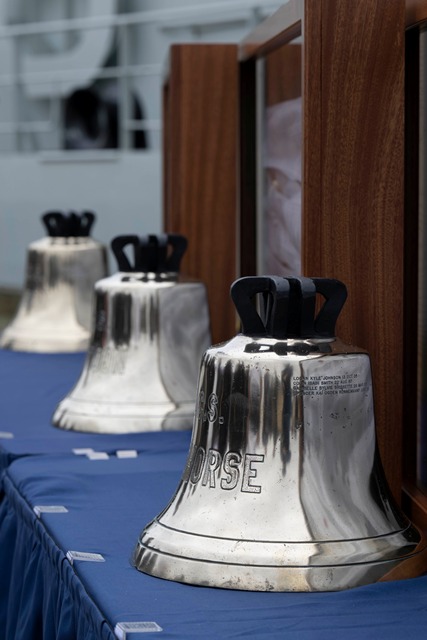
Kingston-Class Paying Off Ceremony held at B Jetty at Canadian Forces Base Esquimalt on 29 September, 2025 Photo: Aviator Rebecca Mainardi, MARPAC Imaging, CFB Esquimalt
There has only been one instance of a RCN ship losing its bell, also during the Korean War, HMCS IROQUOIS (1st) had its bell destroyed when the Tribal class destroyer was engaging Chinese shore batteries off the Korean coast and struck by a shell near “B” Gun, killing three sailors and wounding 11 others. IROQUIOUS broke off the engagement to tend to the wounded and repair the damage, returning the next day, fully operational and destroyed the Chinese batteries.[iv] The shattered pieces of the bell were gathered and given to a bell maker in Sasebo, Japan to be forged into a new bell. IROQUOIS is the only RCN ship that had a bell of Japanese design.

HMCS IROQUOIS (1st) bell forged in Sasebo, Japan during the Korean War. Naval Museum of Halifax photo.
If a ship is lost, the bell stays with the wreck and as the steel corrodes and turns to dust, the brass bell is often the last item able to identify the wreck and mark the grave of the Canadian sailors lost with their ship.
Sadly, in 2025 a diver in the UK discovered the bell from HMCS TRENTONIAN while diving on the wreck and brought it to the surface. The corvette was escorting a convoy in the English Channel on 22 February 1945 when the German U-Boat U1004 attacked the convoy, first torpedoing and sinking the freighter Alexander Kennedy. TRENTONIAN turned to hunt the U-Boat and as the corvette emerged from the port column of the convoy they gained an Asdic (sonar) contact, as the corvette’s engines revved up to make the attack a torpedo exploded on TRENTONIAN’s starboard side, killing six sailors and wounding 14 others. TRENTONIAN sank in just 10 minutes, 96 survivors were rescued by nearby Motor Launches. Five of the sailors killed went down with their ship.
The diver reached out to me several days after I received notice from another UK diver that TRENTONIAN’s bell had been removed from the wreck. The diver wanted a contact for the RCN so he could return the bell to the Canadian Navy.
The RCN was obviously upset that the bell had been taken from one of our war graves and immediately took steps to take possession of the bell. The RCN frigate HMCS MONTREAL was tasked with returning the bell to Canada.

The bell from HMCS TRENTONIAN on board the frigate HMCS MONTREAL in Halifax. Photo courtesy of the Naval Museum of Halifax.
MONTREAL took custody of TRENTONIAN’s bell from the Canadian Consulate and sailed for Halifax, stopping in the English Channel above the location of the wreck of TRENTONIAN to conduct a service of Remembrance for the sailors killed that fateful day.
On arrival in Halifax, MONTREAL’s ship’s company formed up on the frigates flight deck and in a fitting solemn ceremony landed the bell ashore, transferring care to the Curator of the Naval Museum of Halifax. This was the first time TRENTONIAN had returned to its home port since April 1944 when the corvette sailed for Europe.
MONTREAL’s bosun’s piped the still as the bell was walked down the gangway to the jetty and 16 bells were sounded from the frigates bell. The first 8 bells signifying TRENTONIAN had finally returned home and for those sailors their duty was now complete. The second 8 bells signaled to the ship’s company of TRENTONIAN that MONTREAL and all of the Canadian Navy has taken up their watch.
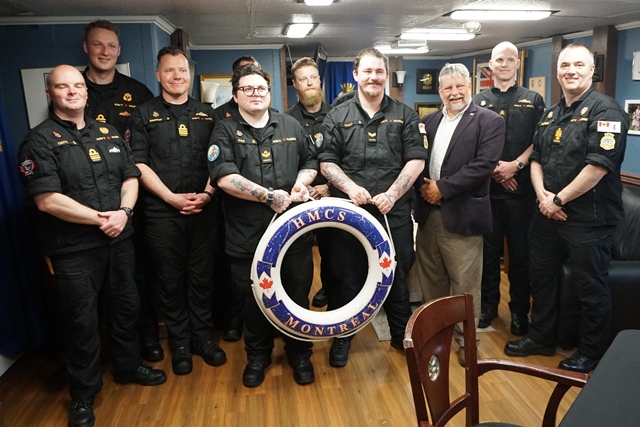
Command team and the sailors from HMCS MONTREAL, who were responsible for caring for TRENTONIAN’s bell as the frigate returned it to Canada. Roger Litwiller Collection
This is not the first time that the war grave of Canadian sailors has been robbed. A few weeks later, the bell from HMCS ALBERNI, also lost in the English Channel was placed for sale on a UK auction site. Efforts are being taken to return the bell to Canada.
The size of a ship’s bell is determined by the size of the ship. A motor torpedo boat will have a relatively small bell, a frigate or destroyer’s bell will moderately larger. The bells for Canada’s aircraft carriers and cruisers are very large.
I would suggest that a visit to one of Canada’s naval museums be a part of your bucket list, not just to see the bells of our Navy’s past ships, but also to explore the rich history that our Canadian sailors having given through service and sacrifice.
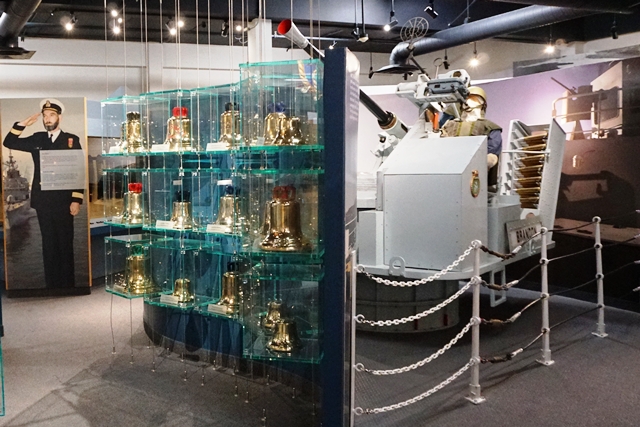
Ships bells from several former RCn ships and the 40mm bofors from HMCS BRANDON, Kingston class MCDV on display at the Naval Museum of Winnipeg. Roger Litwiller Collection, courtesy of Roger Litwiller. (RTL06604)
If you enjoy the content I create and find value in the articles on this website, please feel free to click on the coffee icon on the bottom right of the webpage and “Buy me a Coffee!” Your contribution will ensure that I can continue to provide the stories of these incredible Canadians and the Canadian Navy. Thank you for your support. Cheers, Roger
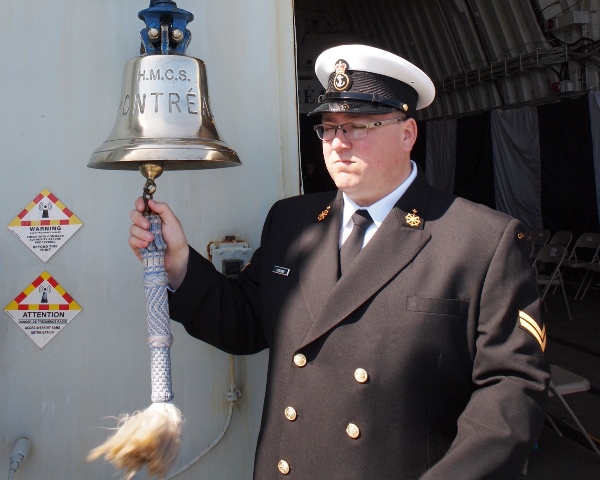
Feature Photo: LS Stephane Ferland sounds out one ring on HMCS MONTREAL’s Bell for each RCN ship lost during the Battle of the Atlantic, on 1 Mar 2016. Roger Litwiller Collection, courtesy Roger Litwiller. (IMG_2668)
Associated Links:
Additional Reading:
- Edward C, Meyers, Thunder in the Morning Calm (Vanwell Publishing, St. Catharines, ON.) 1992.
- Graeme Arbuckle, Customs and Traditions of the Canadian Navy (Nimbus Publishing, Halifax, NS) 1984.
References:
[i] Graeme Arbuckle, Customs and Traditions of the Canadian Navy (Nimbus Publishing, Halifax, NS) 1984, Pg. 46.
[ii] Graeme Arbuckle, Customs and Traditions of the Canadian Navy (Nimbus Publishing, Halifax, NS) 1984, Pg. 102.
[iii] Edward C, Meyers, Thunder in the Morning Calm (Vanwell Publishing, St. Catharines, ON.) 1992, Pg. 165
[iv] Edward C, Meyers, Thunder in the Morning Calm (Vanwell Publishing, St. Catharines, ON.) 1992, Pg. 182-186.
