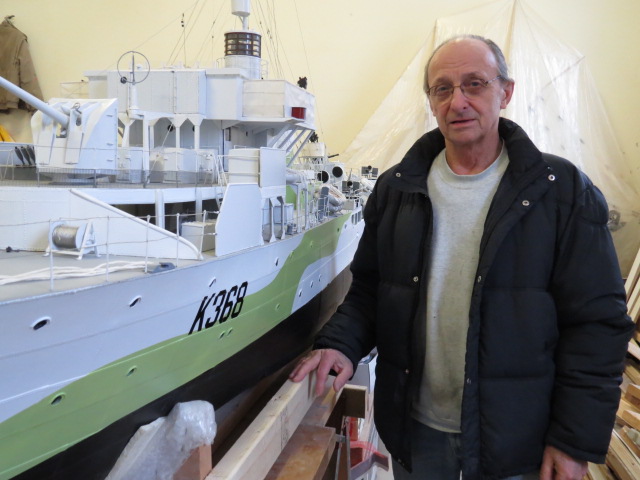
Bill Cullen with his 1/20th scale model of HMCS
TRENTONIAN.
Yesterday I was fortunate to spend the day with Bill Cullen and his wife Sandra at their home outside Gananoque, Ontario. Bill is truly a Master Model Shipwright.Bill has built a scale model of the Royal Canadian Navy corvette, HMCS TRENTONIAN. The model is incredible, at 1/20 scale it measures an impressive 10 feet and fills half of his garage workshop.
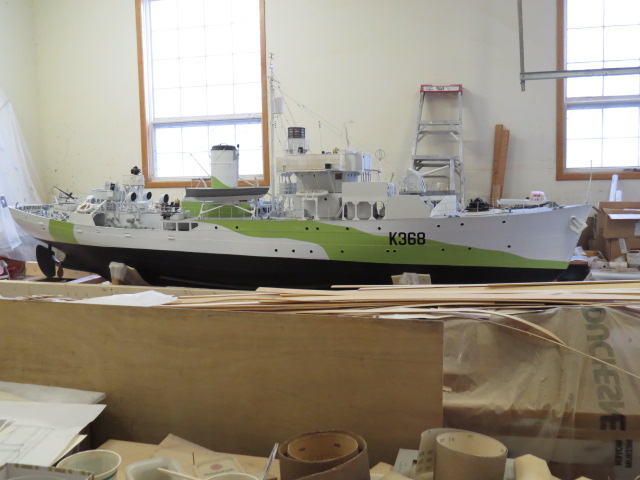
An overall view of HMCS TRENTONIAN, at 1/20 scale the model is over 10 feet long.
Bill’s project began over four years ago. Bill had constructed a 1/20 scale model of a German IXC class submarine and donated it tothe Naval Reserve Unit in Kingston, HMCS CATARAQUI. The Commanding Officer at the time, LCdr. Susan Long-Poucher, suggested adding a corvette to create a diorama, dedicated to our WWII Naval Veterans.
The ship to be modeled was debated and several corvettes were suggested, one condition prevailed, the ship had to have been built in Kingston.
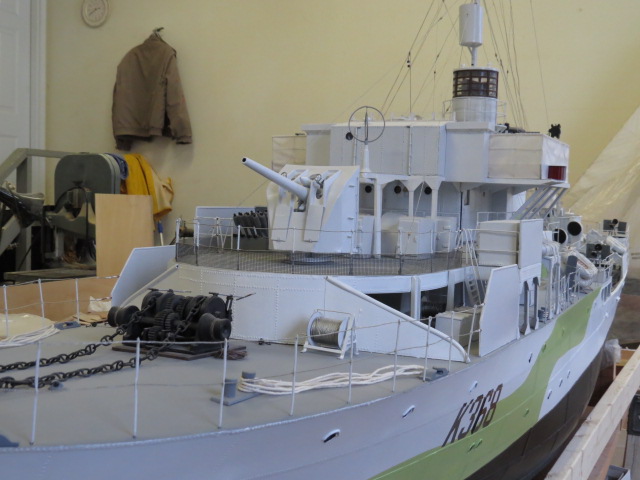
View of TRENTONIAN’s foc’sle, gun deck and
superstructure.
FRONTENAC was the corvette named for Kingston, NAPANEE was the first corvette built at Kingston and BELLEVILLE was the last. CHARLOTTETOWN was lost in the St. Lawrence. TRENTONIAN was also lost, in the English Channel.
Following the launch of my book, Warships of the Bay of Quinte in 2010, the story of TRENTONIAN was now known. The final decision was clear, TRENTONIAN was the last of all corvettes built during WWII, to be lost in action with the enemy and one of CATARAQUI’s own sailors, John McCormick was one of her six casualties.
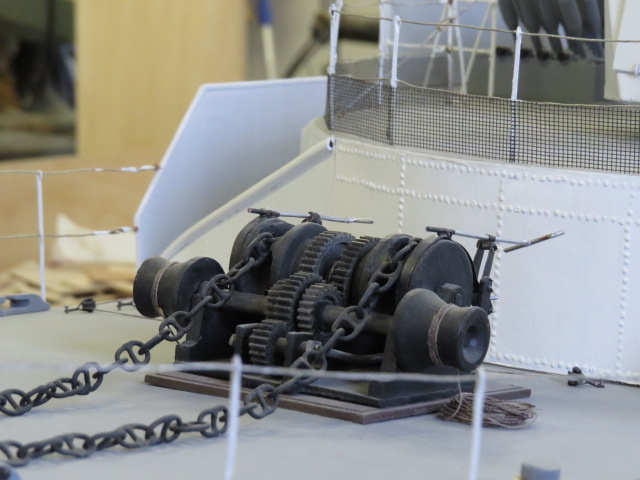
Each link of the two anchor chains has been hand forged by Bill Cullen.
At this point, Bill contacted me for detailed information on this historic corvette. We met and together went through the research I had collected on TRENTONIAN. This included building plans, drawings and over 300 photos, taken by her crew.
Bill showed me photos of a scale model of our famous Canadian icon, Bluenose, that he had already constructed. I knew that his model of TRENTONIAN would be a work of art.
With a keen eye for detail and a passion for accuracy, Bill laid TRENTONIAN’s keel. Kingston Shipyards completed TRENTONIAN in ten months, laying her keel on 19 February 1943 to commissioning the ship into the RCN on 1 December 1943. Bill would take a little longer.
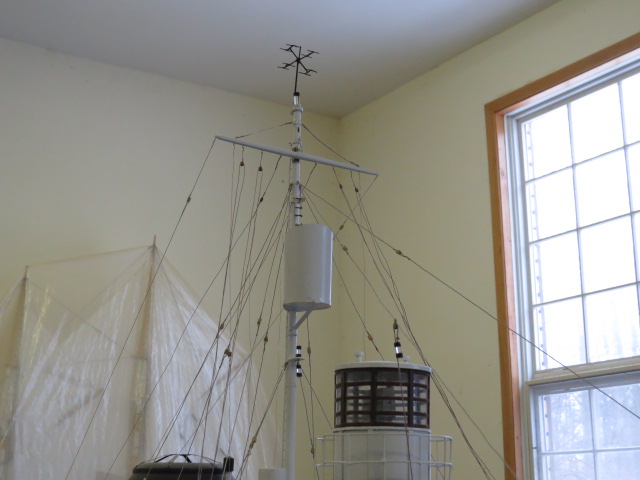
Radars, rigging, lines and halyards have all been recreated to the finest detail.
So dedicated to the smallest of details in his model building, when Bill could not find a chain in the correct scale for TRENTONIAN’s anchors, he set out forging the chain himself, link by link. Not just one but two.
Every rivet has been painstakingly reproduced along the seams of the steel plates that form the ship. The multitude of rigging, lines and halyards are all placed exactly as they should be.
TRENTONIAN’s two radar sets are fully reproduced, the lantern aft of the bridge houses the Type 271Q radar and at the masthead the S.W.2 C/P radars intricate “X” is easily seen.
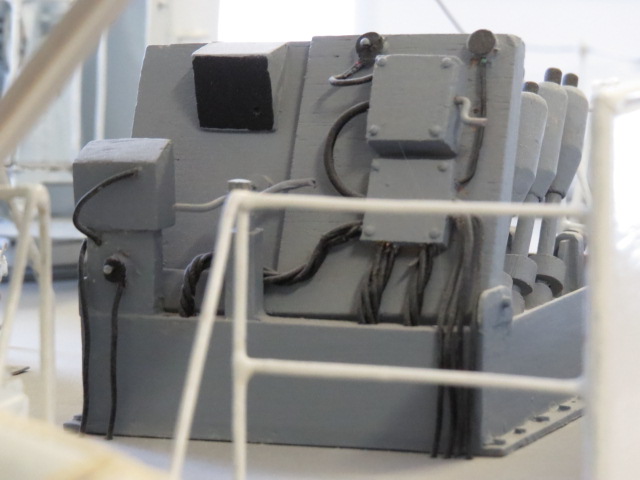
Bill has recreated the control area of the Hedge Hog anti-submarine mortar.
The forward 4 inch gun elevates and rotates on a series of gears. The six 20 mm oerlikon guns are all in correct position and functional.
TRENTONIAN’s anti-submarine weapons are recreated to the final detail. Bill hand built the 96 depth charges, drawing the diamond pattern indicating the type of charge, by hand on each one. The after depth charge rail will release a single depth charge from the stern chute and load the next.
The Hedgehog Mortar located on the forward gun deck has 40 hand made mortars set at different angles. The back of the Hedgehog shows the myriad of electrical boxes, wires and controls.
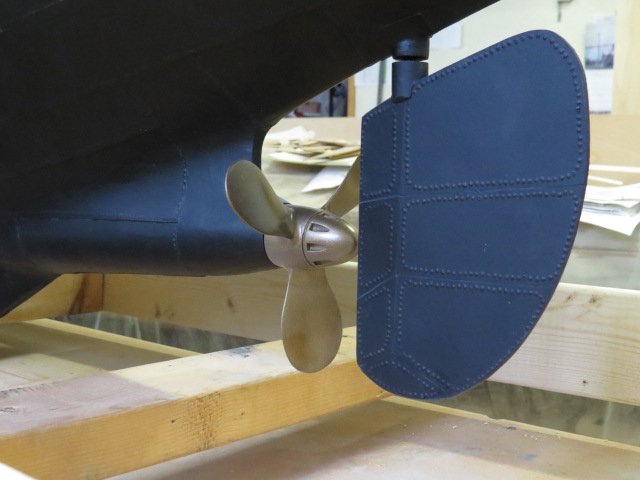
Kingston artist, Hank Winsor provided the three blade screw for TRENTONIAN.
Below the waterline is TRENTONIAN’s rudder and screw. The famous paddle shaped rudder is recreated down to the tiniest detail of the rivets. Kingston artist, Hank Winsor provided the three blade screw that propelled the corvette through the water at 16 knots. Hank’s paintings are now located at the Marine Museum of the Great Lakes in Kingston and two of his wonderful pieces have been featured in my books. HMCS NAPANEE on the cover of Warships of the Bay of Quinte and his painting of the dying last moments of TRENTONIAN in White Ensign Flying. Hank had the screw engineered and machined by a boat propeller manufacturer.
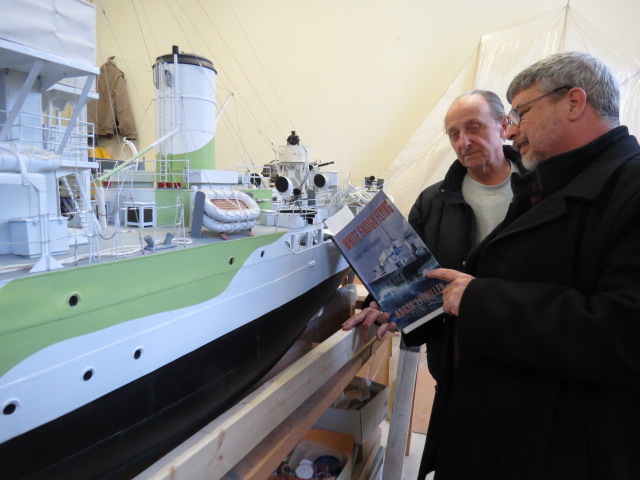
Bill Cullen and myself comparing the amazing accuracy of his TRENTONIAN model with the photos in White Ensign Flying.
Bill’s incredible model of HMCS TRENTONIAN will be donated and permanently displayed at HMCS CATARAQUI during the Battle of Atlantic ceremony this May. It will become the centre piece of the grand entrance to the stone frigate.
I am certain the anticipation of the unveiling and the excitement of everyone finally being able to gaze on this magnificent model will rival TRENTONIAN’s own launching ceremony.
As for Bill, your passion, dedication and skill has earned you the title, Master Model Shipwright. BRAVO ZULU!
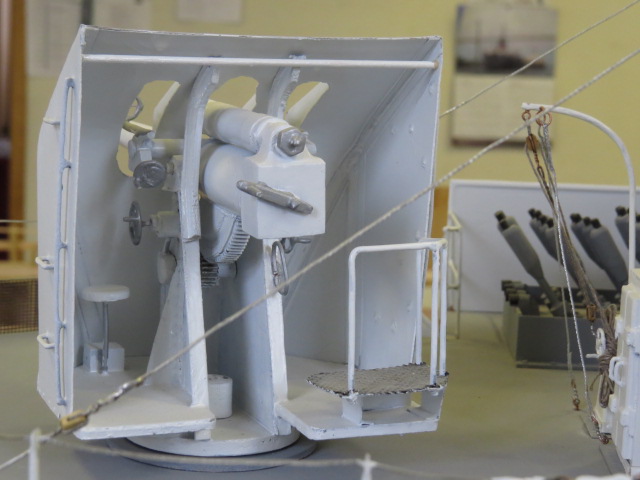
The 4 inch gun operates on a series of gears.

Port side 2mm oerlikon was not on any plans as it had been added after construction, prior to D-Day. Bill had to use photographs to design and build this area.

Engine room skylight, Bill paid close attention to this area, building the butterfly nuts by hand to secure the covers.
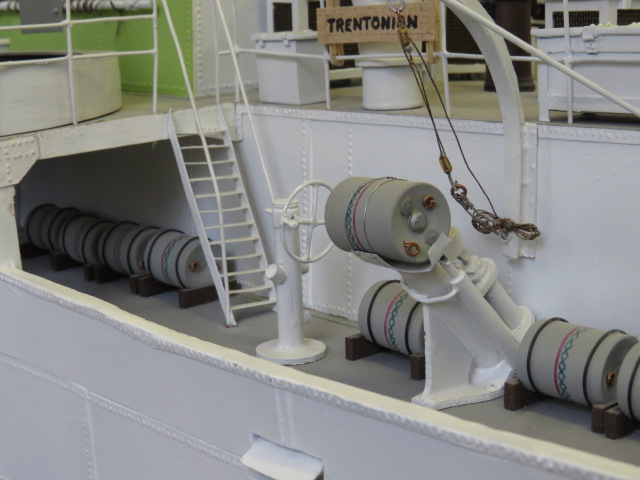
Port side forward depth charge thrower is finely detailed.

Each of the ninety-six depth charges is hand build, ends of the drums are concave and the colored diamond and stripe pattern indicating the type of charge, was drawn by hand.

The details on the after end of TRENTONIAN are striking.

TRENTONIAN’s quarterdeck was fully operational. a lever between the depth charge rails could be lowered to jettison a charge from the stern chute. At the same time it would block the next charge, preventing it from rolling. When the lever was released the next charge would roll into the launching position. Bill has since secured this feature as the model will be under glass.

The distinctive stern of a Flower class corvette.
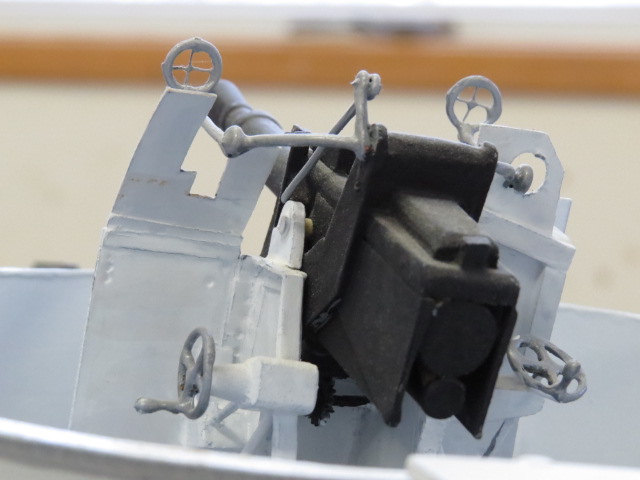
TRENTONIAN’s aft Pom-Pom.
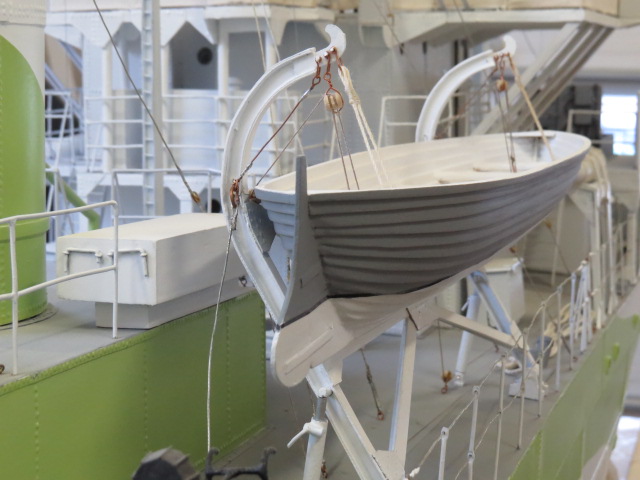
Bill constructed TRENTONIAN’s 27 foot whaler one plank at a time.
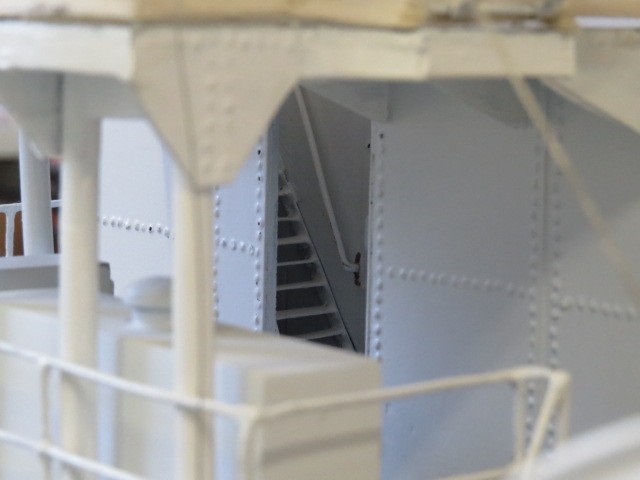
When Bill realized this internal ladder would be visible he modeled the internal structure.
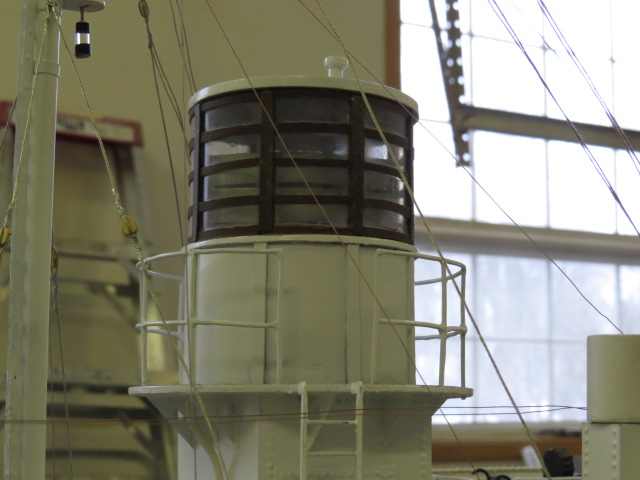
Located aft of the bridge, TRENTONIAN’s lantern radar is fully modeled.
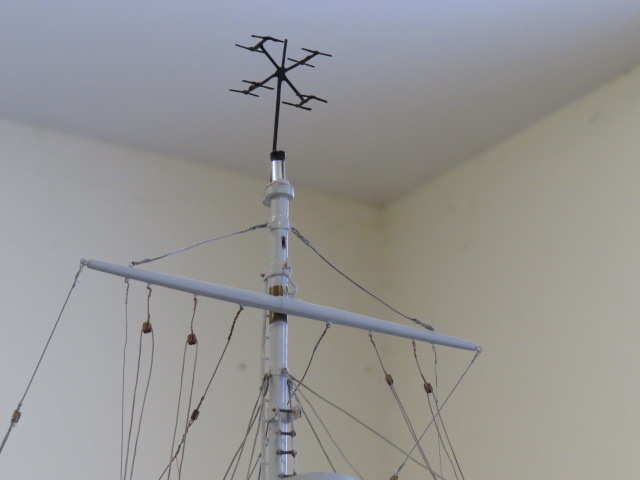
TRENTONIAN’s masthead is complete with steel ladder, rigging, lines, halyards, radar and rope ladder into the crowsnest.
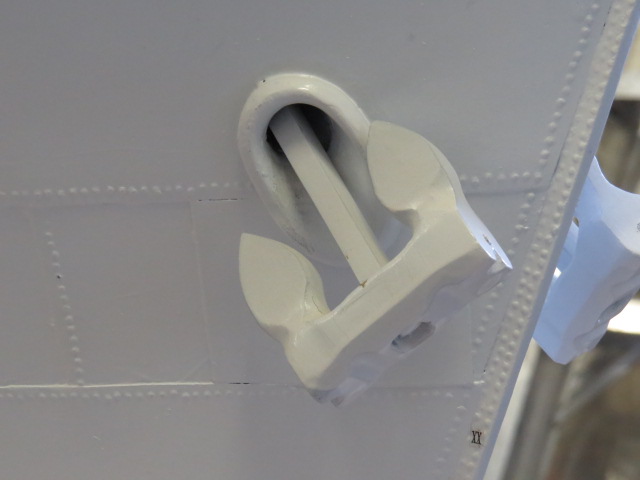
Both anchors had to be carved by hand to match the 1/20 scale of the ship.

Bill paid considerable detail to the size and position of the roman numeral depth marking on TRENTONIAN’s hull.
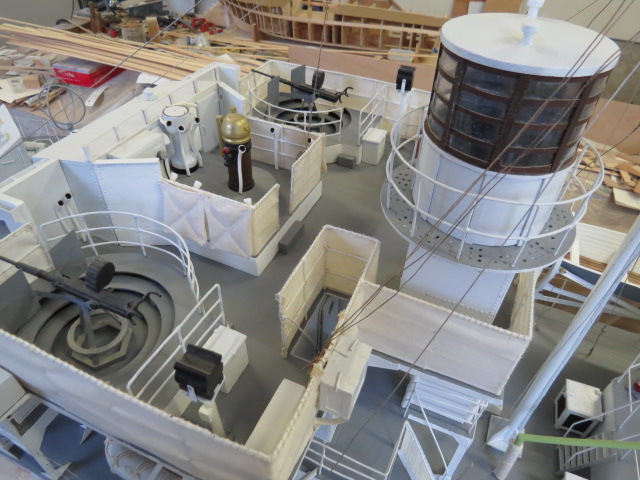
TRENTONIAN’s bridge, every detail of the nerve centre of this corvette is duplicated.
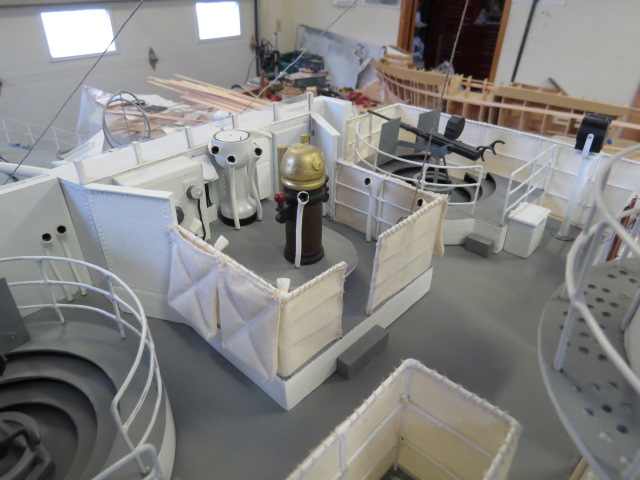
Bill constructed the binnacle and gyro compass, voice pipes, lockers all by hand. Even sewing the railing covers and flak mats.

Signal flag locker and signal light.
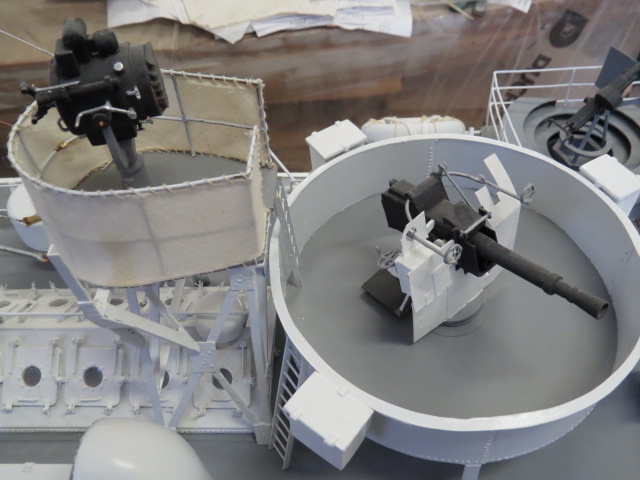
TRENTONIAN’s aft Pom-Pom and search light.
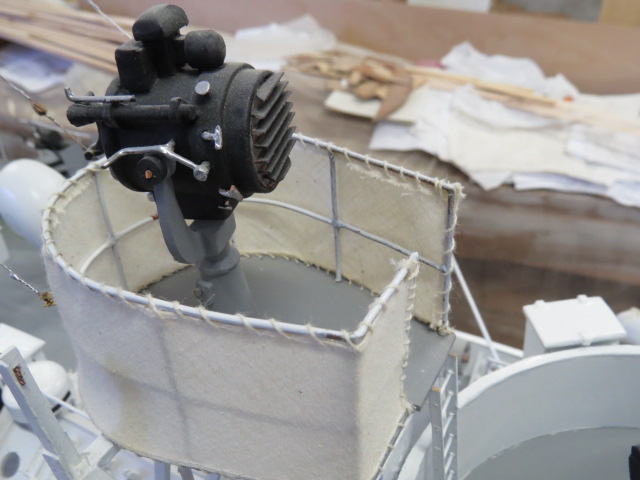
Details of the search light includes each louver has been placed separately.
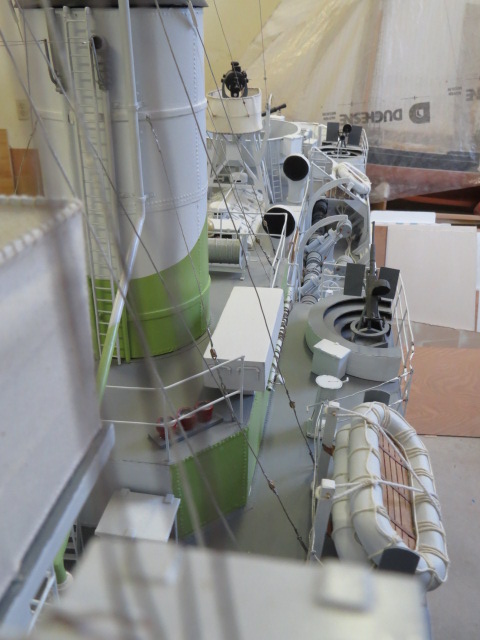
View from the port side bridge wing looking aft on Bill Cullen’s model of
HMCS TRENTONIAN.
If you enjoy the content I create and find value in the articles on this website, please feel free to click on the coffee icon on the bottom right of the webpage and “Buy me a Coffee!” Your contribution will ensure that I can continue to provide the stories of these incredible Canadians and the Canadian Navy. Thank you for your support. Cheers, Roger
