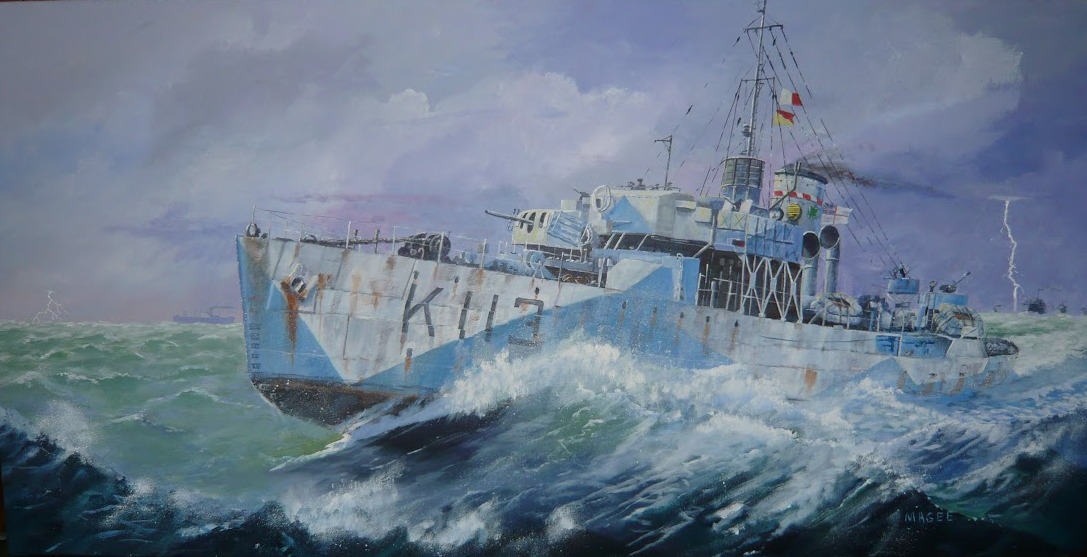
 During the Second World War a fierce and decisive battle was fought on the world’s oceans and seas. Collectively it has become known as the Battle Of Atlantic. Winning this battle would determine the outcome of the war. The momentous responsibility of winning or losing WWII fell on Canada.

The Second World War would have been lost, if not for Canada’s early and continuous contribution protecting the convoys that carried the materials, fuel, munitions, weapons, food, etc. manufactured in Canada to the isolated island of Great Britain.
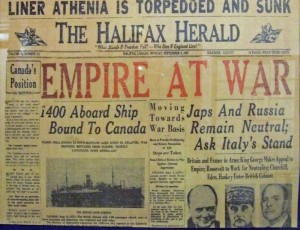
The opening shots of WWII were fired by German submarine U-30, two hours after war was declared, sinking the liner SS Athenia without warning, killing many innocent civilians.
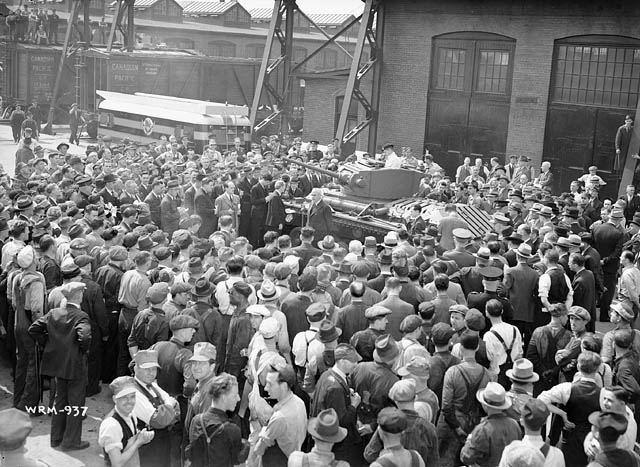
Before the war, powerful steam locomotives for the railway were built by the employee’s of the Montreal Locomotive Works. The plant was modified for wartime production and the employees stand around Canada’s first tank, the Cruiser Tank, as they listen to an address broadcast by Hon. C.D. Howe, the Minister of Munitions and Supply. National Film Board of Canada / Library and Archives Canada / PA-174498
Canada as a nation rallied to defeat the Nazi’s. Men and women turned Canadian industry into a massive war machine, converting factories that once made merchandise for sale in the stores to producing, weapons, tanks, aircraft, munitions, timber and every manner of equipment needed for victory. Farmers stepped up agriculture production, not just to feed Canada, but also the UK, starving from a naval blockade and the millions of soldiers, sailors and airmen that were needed to fight.

SS Drumahoe underway to join an ocean convoy out of Sydney Harbour, in her wartime colours in 1942. Owned by Sarnia Steamships Ltd, the laker has been pressed into wartime ocean service. Roger Litwiller Collection, courtesy Ross Milligan, RCNR. (RTL-REM041)
The determination to win the Battle of Atlantic started in the forests of British Columbia, farms on the prairies, factories in Ontario and Quebec, mines in the north and the rich fishing grounds of the Atlantic Provinces. To move these precious materials to England, Canada’s Merchant sailors took to their ships. The need for ships was so great that Lakers, designed to sail only on the Great Lakes were pressed into ocean service, while larger ships were built.
The danger these Merchant sailors faced began the moment they slipped their lines from Canadian ports at Halifax, Sydney, Quebec City and St. John’s, Newfoundland and headed to sea. They faced the best the German Navy had, surface raiders, battleships and cruisers, all with a simple order to defeat our forces by sinking merchant ships.
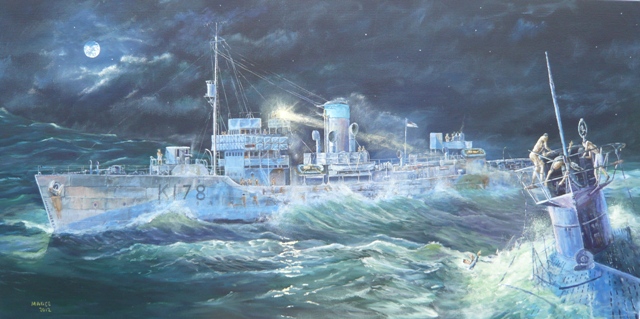
Canadian Artist Marc Magee’s painting of HMCS OAKVILLE’s battle with U94 in the Caribbean, eventually ramming and boarding the submarine before she sank on 28 August 1942. Painting courtesy of Marc Magee.
The greatest threat to Canada and our allies was the U-Boat! Germany deployed her submarines to sink merchant ships and starve England into surrender. They formed in groups, creating impenetrable lines across the ocean. A trap, that once sprung, brought down a pack of wolves onto the unsuspecting sheep. Hundreds of merchant ships were lost, killing thousands of merchant sailors. Great Britain was starving, at the height of the Battle of Atlantic; German U-Boats were sinking two to three merchant ships a day.

HMCS LEVIS torpedoed by U 74 on 19 September 1941, 120 miles east of Cape Farewell, Greenland. The corvette remained afloat for several hours, eighteen of her crew were killed.
Roger Litwiller Collection, courtesy Raymond Leslie Reid, RCNVR. (RTL-RLR028)
The Battle was not just fought on the ocean, the U-Boats penetrated Canadian waters, sinking twenty-three ships in the St. Lawrence River east of Quebec City and in the Gulf of St. Lawrence.
At the beginning of the war, the Royal Canadian Navy was small, a peace time force consisting of six destroyers, thirteen minesweepers and 2,000 sailors. Even with these limited numbers, the navy immediately formed the priceless merchant ships into convoys, escorting them to the UK.
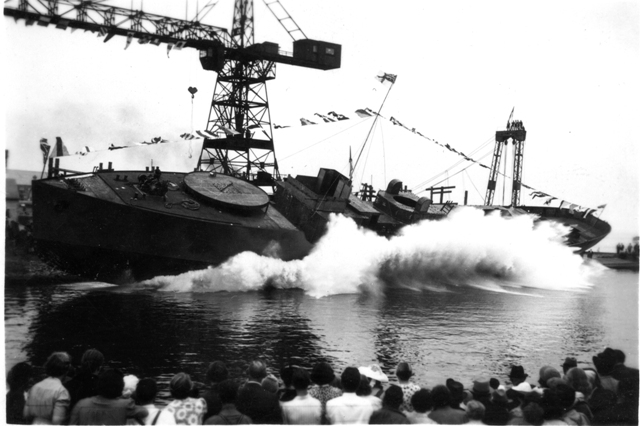
HMCS NAPANEE creates a giant wave as she is launched at Kingston Shipbuilders on 31 August 1940. She is the first corvette built at Kingston for the war effort. As soon as she was clear, the keel of the second corvette, HMCS PRESCOTT was laid. Marking the first time in Canadian history that a ship was launched and a new ship started construction in the same day by a shipyard.
Roger Litwiller Collection, courtesy Hank Winsor. (RTL-HW008)
As Canada mobilized her industry, a ship building program began, building larger merchant ships, frigates and destroyers on the Atlantic and Pacific coasts. In the Great Lakes a multitude of smaller ships were built, including corvettes, minesweepers, motor launches, trawlers, landing craft, rescue boats and tugboats.
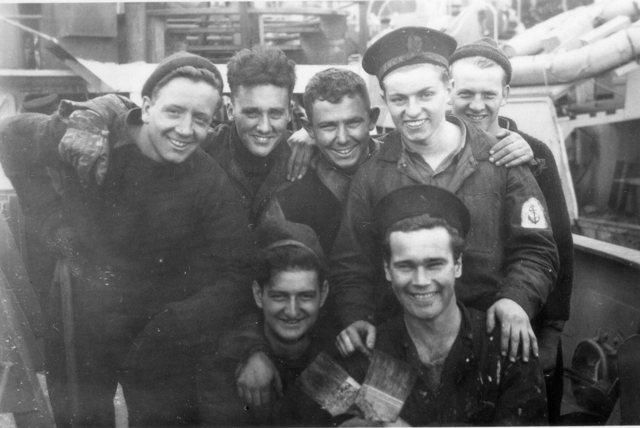
Demonstrating what seems to be a sailors primary duty, chipping and scraping for painting ship a group of sailors from HMCS TRENTONIAN take a moment and cross brushes for the camera while in Milford Haven, UK, February 1945.
Roger Litwiller Collection, Allen E. Singleton, RCNVR photo, courtesy Douglas Campbell, RCNVR. (RTL-DC055)
Retired sailors, re-enlisted into the RCN, experienced merchant sailors and fishermen joined the Royal Canadian Navy Reserve (RCNR). Young men and women enrolled in the Royal Canadian Navy Volunteer Reserve (RCNVR) and the Women’s Royal Canadian Naval Service (WRCNS) enlisting in Naval Reserve Units across Canada. Over 100,000 Canadians joined the navy to fight at sea; many had never seen the ocean.
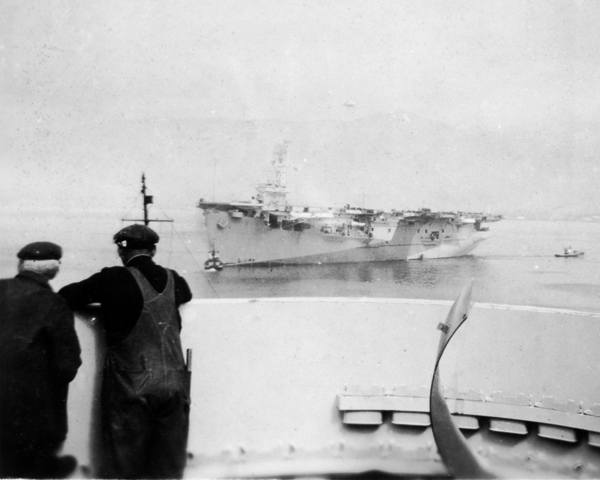
HMS NABOB taken from HMS PUNCHER at Vancouver while both escort carriers were completing in February 1943. PUNCHER (foreground) is in the builders hands, just starting conversion to RN standards, while NABOB is undergoing acceptance trials. Both escort aircraft carriers are manned by Royal Canadian Navy ship’s company’s and are considered to be the RCN’s first aircraft carriers.
Roger Litwiller Collection, courtesy Howard Abbott, RCNVR. (RTL-HA087)
To meet the threat against Canada’s ocean trade, the RCN needed ships. At the beginning of the war private yachts and RCMP patrol boats were hastily turned into fighting ships and given names of Canadian animals. As the shipbuilding industry grew, the six destroyers, minesweepers and Animal class yachts grew to an imposing fleet of over 400 fighting ships, consisting of motor launches, minesweepers, corvettes, frigates, destroyers, cruisers and aircraft carriers.
Canada’s Navy had become the third largest navy in the world by the end of the war. RCN sailors were fighting in the Atlantic, Pacific and Arctic Oceans, The St. Lawrence, Caribbean, Mediterranean, North Sea, taking part in every major theatre of the war.
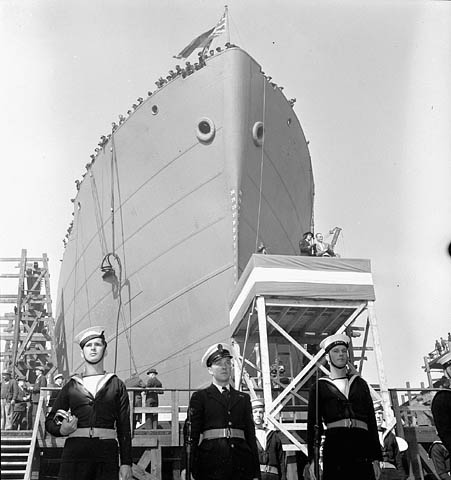
View of the christening podium and guests of honour at the launch ceremony of the 10,000-ton cargo ship, the S.S. Fort Esperance, from the United Shipyards Ltd. shipyard in Montreal, QC. Credit: National Film Board of Canada
The Merchant Navy grew too. Hundreds of war measure merchant ships were constructed on both Canadian coasts, building the merchant fleet to the fourth largest in the world. For the over 12,000 Merchant Sailors, the war at sea was no different than their navy counterparts. The Merchant sailors and their big lumbering ships sailed alongside the sleek corvettes, frigates and destroyers into battle against the U-Boats. These civilian sailors paid a high price, with one in seven sailors killed.
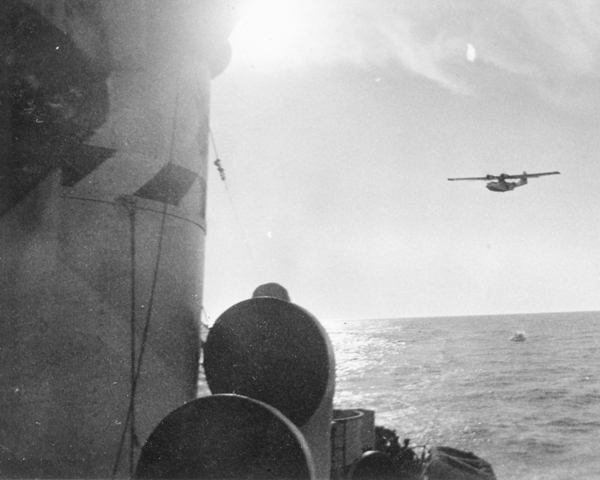
Catalina patrol aircraft dropping depth charges astern of HMCS ARVIDA on 16 September 1943, possibly while escorting HX256 in the North Atlantic. Roger Litwiller Collection, courtesy Howard Abbott, RCNVR.
Canada’s Navy did not fight alone. The Royal Canadian Air Force (RCAF) formed several squadrons of Maritime Patrol Aircraft. The Squadrons flew over the convoys and harbour approaches, hunting the U-Boats from the air. The Canadian Army built and manned shore defenses along the East Coast and harbours. Guns disguised into the country side, some camouflaged as churches, others buried into cliffs, ready to fire on any German surface raider or U-Boat that dared attack Canadian soil.

Marc Magee’s painting of HMCS NAPANEE alongside the torpedoed tanker, SS Scottish Heather, during the Battle for Convoy ONS 154. Six RCN ships escorting 46 merchants ships. came under attack by 23 U-Boats in a seven day running battle across the Atlantic Ocean. Fourteen merchants ships were lost, killing 551 Canadian and Allied merchant sailors, another 564 were rescued. One German submarine was sunk, in the battle that began the day after Christmas 1942.
The battle at sea was fierce; Churchill himself stated his greatest fear was losing the Battle of Atlantic. This was the only battle during the Second World War that if lost, the entire war would be lost. Convoys of sixty or more merchant ships, escorted by navy ships would slowly sail across the Atlantic. At times as many as thirty U-Boats in Wolf Packs would swoop down for an attack, devastating the convoy.
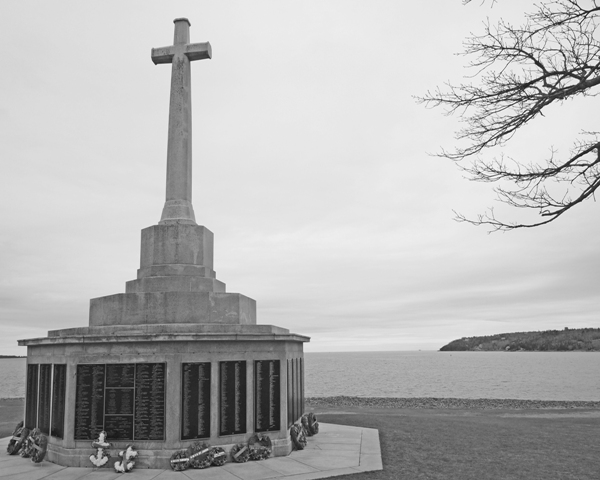
The Halifax Memorial commemorating the Battle Of Atlantic is located in Point Pleasant Park. It contains the names of over 3100 Canadians and Newfoundlander’s, who have no grave. Roger Litwiller Collection, courtesy Roger Litwiller (RTL26595)
Losses for Canada were heavy, thirty-three Navy ships were sunk, many more damaged, nearly 2,210 RCN sailors, 752 RCAF air crew, Canadian Army soldiers and civilians were lost at sea. For the Merchant Navy, over one hundred Canadian and Newfoundland ships were lost to the enemy, killing over 1600 Merchant Sailors.
Early in the war, training for Canada’s novice sailors was “On The Job,” new ships went straight from the shipyard and joined the Battle Of Atlantic, often with disastrous results. With time, the skill and expertise of Canada’s sailors grew into a professional anti-submarine hunter/killer force. Turning the tide in the Atlantic, no more were the U-Boats having the success they enjoyed early in the war.
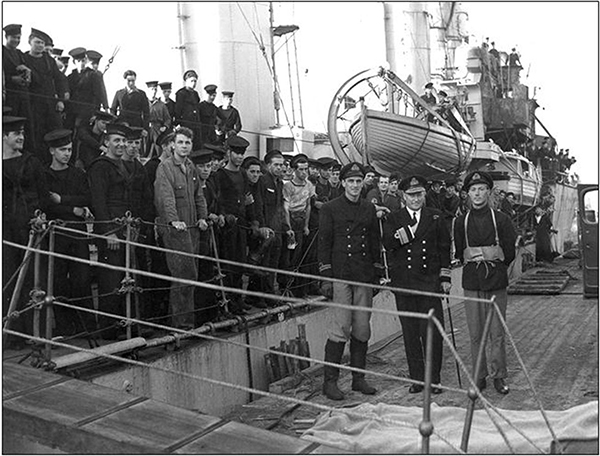
Rear-Admiral L.W. Murray, Flag Officer Newfoundland, greets the crew of the destroyer ASSINIBOINE at St. John’s after their sinking of U-210 on 6 August 1942; the ship’s captain, Lieutenant- Commander John Stubbs (right), would be lost with his next ship, Athabaskan. RCN Photo.
Canada was finally recognized for it’s overwhelming contribution in the Battle Of Atlantic when responsibility for all convoys, escorts and aircraft in the Canadian Northwest Atlantic Command was given to Rear-Admiral Leonard Murray, RCN in April 1943. Murray became the only Canadian to command a Theatre of War during WWII and became Commander-in-Chief of the area from the Gulf of Maine to Baffin Island, ranging out to mid-Atlantic.
As terrible as the losses for Canada were, our forces inflicted a heavy toll on the enemy. Jointly between the RCN and RCAF, over fifty U-Boats were sunk and many more damaged. Canadian Forces were also responsible for sinking and damaging a multitude of enemy merchant ships and warships.

Convoy of thirty-seven merchant ships from Halifax to the UK. Photo taken from convoy escort HMCS WASAGA on the starboard side of the convoy in 1942. Roger Litwiller Collection, courtesy Ross Milligan, RCNR. (RTL-REM049)
In total, the Royal Canadian Navy escorted a staggering 25,000 merchant ship voyages from Canadian and American ports, successfully delivering 165 million tons of cargo, sustaining the war against the Nazis.
When history measures Victory from total enemy submarines and ships sunk, Canada’s contribution to the Battle Of Atlantic has not been properly recognized. Our Navy and Air Force were given a task that our Allies deemed insignificant in the ideology of Naval Warfare, the lowly responsibility of escorting merchant ships. World War Two did not become the Grand Fleet action, Battle Fleets slugging it out on the high seas for supremacy of the world’s oceans.

Marc Magee’s painting of Bangor class minesweeper HMCS PORT HOPE and Flower class corvette HMCS FENNEL leading a convoy of merchants ships out to sea from the safety of harbour.
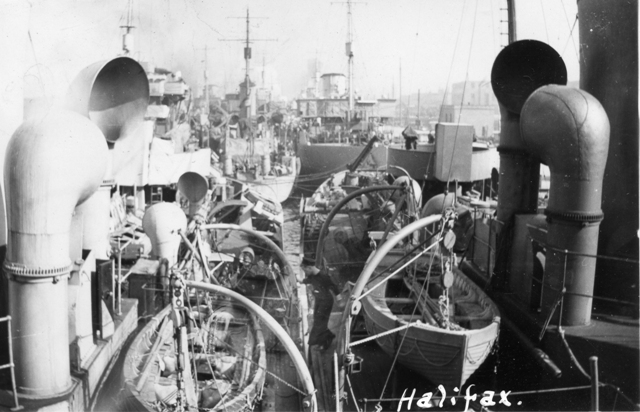
View from HMCS SUDBURY’s port bridge wing (left side of photo) looking aft. A total of eight corvettes are nested together in this picture from 1942. Roger Litwiller Collection, courtesy Ross Milligan, RCNR. (RTL-REM021)
Instead it became a war of attrition on the high seas, single ship actions by little ships -destroyers, frigates, corvettes, minesweepers and motor launches supported by aircraft in the determined hunting and killing of submarines.
The major world navies had built their Grand Fleets of battleships, cruisers, aircraft carriers. These behemoths of the oceans were spread around the world, fighting in the Pacific, Atlantic, Arctic, and Indian oceans and therefore lacked the ability to fight and win the real war. Canada in turn had hundreds of these little ships and this nation’s contribution to the Battle Of Atlantic turned the tide of the war, allowing the material to reach England.

View of Polyarnoe, Russia from HMCS IROQUOIS during one of the destroyers layovers, having escorted an Arctic convoy in late 1943 or early 1944. As soon as the next convoy was formed, she would escort the merchant ships back to England. Roger Litwiller Collection, Lynford Bourne, RCNVR photo, courtesy Battle of Atlantic Place. (RTL-LRB023)
- Without Canada, England would have been starved into surrender.
- Without Canada, there would not have been the planes, pilots, munitions and fuel to win the Battle of Britain, stopping the invasion of the UK by Germany.
- Without Canada, the Russian military would not have the tanks, weapons, aircraft to repel Germany’s invasion.
- Without Canada, there would not have been the landing craft, tanks, munitions and soldiers to invade North Africa, Scilly, Italy and Normandy.
- Without Canada, the material, weapons, soldiers would not have been available to liberate Europe and force Germany’s surrender.
History has recorded the Battle Of Atlantic as the longest single battle in the history of mankind. Beginning on 3 September 1939, two hours after war was declared, both Allied and Axis forces fought bitterly until the final minutes of the war, the last merchant ship, SS Avondale Park (Canadian Government Steamship Lines) was torpedoed by U2336 one hour before Germany’s surrender on 8 May 1945. The Battle Of Atlantic is the only battle that ultimately determined the outcome of the war.
If the Battle Of Atlantic had been lost, the Second World War would have been lost. Without Canada, the Battle Of Atlantic would have been lost!
Cover photo: HMCS ARVIDA painting by Marc Magee.
©Roger Litwiller
Related Posts:
- Canada and the Battle Of Atlantic
- Royal Canadian Navy -Victory’s/Losses WWII
- Royal Canadian Air Force -Victory’s/Losses WWII
- Canadian and Newfoundland Merchant Navy Losses WWII
If you enjoy the content I create and find value in the articles on this website, please feel free to click on the coffee icon on the bottom right of the webpage and “Buy me a Coffee!” Your contribution will ensure that I can continue to provide the stories of these incredible Canadians and the Canadian Navy. Thank you for your support. Cheers, Roger.
