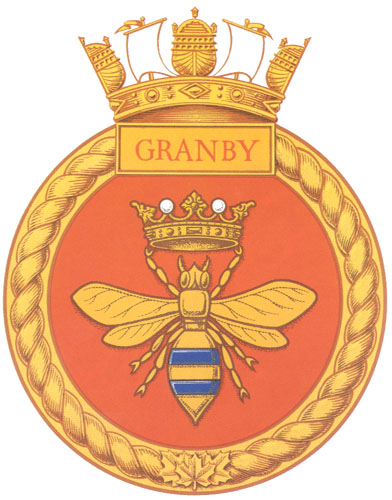
The Ship’s Badge for HMCS GRANDBY is a play on the name for the ship. A queen bee holding her crown above for “Grand Bee.”
As an author and historian of the Royal Canadian Navy I have experienced many examples of poor Naval grammar. One of my biggest pet peeves comes from the use of the word “crest,” when referring to a ship’s badge. When I hear this despicable word used, I explain “crest is for teeth, our ship’s have badges.”
With time and an increased reliance on social media, newspapers, printers, etc. the correct grammar of the Navy is being lost. Primarily because of lack of knowledge. If we see something spelled wrong often and long enough, it eventually becomes correct. We then change the grammar to reflect the new common usage.
I believe that just because someone does not know the correct naval terms or grammar is not an excuse to give up our customs and traditions, in essence our written history.
Here is some of my own personal pet peeves, when it come to naval grammar and etiquette.
1. Ship’s Badges -as you might have guessed, at the top of the list. Every ship, shore establishment and unit of the Royal Canadian Navy is represented by a BADGE. Not a crest. The RCN adopted the round shield with a Royal Naval crown on top. The crown represents five ships, three hulls and two masts and sails. Between the crown and shield is a name board, with the name of the ship in capital letters. At the bottom of the Badge is three maple leafs to give our Ship’s Badges a distinct Canadian identity.
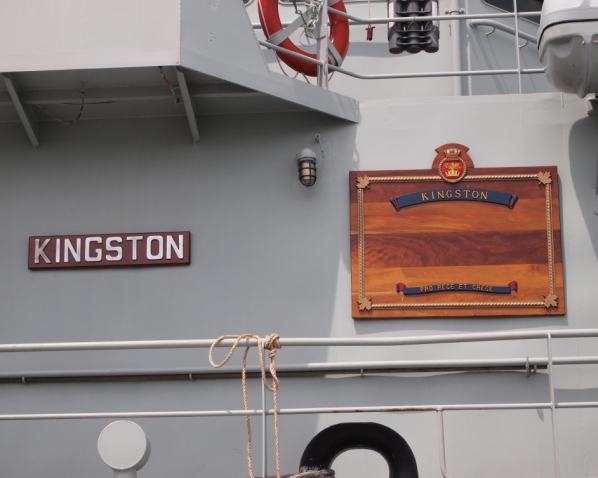
HMCS KINGSTON’s Battle Honours and Name Boards on display. I could have chosen another ship with several Battle Honours, but as new ships are being given names without a past usage in the RCN, more of our ships will be displaying empty Battle Honour Boards.
Each Ship’s Badge is governed by strict guidelines when it comes to the heraldry placed into the shield. The shield represents important aspects of the ship, including the ship’s colors and symbols.
2. Ship’s Names in Lower Case Italics -All to often in newspapers, books and the internet we see Royal Canadian Navy ship’s names in lower case letters, italics and quotations. This is all incorrect. The name on the badge is in capital letters, this is also true of the Ship’s Bell, Name and Battle Honour Boards placed on display in each ship. RCN ships are to be spelled in CAPITALS!
ATHABASKAN is correct. Not Athabaskan, Athabaskan, “Athabaskan”, or “ATHABASKAN.”
Author David Freeman discusses this subject very well in his book -Canadian Warship Names, (Vanwell Press, 2000). NAVAL SHIPS are in capitals, Merchant Ships are in italics and Geographical names are in first letter capital followed by lower case.
3. The word “THE” -I place capitals on THE to make a point! Naval ships are NEVER referred to as “the HMCS IROQUOIS.” I cringe to the depths of my soul when I see or hear this. You talk to any sailor, a ship is a person, with an identity, characteristics, moods and personality. You would never refer to your best friend as “the Frank,” or to your spouse as “the Susan.” Our ships are simply, HMCS IROQUOIS.
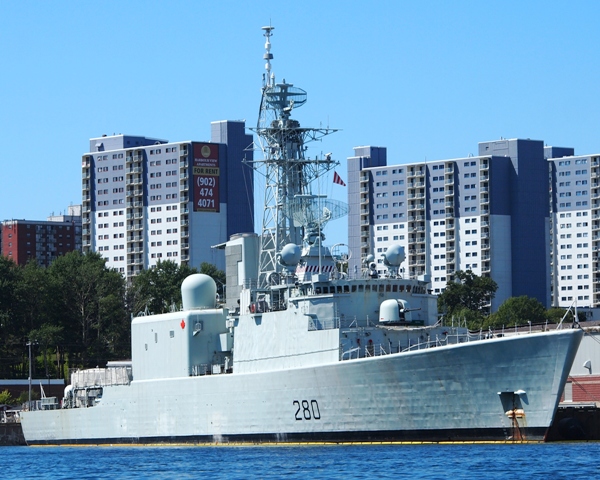
Ex-HMCS IROQUOIS at HMC Dockyard in Halifax on 5 September 20015, shortly after she was paid off from the Royal Canadian Navy.
4. “In” vs “On” a Ship -All to often when referring to the men and women that work a ship, the term “On” is used. Example, They served on HMCS OTTAWA. It is a cruel heartless bastard of an old man that does not allow his ship’s company into their ship. Therefore sailors live and work “IN” a ship, not “ON” a ship.
5. Ship’s Company vs Crew -The men and women that serve in a naval ship are referred to as Ship’s Company while the sailors in a merchant ship form her crew.
6. Paid Off vs Decommission -At the end of a naval ships career it is said to be Paid Off. This refers to an old practice where the ship’s company was not paid during the voyage until the ship returned to home port. This prevents the sailors from jumping ship. If they did not remain for the entire voyage of the ship, they would not be paid for their service.
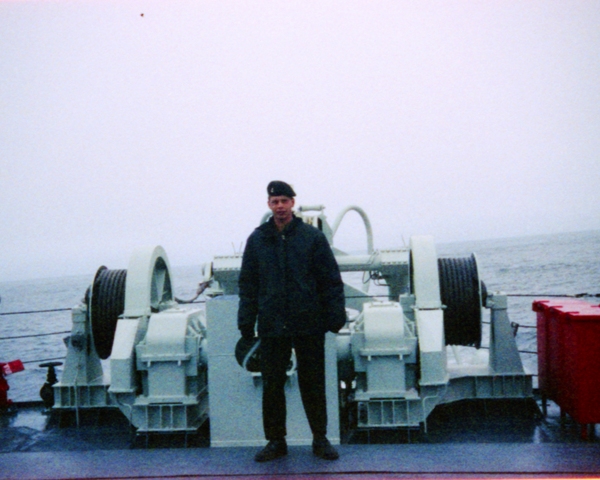
A photo of me in 1981 standing on deck, when I served in HMCS OTTAWA (3rd). I was honoured to be a member of her Ship’s Company.
This is just a few of the more common examples of how Naval Grammar is being lost in our modern social media world. Anyone that has read my books, White Ensign Flying or Warships of the Bay of Quinte, will comment, some of these errors are printed in my work. I have had this discussion with my publisher several times. Because of adopted modern practice, both the Canadian Manual of Style and the Chicago Manual of Style, the two books that guide how we format words, grammar, titles, etc. have been changed to reflect the common civilian grammar.
During the discussions of editing my books, concessions had to be made by myself and the editor. I did get all the “THE’s” removed from the ships names after the editor put them in. Unfortunately the ships names are printed in capital first letter, followed by lower case. In my own articles and social media posts, I endeavor to ensure naval grammar is followed.
So I challenge each of you to use proper naval grammar when you write, whether it is an article for publishing or a Tweet of only 140 characters. Insist on proper naval grammar when working with an editor or publisher.
This is a battle we can yet win, as we all know “the pen is mightier than the sword!”
If you enjoy the content I create and find value in the articles on this website, please feel free to click on the coffee icon on the bottom right of the webpage and “Buy me a Coffee!” Your contribution will ensure that I can continue to provide the stories of these incredible Canadians and the Canadian Navy. Thank you for your support. Cheers, Roger
