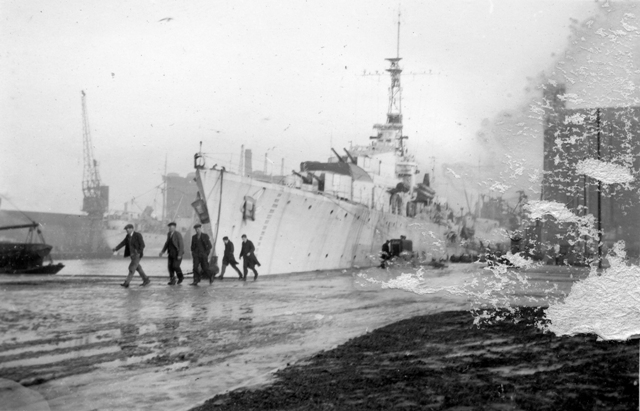
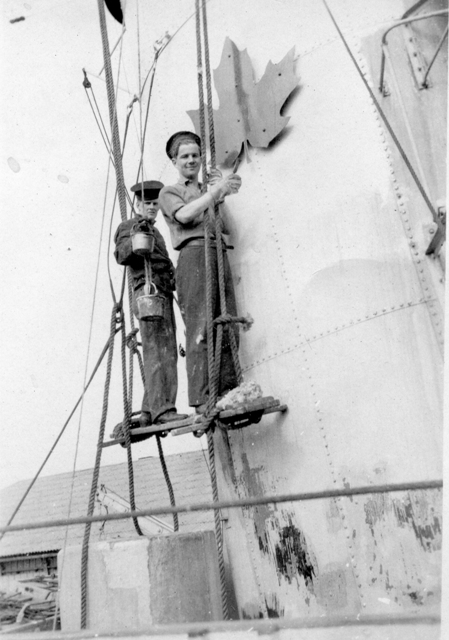
HMCS IROQUOIS’s Maple Leaf on her funnel gets a fresh coat of paint in 1944. Unknown location. Roger Litwiller Collection, Lynford Bourne, RCNVR photo, courtesy Battle of Atlantic Place. (RTL-LRB011)
Great detail has been recorded of the Royal Canadian Navy’s ships during the Second World War, including the Battle of the Atlantic, Operations in the Arctic, Mediterranean and many other ocean battlefronts. Sadly very little has been written about what happened to our ships after VE Day?
Recently I have received a large collection of personal photos from Royal Canadian Navy veteran, Lynford Bourne, RCNVR throug Battle of Atlantic Place in Halifax. Lynford had served in the Tribal class destroyer, HMCS IROQUOIS. He saw action with his shipmates on the Atlantic Ocean, Arctic Convoys, D-Day operations, Norway and Russia. His photos reflect this service.
Remarkably, Lynford’s photos included IROQUOIS operations immediately following VE Day, with trips to Norway, Denmark and into Germany. Much of the written historical account of IROQUOIS’s operations, state this simply with few details and no dates. I have had to spend a considerable amount of time and effort to give these remarkable photos context.
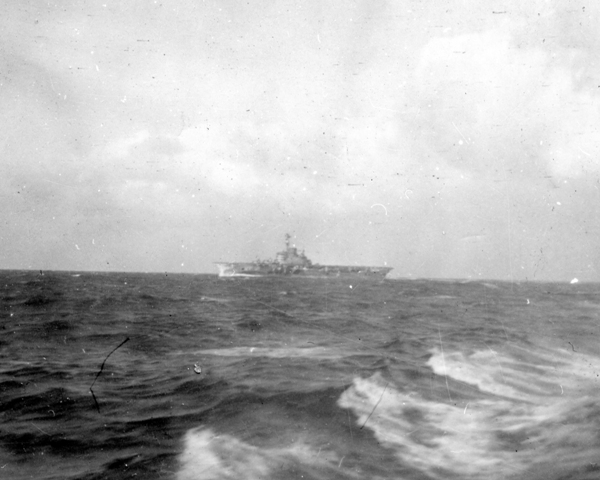
HMS INDEFATIGABLE underway, photo taken from HMCS IROQUOIS, unknown date/location. Roger Litwiller Collection, Lynford Bourne, RCNVR photo, courtesy Battle of Atlantic Place. (RTL-LRB019)
I will let Lynford’s photos tell this remarkable story.
In the final days of the war, IROQUOIS was assigned to Arctic operations, including escorting carrier attacks off Norway and convoys to Russia. On 16 April 1945, she left with her sisters HMCS HAIDA and HMCS Huron to escort the twenty-two ship convoy JW66 from Loch Ewe, UK to Kola Inlet in Russia. The convoy arrived safely on 25 April, and the three RCN Tribals proceeded to Polyarnoe, Russia to wait for the return convoy.

View of Polyarnoe, Russia from HMCS IROQUOIS during on of her stops while escorting Arctic convoys in late 1943 or early 1944. Roger Litwiller Collection, Lynford Bourne, RCNVR photo, courtesy Battle of Atlantic Place. (RTL-LRB023)
On 29 April 1945 IROQUOIS, HAIDA and HURON joined the twenty-seven ship convoy RA66, picking up the convoy at Kola and headed for the Clyde. Later that day U427 fired two torpedoes at IROQUOIS and HAIDA, missing both ships. The two destroyers then hunted the German U Boat dropping a total 678 Depth Charges, U427 escaped. Later that same day one of the other escorts, HMS GOODALL, frigate was torpedoed and sunk by U-286.
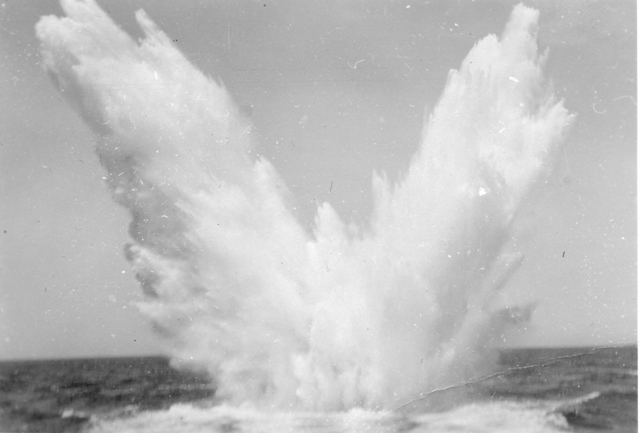
The water astern of HMCS IROQUOIS vapourizes from the explosion of the destroyers depth charges. Unknown date/place. Roger Litwiller Collection, Lynford Bourne, RCNVR photo, courtesy Battle of Atlantic Place. (RTL-LRB005)
The three Tribals left the convoy on 7 May and proceeded to Scapa Flow, arriving there the next day, after the announcement of Germany’s surrender.
Celebrations would be brief, as IROQUOIS sailed for Oslo, Norway on 12 May with HMS DEVONSHIRE and HMS APOLLO, returning Crown Prince Olav of Norway and the exiled Norwegian government.

HMS APOLLO, Manxman minelayer, carrying the Crown Prince Olav of Norway and the exiled Norwegian government, approaches HMCS IROQUOIS on 13 May 1945 in Oslo, Norway. Roger Litwiller Collection, Lynford Bourne, RCNVR photo, courtesy Battle of Atlantic Place. (RTL-LRB015)
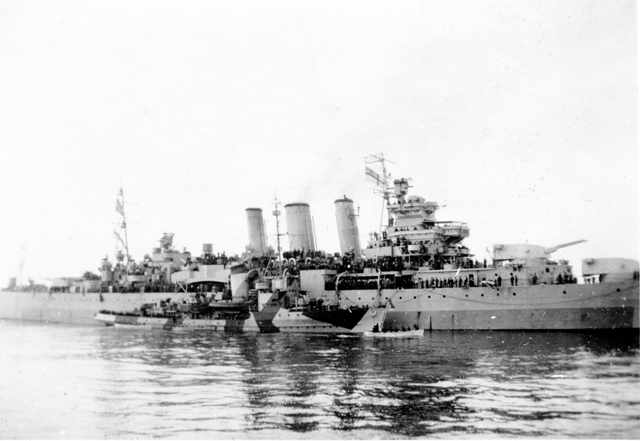
HMS DEVONSHIRE with a surrendered German M class mine sweeper alongside in Oslo, Norway. Photo taken from HMCS IROQUIOS on 12 May 1945. The RN cruiser is flying the Norwegian flag from her aft mast. IROQUOIS and DEVONSHIRE provided escort to HMS APOLLO carrying the Crown Prince Olav of Norway and the exiled Norwegian government to Oslo. Roger Litwiller Collection, Lynford Bourne, RCNVR photo, courtesy Battle of Atlantic Place. (RTL-LRB039)

Several Catherine class minesweepers in Oslo, Norway in May 1945. HMS GRECIAN (J352) is facing. Photo taken by Lynfourd Boune in HMCS IROQUOIS. Roger Litwiller Collection, Lynford Bourne, RCNVR photo, courtesy Battle of Atlantic Place. (RTL-LRB029)
While in Oslo, there was time for a quick run ashore to see the city.
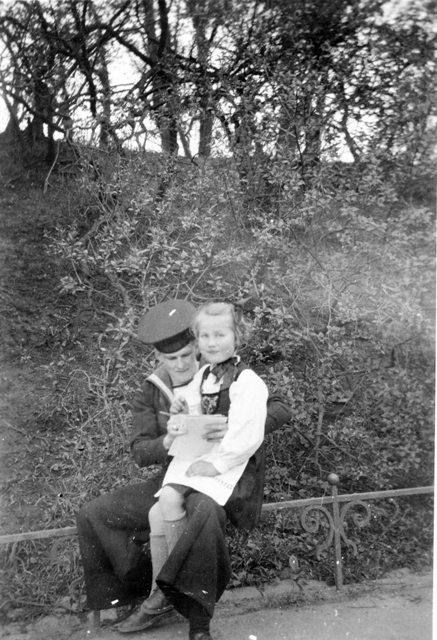
A local child poses with a Canadian sailor from HMCS IROQUOIS as he writes a letter while in Oslo, Norway in May 1945. Roger Litwiller Collection, Lynford Bourne, RCNVR photo, courtesy Battle of Atlantic Place. (RTL-LRB028)

There were plenty of reminders that this beautiful city had been occupied by the Germans. Gestapo Headquarters in Oslo, Norway in May 1945. Photo taken by RCN Sailor Lynford Bourne of HMCS IROQUOIS after the destroyer had escorted the exiled Norwegian Government to Oslo on 12 May 1945. Roger Litwiller Collection, Lynford Bourne, RCNVR photo, courtesy Battle of Atlantic Place. (RTL-LRB025)

HMS APOLLO, Manxman minelayer, in Oslo, Norway on 12 May 1945 after returning Crown Prince Olav of Norway and the exiled Norwegian government. Photo taken from HMCS IROQUOIS. Roger Litwiller Collection, Lynford Bourne, RCNVR photo, courtesy Battle of Atlantic Place. (RTL-LRB030)
IROQUOIS was then detailed to travel to Copenhagen, Denmark with DEVONSHIRE and joined HMS DIDO to take charge of the German cruisers PRINZ EUGEN and NURMBERG. These two powerful cruisers were the last operational capital ships of the German Navy. IROQUOIS arrived in Copenhagen on 24 May 1945.
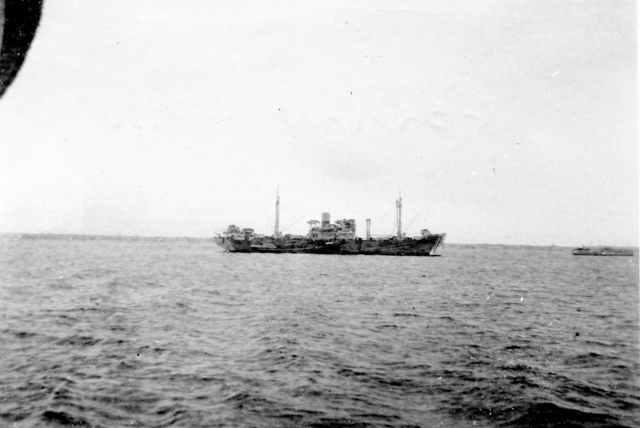
German merchant ship in Copenhagen in May 1945. Photo taken from HMCS IROQUOIS. Roger Litwiller Collection, Lynford Bourne, RCNVR photo, courtesy Battle of Atlantic Place. (RTL-LRB027)
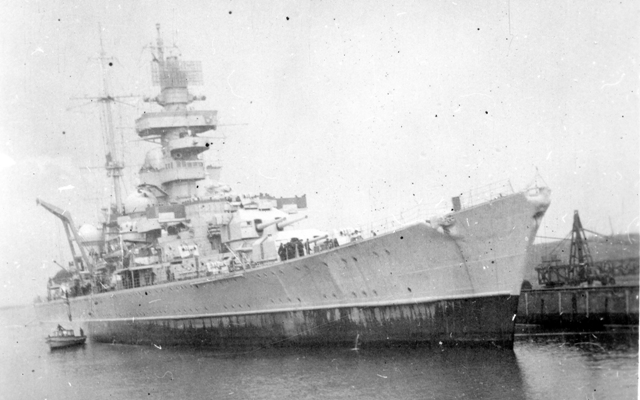
German Navy’s Admiral Hipper class cruiser, PRINZ EUGEN launching her sea boat at Copenhagen, Denmark in May 1945. Photo taken from HMCS IROQUOIS, who formed part of the Allied escort for the surrendered cruiser and the Leipzig class cruiser NURMBERG to Wilhelmshaven, Germany for their formal surrender to the Allies. Roger Litwiller Collection, Lynford Bourne, RCNVR photo, courtesy Battle of Atlantic Place. (RTL-LRB033)

A large group of German Prisoners-of-War in Copenhagen, Denmark in May 1945. Photo taken by Lynford Boune while his ship HMCS IROQUOIS was in the city following the surrender of German forces. Roger Litwiller Collection, Lynford Bourne, RCNVR photo, courtesy Battle of Atlantic Place. (RTL-LRB031)

View of German Navy’s Admiral Hipper class cruiser, PRINZ EUGEN’s bow from HMCS IROQUOIS (foreground) in Copenhagen, Denmark in May 1945. The heavy cruiser has an impressive weapons suite with, four 20.3 cm (8 inch) guns mounted in two turrets forward and another four aft. Each primary gun could fire a 122 kilogram projectile over 33 km. One of the twelve 10.5 cm (4 inch) guns is below the bridge and one of the twelve 3.7 cm (1.5 inch) guns is located on the main deck. IROQUOIS was part of the escort force transferring PRINZE EUGEN and NURMBERG to Wilhemshavem for their formal surrender. Roger Litwiller Collection, Lynford Bourne, RCNVR photo, courtesy Battle of Atlantic Place. (RTL-LRB034)

View of German Navy’s Admiral Hipper class cruiser, PRINZ EUGEN’s midships and stern from HMCS IROQUOIS (foreground) in Copenhagen, Denmark in May 1945. One of the three Arado Ar 196 reconnaissance float planes is still on the catapult. IROQUOIS has been assigned to the escort force to transfer PRINZ EUGEN to Wilhelmshaven for the formal surrender. Roger Litwiller Collection, Lynford Bourne, RCNVR photo, courtesy Battle of Atlantic Place. (RTL-LRB035)
IROQUOIS remained alongside for several days in Copenhagen. The Allied escort group departed with PRINZ EUGEN and NURMBURG on 27 May 1945 and arrived in Wilhelmshaven, Germany the next day.

Admiral Hipper class cruiser, PRINZ EUGEN from HMCS IROQUOIS. The Canadian destroyer is escorting PRINZ EUGEN and NURMBURG from Copenhagen, Denmark to Wilhelmshaven, Germany for the formal surrender. The two German cruisers and escort force departed Copenhagen on 27 May 1945, arriving the next day. Roger Litwiller Collection, Lynford Bourne, RCNVR photo, courtesy Battle of Atlantic Place. (RTL-LRB036)

Admiral Hipper class cruiser, PRINZ EUGEN arriving at the locks at Wilhelmshaven, Germany from HMCS IROQUOIS (foreground) on 28 May 1945. The Canadian destroyer was part of the Allied force, escorting PRINZ EUGEN and NURMBURG from Copenhagen, Denmark to Wilhelmshaven, Germany for the formal surrender, leaving Copenhagen the previous day. Roger Litwiller Collection, Lynford Bourne, RCNVR photo, courtesy Battle of Atlantic Place. (RTL-LRB037)

View of dockyard at Wilhelmshaven, Germany from HMCS IROQUOIS as the Canadian destroyer arrived in the German city on 28 May 1945. IROQUOIS was part of the escort force that brought the German Navy cruisers, PRINZ EUGEN and NURMBURG from Copenhagen, Denmark for their formal surrender to the Allies. Roger Litwiller Collection, Lynford Bourne, RCNVR photo, courtesy Battle of Atlantic Place. (RTL-LRB040)
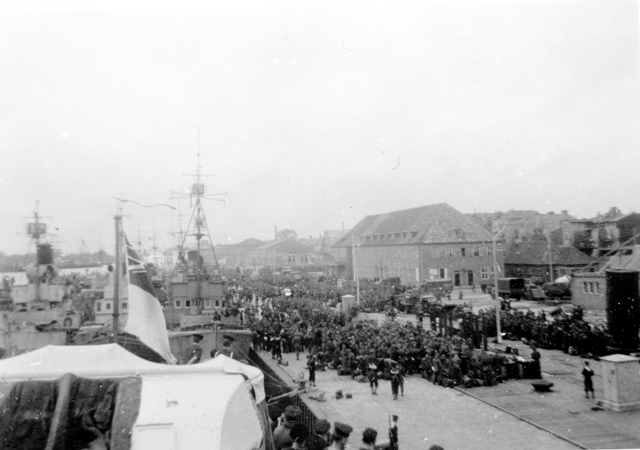
Under the watchful eyes of armed RN sailors, thousands of German Prisoner-of-War have been gathered at the harbour in Wilhelmshaven, Germany on 28 May 1945. Photo taken from HMCS IROQUOIS (foreground) on her arrival in the German port after escorting the German cruisers PRINZ EUGEN and NURMBURG from Copenhagen, Denmark for their formal surrender to Allied forces. Roger Litwiller Collection, Lynford Bourne, RCNVR photo, courtesy Battle of Atlantic Place. (RTL-LRB038)

Two heavily armed HMCS IROQUOIS sailors standing sentry with Lanchester sub-machine guns, with 50 round magazines and long bayonets in 1945. Roger Litwiller Collection, Lynford Bourne, RCNVR photo, courtesy Battle of Atlantic Place. (RTL-LRB012)
With her immediate post-war duties complete, IROQUOIS headed to Greenock, Scotland and re-joined her sisters HAIDA and HURON. With their wartime operations completed, the three Canadian Tribals departed on 4 June 1945 and arrived in Halifax on 10 June.
These photos are part of a larger collection from Lynford Bourne. With over 100 photos in his collection, the scanning, cataloging, tagging and captioning is still a work in progress. Some of these pictures have been uploaded to my Flickr page and can be viewed from this link. Lynford Bourne, RCNVR -Photo Collection.
As part of my research I have been gathering personal photos from RCN Veterans past and present. The Roger Litwiller Royal Canadian Navy Photo Collection has grown to over 1700 personal photos and provides a visual history of the RCN from 1938 to present day. You can view the entire collection on Flickr at Roger Litwiller Royal Canadian Navy Photo Collection or on this website under Photo Of The Day. The Photo of the Day is also posted each morning on my social media feeds at Twitter and Facebook.
I use these photos in my research and writing. I have also donated the entire collection to several Canadian Naval Museums, in Ottawa, The Canadian War Museum and the Royal Canadian Navy Directorate of History and Heritage. In Halifax –Maritime Command Museum, Canadian Naval Memorial Trust and Battle of Atlantic Place. Additionally the Naval Museum of Manitoba in Winnipeg and the Naval Museum of Alberta at The Military Museums in Calgary.
From these locations the photo collection is available to any authors, researchers and historians working on RCN History.
All of the photos have been donated to the Roger Litwiller Collection by the individual veteran or their family. After scanning at high resolution, all original photos are returned to the donor. If you have photos of Canada’s proud Naval Heritage and would be interested in contributing your collection, please contact me at litwillerroger@gmail. com.
If you enjoy the content I create and find value in the articles on this website, please feel free to click on the coffee icon on the bottom right of the webpage and “Buy me a Coffee!” Your contribution will ensure that I can continue to provide the stories of these incredible Canadians and the Canadian Navy. Thank you for your support. Cheers, Roger
