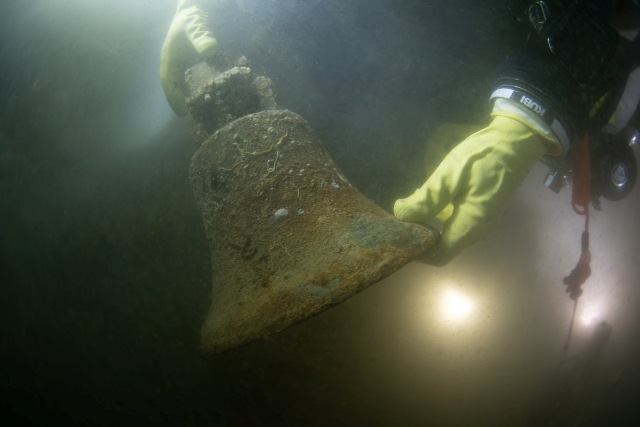
The UK news reported on Sunday, “Diver found WWII Royal Canadian Navy ship bell – missing for 80 years!”
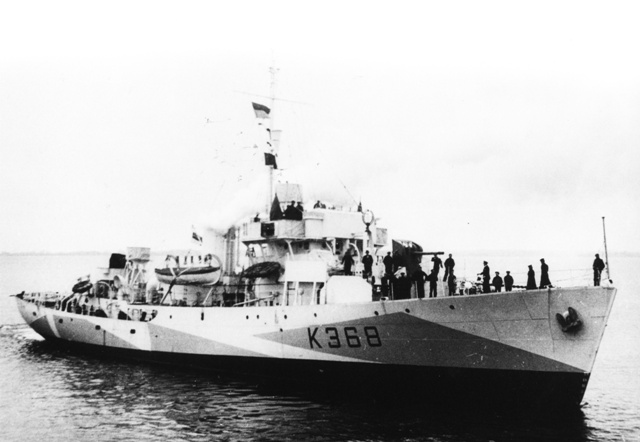
HMCS TRENTONIAN at Kingston Shipyards, prior to her commissioning on 1 December 1943. Marine Photo Museum of the Great Lakes
I was contacted by the diver in question three weeks ago that he had recovered the bell from the wreck of the Royal Canadian Navy’s WWII corvette HMCS TRENTONIAN. This may seem exciting news, until we realize TRENTONIAN is a Canadian War Grave. The bodies of five Canadian sailors are still with their ship where it was torpedoed in the English Channel.
Taking artifacts from a ship designated as a War Grave is the same as going into a battlefield cemetery in Normandy and digging up the graves of a Canadian soldier or aviator to take the brass handles from the casket as a souvenir or worse yet resale on the market or the value as scrap metal.
If one morning it was found that a War Cemetery in France was dug up and the graves robbed, there would be an immediate and international response condemning the action, followed by a manhunt to find and prosecute the perpetrators.
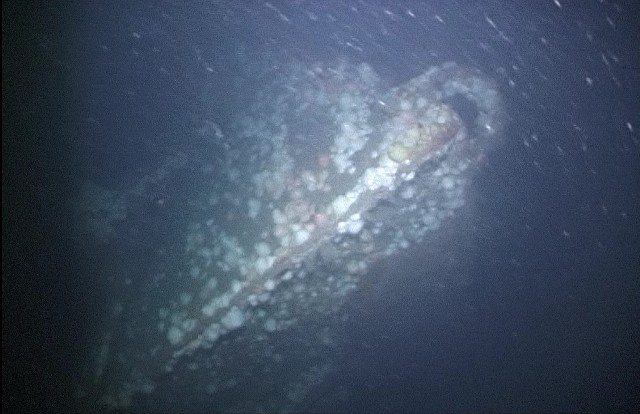
The bow of HMCS TRENTONIAN is clearly identifiable as the wreck of the corvette rests at the bottom of the English Channel near Falmouth. Once a scene of tragedy and death, it now harbours many species of marine life.
Unfortunately the removal of items from the wrecks of our ships does not garner the same attention. Mostly because the war graves of many of Canada’s sailors cannot be seen or visited. Nor can an inspiring cenotaph be erected on the battlefield to remind us of their service and the details of their sacrifice.
Our Royal Canadian Navy played an active role during the Second World War, from the onset of war in September 1939 our Navy was escorting convoys to the UK, merchants ships filled with the materials, food and munitions built by Canadian factories, steel mills, mines, farms and industry. Canada was the lifeline that saved the UK and our Navy was the bridge that reached across the Atlantic Ocean.
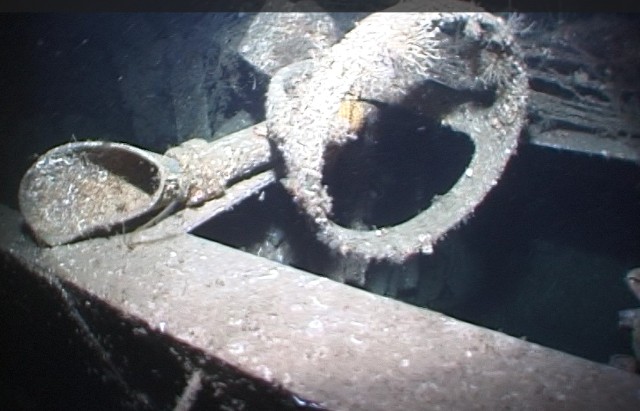
Canadian Navy ships were commanded and fought from their bridge. This is TRENTONIAN’s bridge with a brass voice pipe that once carried commands to the helmsman below and the empty bracket that once held the ship’s compass. highly prized by souvenir divers.
Our ships fought in every major operation during the war, in addition to the Atlantic our Navy played pivotal roles in the waters around the UK and France, Mediterranean, Caribbean, Arctic, Pacific Ocean and when Germany brought the war into Canada’s interior, fought U-boats in the Gulf of St Lawrence and the St. Lawrence River as far west as Rimouski.
These actions came with sacrifice, 33 RCN ships and patrol craft were lost in the UK, the coast of France, Mediterranean, Arctic, coastal waters of Canada and the St. Lawrence.
Three of our Canadian ships are at the highest risk of grave robbing, HMCS TRENTONIAN, HMCS ALBERNI and HMCS REGINA all in UK waters. We know that both TRENTONIAN and REGINA have had artifacts removed from the ship as some of these artifacts have been recovered by the RCN.
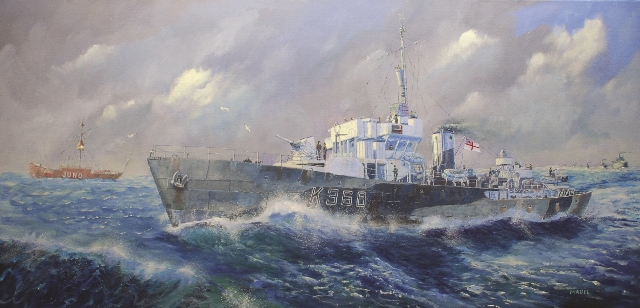
HMCS TRENTONIAN off the Normandy Beaches -Painting by Marc Magee, now on display at the Quinte West Public Library in Trenton, ON.
Let’s look at TRENTONIAN specifically as this is the most recent incident. TRENTONIAN was one of 123 Flower class corvettes to enter service with the RCN during the war and like many of our ships during the war was named for a community in Canada, Trenton, Ontario. This corvette escorted convoys on the Atlantic and off the coast of Canada, Newfoundland, France and the UK. Played an active role in the victory of the Normandy landings, rescued sailors from two merchant ships and a Royal Navy submarine. The sailors in TRENTONIAN enjoyed shore leave in Canada, Bermuda, Ireland, England and even France.
During this time, TRENTONIAN was on the receiving end of an unfortunate friendly fire incident with an American destroyer. When TRENTONIAN first met the enemy, the big German rail guns at Calais fired on the corvette, some of the sailors remarked, “it’s about time the enemy took a few shots at us too!”
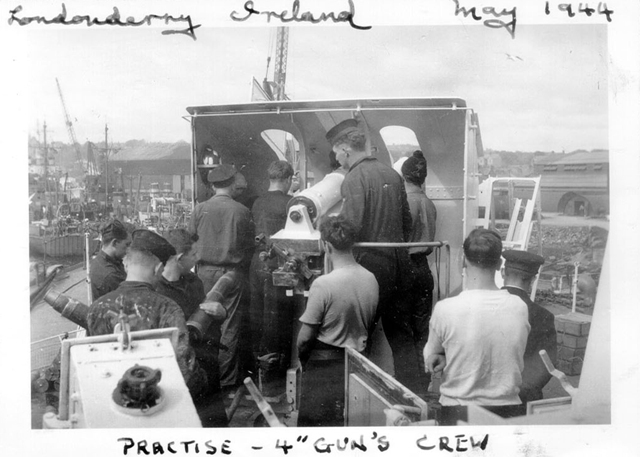
HMCS TRENTONIAN’s forward gun, the gunners in this photo had to take cover under the gunshield as large pieces of steel crashed down on them from the torpedo strike.
Roger Litwiller Collection, Allen B. Singleton, RCNVR photo, courtesy Bruce Keir, RCNVR.
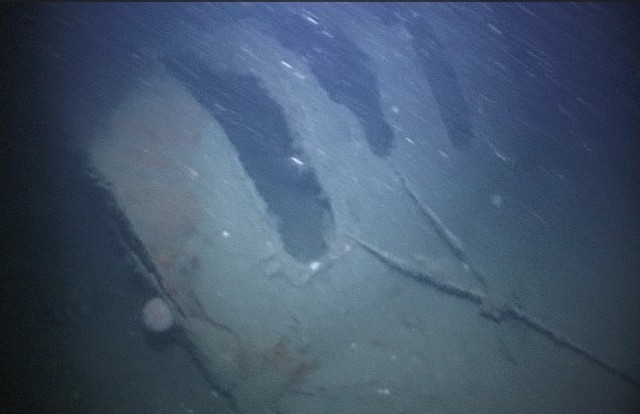
HMCS TRENTONIAN’s Gunshield as it is on the wreck. A cable can be seen attached to the openings for the gun to pull it off the gun. The gun itself appears to have been removed from the wreck.
On 22 February 1945, TRENTONIAN was escorting a small convoy in the English Channel. Suddenly the second ship in the port (left) column exploded. Action Stations sounded as the corvette turned to port to hunt the U-boat that fired the torpedo. Instructions were received from the Convoy Commodore in the lead Merchant ship that the torpedo struck the starboard (right) side of the merchant ship, so TRENTONIAN continued its turn, passing through the convoy just ahead of the now sinking merchant ship.
Clearing the underwater noise of the merchant ships, TRENTONIAN gained a strong ASDIC (sonar) contact and began turning towards its target. Suddenly a tremendous explosion erupted from the stern of the corvette. U-1004 had fired a second torpedo at the convoy and it had struck TRENTONIAN. The corvette was mortally wounded; the skipper ordered Abandon Ship, TRENTONIAN sank in just 10 minutes.
Five sailors were killed and went down with their ship. A sixth sailor died of his wounds after being rescued, 96 sailors survived the attack with 14 of them wounded.
This is how we generally discuss the loss of a ship. The reality is, every sailor in TRENTONIAN was a Canadian son, brother, uncle, father or husband. They are not just 6 sailors that were killed, they had names, lives and families that were heartbroken with their loss.
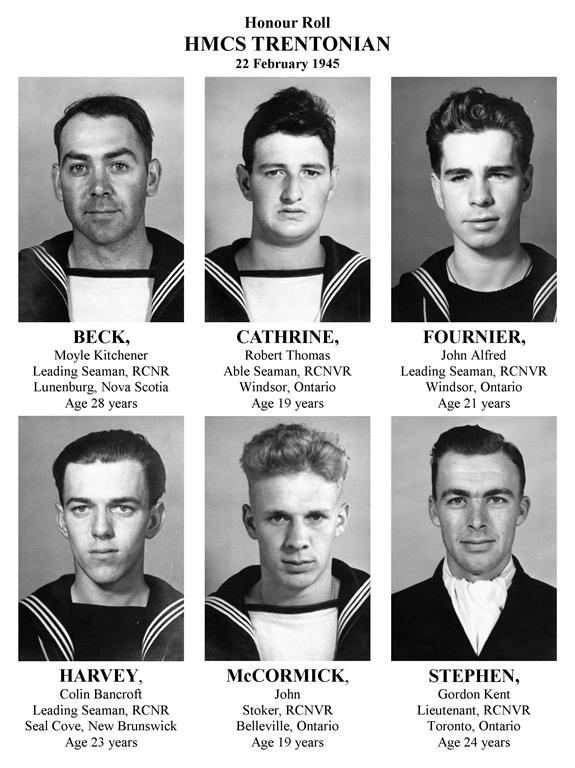
Moyle Beck was a fisherman before he joined the RCN, leaving his wife and young son; at 28 years old he was one of the “older” sailors in the ship. TRENTONIAN had been working hard since it was first commissioned in December of 1943 and was soon to return to Canada for refit and with the European war coming to an end, the corvette was schedule to move to the Pacific to continue the fight with Japan. Beck had been trading off his shore leave in the UK so he could collect on these trades and have an extended leave with his wife and son while his ship underwent topicalization. Moyle was standing directly above the location were the Torpedo struck, along with his shipmates Robert Cathrine, John Fournier and Colin Harvey. All four were killed instantly.
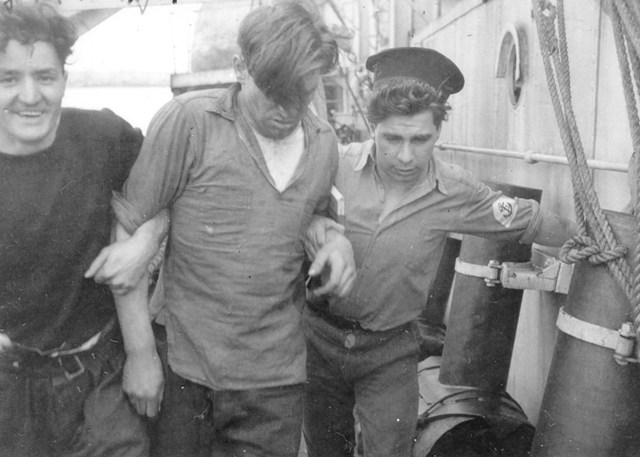
TRENTONIAN sailors Robert Cathrine and John Fournier assist a “sick” friend from HMCS MOOSE JAW back to his ship after shore leave. Roger Litwiller Collection, Allen B. Singleton, RCNVR photo, courtesy Bruce Keir, RCNVR.
John McCormick was to young to enlist, so he joined the local sea cadet corps RCSCC Quinte in Belleville, Ontario. As soon as he came “of age” he immediately enlisted at the Naval Reserve Unit in Kingston, HMCS CATARAQUI. In September 1943 he had been part of the Honour Guard at TRENTONIAN’s launch at the Kingston Shipyards. Imagine the young sailors surprise to be assigned to the same ship. As the youngest sailor in the ship, following naval tradition John had exchanged positions with the commanding officer during Christmas Day festivities. John’s action station was part of the aft depth charge party, the explosion from the torpedo tore apart the aft part of his ship and he was trapped in the twisted steel wreckage. Despite the frantic efforts of his shipmates, many wounded themselves, they could not rescue young John and he went down encased in his ship.
These five sailors remain with their ship, HMCS TRENTONIAN was their wartime home during life and now is their final resting place and war grave. For their families there is no possibility of visiting the gravesite, there will never be a headstone to mark the sacrifice of these sailors.
The sixth sailor killed was Gordon Stephen, The young officer had volunteered from university. As TRENTONIAN was soon to return to Canada, he had become engaged just after Christmas and the happy couple were to marry as soon as his ship returned. Stephen’s fiancé was somewhat of a socialite in Toronto and their engagement made all the social pagers in the newspapers, only to have those same papers report the death of the young officer a few weeks later. Stephen had been blown from the deck of TRENTONIAN into the icy English Channel. Severely wounded and unconscious with a head injury, he was brought aboard TRENTONIAN’s whaler and died before reaching Falmouth. Lt. Stephen is the only sailor to be buried, his funeral attended by his surviving shipmates.
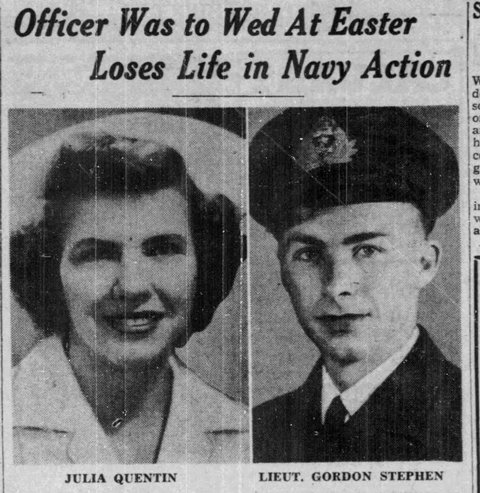
The Toronto Star, 24 March 1945
TRENTONIAN is not unique; every one of the 33 RCN ships that was lost during the war has similar stories, young sailors that lost their lives in service to our country. Over 2000 Canadian sailors made the ultimate sacrifice during the war, many of them forever remain with their ships.
Going back to the beginning of this blog, why are Canadian ships being robbed?
The UK, France and the United States, our allies during the war have passed laws, protecting their wrecks as war graves wherever they are located and aggressively pursue and prosecute anyone that has been found stealing from their wrecks. France has some of the strictest laws restricting all diving activity on their war graves without consent of the government. These dives with consent of the French government are highly supervised, regulated and an absolute “hands off” enforced.
Unfortunately Canada has not passed any legislation to protect our war graves; this includes the Canadian Navy ships that have been lost in Canadian waters. Anyone anywhere can dive our war graves and with no regulation there is no legal repercussion for removing an item from the wreck.
The French government has graciously extended their regulations to include the wreck of HMCS ATHABASKAN, a Tribal class destroyer that was lost in a surface action with German destroyers prior to D-Day, 129 Canadian sailors were killed.
Our Royal Canadian Navy has been actively working with the Royal Navy to have the same extension of Royal Navy protection to the Canadian ships lost in and around the UK. This includes TRENTONIAN and also REGINA, torpedoed off Cornwall with the loss of 30 RCN sailors and ALBERNI, torpedoed in the English Channel, sinking in 30 seconds killing 59 Canadian sailors.
I am very glad to report that this protection will soon be in effect.
This still does not save the Canadian Navy’s war graves in other waters, including those wrecks here in Canada.
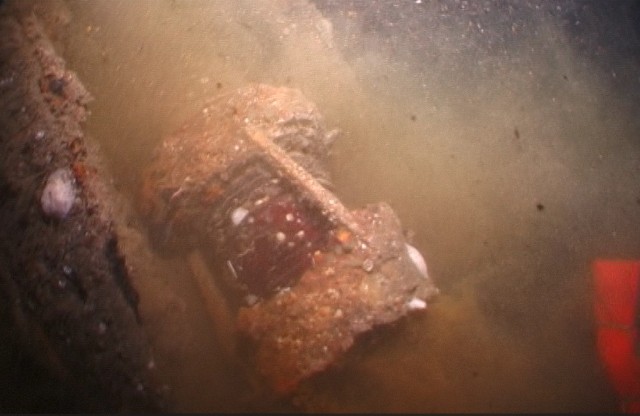
Screen shot from a 2018 dive video of HMCS TRENTONIAN’s port navigation lamp, lying on the wreck.
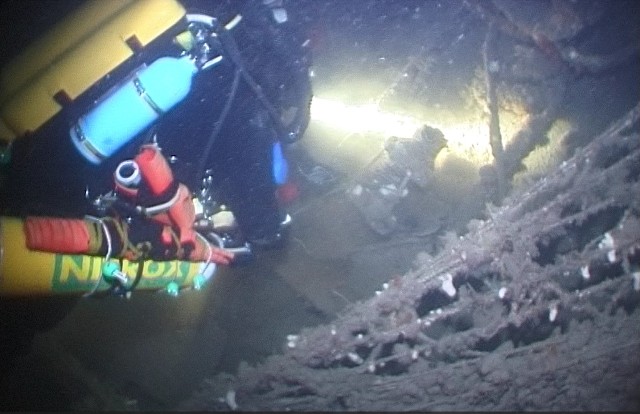
A second screenshot from the same video showing an unidentified diver securing a recovery bag to the Brass lamp. The diver has several of red recovery bags strapped to their dive equipment.
Now you might ask why is the robbing of our war graves happening so frequently now. After the Second World War many of the wreck locations were not known, yes we knew were the ship was attacked and sunk, but the exact location of the final resting place on the bottom was unknown. Our ships lost in the Atlantic, their final resting place may never be known.
Initially, the same applied for our ships lost in coastal waters. Several factors have changed this. As undersea mapping equipment, side scan sonar, magnetometers, etc. have improved, the technology has made finding a wreck easier. Additionally diving equipment has also improved; post-war diving equipment was rudimentary and available to very few.
Again this technology has continued to improve and has developed into sport diving, where anyone with some basic training can begin diving. This has made our wrecks more accessible and therefore more prone to theft. There once was an unwritten code, dive, visit, explore with respect and honour.
This no longer is the norm. For some a wreck, regardless of it being a war grave is an opportunity for “trophies.” I am not throwing all sport divers into this category, just the ones that feel they can take from the ships that are the final resting place of our sailors. The vast majority of divers are truly interested in preservation and conservation and condemn the divers that come to the surface with souvenirs.
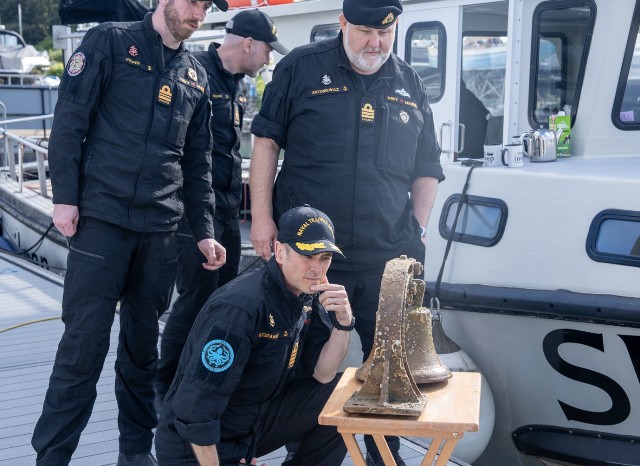
Canadian Sailors took possession of HMCS TRENTONIAN’s bell last week. Aidan Davies photo.
Immediately on receiving the email from the UK diver, I contacted the Royal Canadian Navy to report that the bell had been recovered, RCN command acted swiftly in contacting the diver and formally taking possession of TRENTONIAN’s bell through the Naval Attaché at the Canadian Consulate. RCN personnel accepted the bell last week and arrangements have been made for HMCS Montreal to return the bell to Halifax where, after any necessary conservation, it will be turned over to the Naval Museum of Halifax.
As long as there are no repercussions for stealing from Canada’s war graves, the theft will continue. Dive video of TRENTONIAN shows this wreck has been almost stripped of anything of value.
Our Canadian government must enact legislation protecting Canadian Naval War Graves at home and abroad. These were Canadians that volunteered to serve our nation and protect our country. The least we can do is protect their graves after they have sacrificed everything for our future.
As far as the UK headline is concerned “Diver found WWII Royal Canadian Navy ship bell – missing for 80 years,” HMCS TRENTONIAN’s bell was not missing. We knew exactly where it was, it the cenotaph to the service of 96 Canadian sailors that fought and survived the loss of their ship in battle and was the headstone marking the graves of five Canadian sailors who’s bodies rest with their ship!
I was contacted by the diver because I have researched and written extensively about HMCS TRENTONIAN. This Canadian corvettes story is detailed in my book, White Ensign Flying -the Story of HMCS TRENTONIAN, published by Dundurn Press. To write this historic ships legacy I managed to interview over 20 of the survivors of that fateful day on 22 February 1945. Sadly, they have all passed on now, I know from speaking with them and their families that I continue to communicate with, each of them would be angered by what has happened to their ship and the graves of their shipmates.
Cover Photo: HMCS TRENTONIAN’s bell shortly after it was pulled from the wreck. Photo Rick Ayrton.
LINKS:
Online article: Diver found WWII Royal Canadian Navy ship bell – missing for 80 years
Diver’s YouTube video of his recovery of TRENTONIAN’s Bell. I Found The Ship’s Bell From A WWII Canadian Navy Ship – HMCS Trentonian

White Ensign Flying -Corvette HMCS TRENTONIAN in the Second World War
If you enjoy the content I create and find value in the articles on this website, please feel free to click on the coffee icon on the bottom right of the webpage and “Buy me a Coffee!” Your contribution will ensure that I can continue to provide the stories of these incredible Canadians and the Canadian Navy. Thank you for your support. Cheers, Roger
