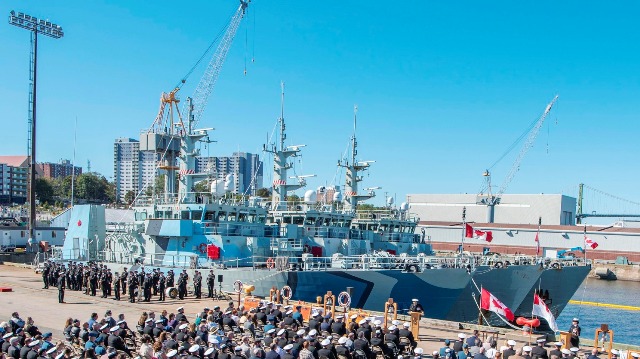
Last week we witnessed the paying-off ceremonies of eight Royal Canadian Navy (RCN) ships, three Kingston class Maritime Coastal Defence Vessels (MCDV), His Majesty’s Canadian Ships BRANDON (2nd), SASKATOON (2nd) and WHITEHORSE were paid-off on 29 September 2025 in a joint ceremony at CFB Esquimalt on Canada’s West Coast. Similarly five MCDV’s were paid-off on Canada’s East Coast on 3 October, HMCShips KINGSTON, GLACE BAY (2nd), GOOSE BAY, SHAWINIGAN (2nd) and SUMMERSIDE (2nd) in Halifax.
Kingston-Class Paying Off Ceremony held at B Jetty at Canadian Forces Base Esquimalt on 29 September, 2025 Photo: Aviator Rebecca Mainardi, MARPAC Imaging, CFB Esquimalt
When an RCN ship has reached the end of its service life and is/or no longer required the ship is paid-off. This is an old reference to the days of sail, when a ship returned from a long voyage all accounts would be settle and the sailors would then receive the wages that had been withheld during the voyage to ensure they did not “jump ship” before the ship returned to its home port, hence the term “paying-off or paid-off.
Fortunately for our sailors, the RCN does not withhold pay.
At the end of service for an RCN ship, it is considered all accounts are now closed; the ship will no longer be used by the navy. The Canadian Naval Ensign and Jack are hauled down from the bow and stern and the ship’s commissioning pennant is removed from the masthead. The ship is no longer referred to as His/Her Majesty’s Canadian Ship (HMCS). The sailors that once made up the ships company are ceremonially marched off their ship for the final time. Later the pennant number on the hull is painted over.
The once living warship now sits alongside a distant jetty, forlorn and devoid of life, waiting its ultimate fate, either to be sold to another nation to resume duties as a warship or a shipping company to transform into merchant service. Sometimes a dive group will purchase a ship and after removing all environmental hazards, intentionally sink the ship as a dive park. The RCN may retain a ship and use it as a target during a SINKEX to enhance our sailors skills in gunnery, missiles and/ torpedoes.
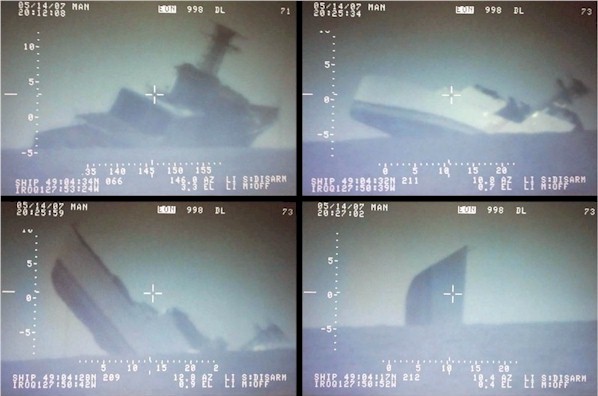
The final moments of HMCS HURON, Iroquois class destroyer intentionally sunk for target practice by live fire from RCN ships and RCAF aircraft. RCN Photo
Occasionally a ship will be very lucky and become a museum ship, preserved to pass on the legacy of the sailors that served.
For most paid-off ships, they do not receive a reprieve and are sold for breaking up. Once the ship has been ripped to pieces, the steel, aluminum, copper and other valuable materials are sold for the value of the scrap.
With warships continuing in service for much longer periods of time, it has become rare to witness a paying-off ceremony, even more rare to see 8 ships paid off in a week, or five ships in a single day.
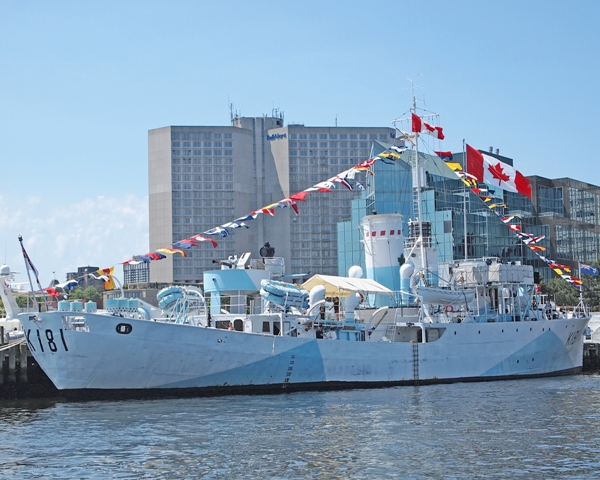
HMCS SACKVILLE is the last surviving corvette from WWII. She is kept in her Western Approaches Camouflage scheme as a tribute to the sailors that sacrificed and served in the Battle Of Atlantic. Roger Litwiller photo.
Not since the end of the Second World War when our RCN was disposing of its incredible wartime fleet of over 400 ships. From mid-1945 to early 1946 an RCN ship or two was paid-off almost daily, many without ceremony or recognizing their historic war service.
The once battle hardened fighting ships were moved to Sydney, CB. or Sorel, QC. and secured in long lines together at anchor waiting their fates. Some went to smaller navies; others became the first warships of new nations formed in the political aftermath of the war. Some entered merchant service, and a few became personal yachts of the rich and famous. Most, worn out after the rigors or war found their way to the breakers yards.
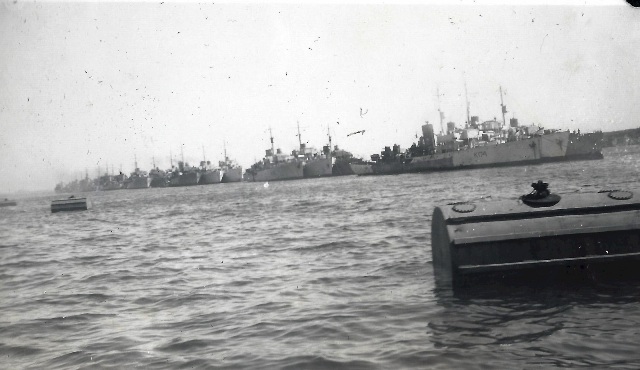
RCN ships tied up waiting disposal after the war – location unknown. HMCS TRAIL K174 lead ship on right. Courtesy For Posterity’s Sake.
The five RCN ships from a single class paid-off 3 October is not a record for Canada’s Navy; 31 July 1945 holds that record when six Bangor class minesweepers were paid-off, HMCS DIGBY, HMCS GRANDBY (1st), HMCS LACHINE, HMCS TRANSCONA, HMCS TROIS-RIVIÈRES and HMCS TRURO. Also on that day HMCS PORTAGE an Algerine class minesweeper was paid-off. Two additional RCN ships were paid-off on 31 July, HMCS QU’APPELLE (2nd), Mackenzie class destroyer escort and HMCS OTTAWA (3rd), St. Laurent class destroyer were paid-off in 1992. A total of 9 RCN ships paying-off on the calendar date of 31 July.
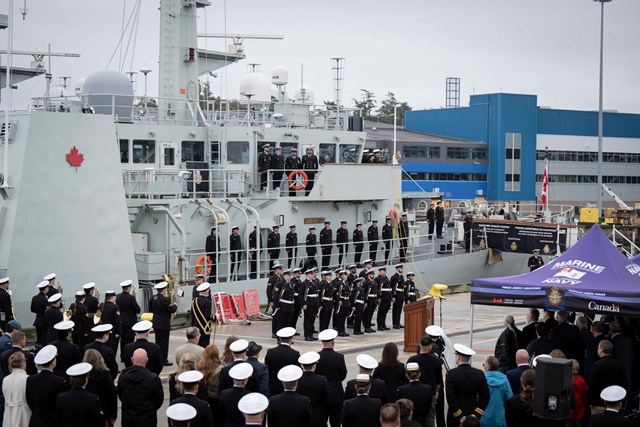
Kingston-Class Paying Off Ceremony held at B Jetty at Canadian Forces Base Esquimalt on 29 September, 2025 Photo: Aviator Rebecca Mainardi, MARPAC Imaging, CFB Esquimalt
This too is not the record for most ships paying-off on a single calendar day, that date belongs to 31 March.
A total of 15 Canadian Navy ships and shore establishments have been paid-off over the 115 year history of the navy on 31 March.
- 1915 –HMCS HOCHELAGA, armed yacht paid-off.
- 1920 –HMCS MALASPINA, patrol vessel, paid-off.
- 1920 –HMCS STADACONA, patrol ship, paid-off.
- 1945 –HMCS MALASPINA, patrol/training ship, paid off for a 2nd time.
- 1945 –HMCS CONESTOGA, WRCNS Training Establishment in Galt, ON. paid-off and closed.
- 1954 –4 Bay class minesweepers paid-off to be transferred to the French Navy, HMCS CHIGNECTO (2nd) renamed LA BAYONNAISE, COWICHAN (2nd) renamed LA MALOUINE. HMCS FUNDY (2nd) renamed LA DUNKERQUOISE, HMCS THUNDER (2nd) renamed LA PAIMPOLAISE.
- 1958 –HMCS CARIBOU II, Naval Reserve Division in Corner Brook, NF. Paid-off and closed.
- 1964 –HMCS MICMAC, Tribal class destroyer escort paid-off.
- 1964 –HMCS CHATHAM, Naval Reserve Division in Prince Rupert, BC, paid-off and closed.
- 1996 – 2 Port class gate vessels paid-off, HMCS PORTE SAINT JEAN and HMCS PORTE SAINT LOUIS.
- 2005 –HMCS HURON (2nd), Iroquois class destroyer escort, paid-off.
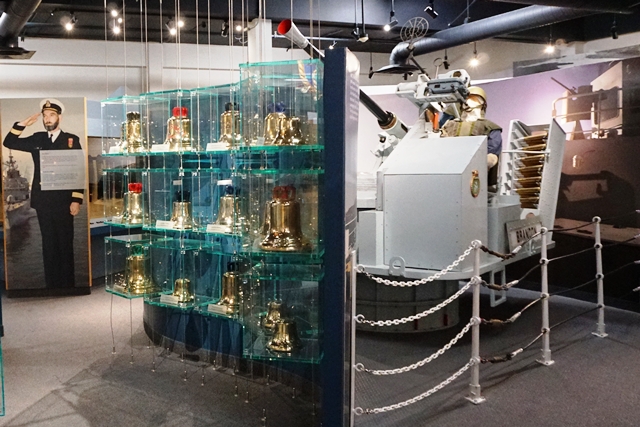
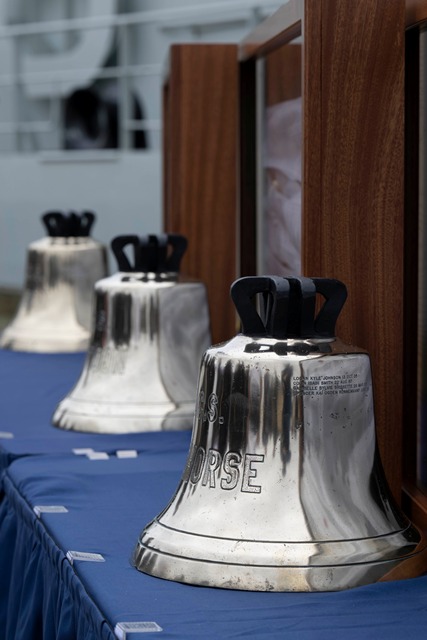
Ships bells from several former RCN ships and the 40mm Bofors from HMCS BRANDON, Kingston class MCDV on display at the Naval Museum of Winnipeg. Roger Litwiller Collection, courtesy of Roger Litwiller. (RTL06604)
The paying-off ceremony has formed several customs and traditions the details of which are best described on the RUSI (NS) website. After the ceremony, historical items are removed from the ship, including the ships bell with the ships name and commissioning year, along with the name boards, Battle Honour board and any other items of significance reflecting the legacy of the ship. Most of these items are turned over to the RCN Naval museums at Halifax, Shearwater, Quebec City, Winnipeg, Calgary and Esquimalt for care and custody. Sometimes the ship’s bell may be given to the community that the ship was named.
These items are retained for when the time comes that another RCN ship is commissioned that perpetuates the same name and will be given to the new ship to carry the legacy.
New ships in the RCN are welcomed into the fleet with a commissioning ceremony. The Canadian Naval Ensign and Jack are raised at the ships bow and stern and a full ship’s company of RCN sailors man the ship. The ship is referred to as HMCS from that point forward.
In the history of the RCN there are two significant dates for the commissioning of ships. On 24 September 1940, six Town class destroyers commissioned into the RCN at Halifax.
- HMCS ANNAPOLIS (1st) (ex-USS MACKENZIE)
- HMCS COLUMBIA (1st) (ex-USS HARADEN)
- HMCS NIAGARA (ex-USS THATCHER)
- HMCS ST. CLAIR (ex-USS WILLIAMS)
- HMCS ST. CROIX (1st) (ex-USS MCCOOK) and
- HMCS ST. FRANCIS (ex-USS BANCROFT).
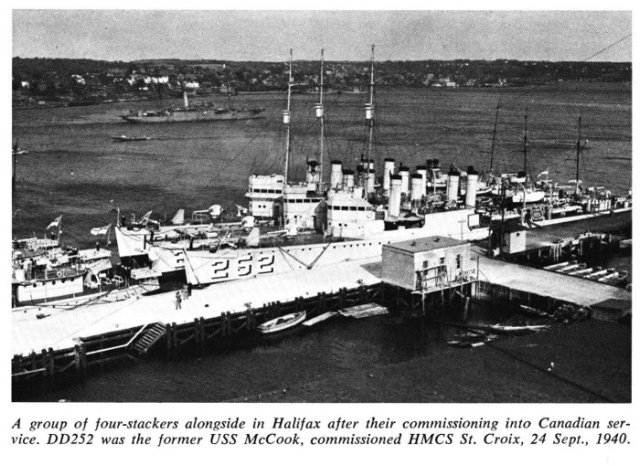 These former American destroyers were transferred to the Royal Navy from the US Navy under the destroyer for bases program. The RN then transferred these six ships to the RCN for convoy escorts. A total of 8 Town class destroyers would serve in the RCN.
The most RCN ships commissioned in a single calendar day is on 13 November with a total of 9 RCN ships commissioned. Including 6 Battle class trawlers in 1917, HMCS FESTUBERT, HMCS MESSINES, HMCS ST. ELOI, HMCS VIMY, HMCS YPRES and HMCS JULIEN. Also HMCS DUNDALK, Auxiliary Tanker in 1943 and HMCS THORLOCK, Revised Flower Class corvette in 1944
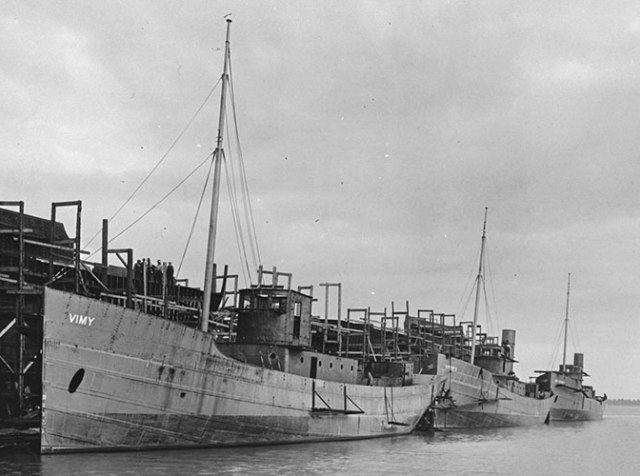
Battle class trawlers HMCShips VIMY, YPRES and MESSINES fitting out in Toronto during the First World War. RCN Photo.
Our Royal Canadian Navy traditionally has gone through cycles of “Boom or Bust” when it comes to building and later reducing the fleet. During the First World War, over 127 ships were commissioned into the Canadian Navy. Also to win the Second World War over 400 ships were commissioned. Looking at the calendar year almost every day has the commissioning or the paying-off of a ship since the RCN was formed in 1910.
Canada is currently in a boom cycle of ship building and subsequent paying-off of ships as demonstrated by the ceremonies last week. Six Arctic and Offshore Patrol Ships (AOPS) have been added to the fleet and 15 new River class destroyers are under construction and will be commissioned as they are completed. The new destroyers will replace the Halifax class frigates and each of these ships will be paid-off in turn. The Canadian Government is in the process of acquiring 12 new submarines to replace the current 4 Victoria class submarines. Two large Joint Support Ships (JSS)) are under construction on the west coast.
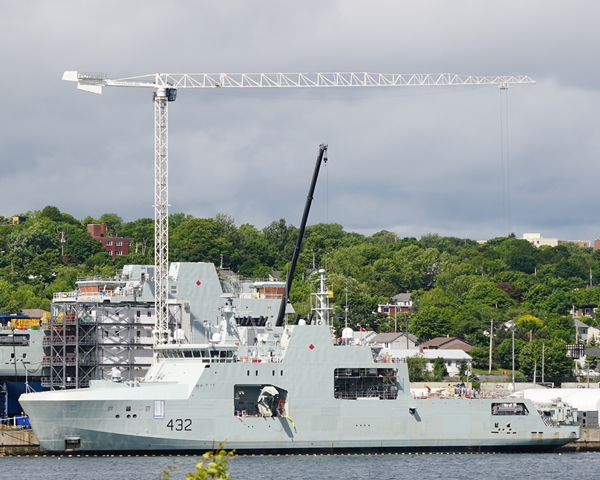
The future HMCS Max Bernays is finishing construction alongside the wall at Irving Shipyard in Halifax on 22 June 2022. The 4th Artic and Offshore Patrol Ship, William Hall is behind on the assembly pad. Roger Litwiller Collection, courtesy Roger Litwiller. (RTL03433)
For Canada’s Naval Reserve, there is a plan underway to increase the size of the West Coast Orca class patrol/training vessel fleet with additional ships located on the East Coast, St. Lawrence River and Great Lakes. Currently the 8 Orcas are not commissioned in the RCN, as their role changes from training to patrol, they too may become His Majesty’s Canadian Ships.
The remaining four Kingston class MCDV’s will be paid-off in the next few years and the intent is to replace them with 12 Canadian designed multi-mission corvettes.
Over the nearly 30 years that the Kingston class ships have been in service each ship has distinguished itself and has added to the rich history of our Canadian Navy. Overall the entire class has undergone many transformations since the first ship was commissioned in 1996, designed for coastal patrol, conducting minesweeping and training of Naval Reserve sailors. These ships have transited the North Atlantic to Europe and North Africa, crossed the vast expanse of the Pacific Ocean, operated in Canada’s Arctic and conducted anti-drug interdictions in the Caribbean, Central and South America.
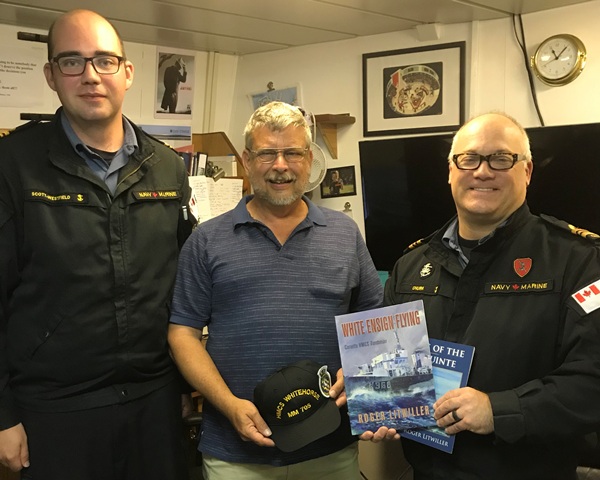
Honoured to be invited aboard HMCS WHITEHORSE by LCdr Chura, Commanding Officer & Lt. Scott-Westfield during our visit to CFB ESQUIMALT in September 2019. Roger Litwiller Collection, courtesy Rhonda Litwiller. (RTL-IMG_0023)
I have had the privilege to have visited many of the Kingston class ships and honoured to have played a small part in the legacy of the Kingston class, on 23 May 2018 I reached out to VAdm Ron Lloyd, then Commander of the RCN with the proposal to honour our Second World War sailors for the upcoming 75th anniversary of the end of the Battle of the Atlantic and paint two of our ships in the Admiralty Disruptive Camouflage scheme used during the war. Following in person discussion with VAdm Lloyd the proposal moved forward and HMCS MONCTON was the first RCN ship to receive the unique camouflage in 2019.
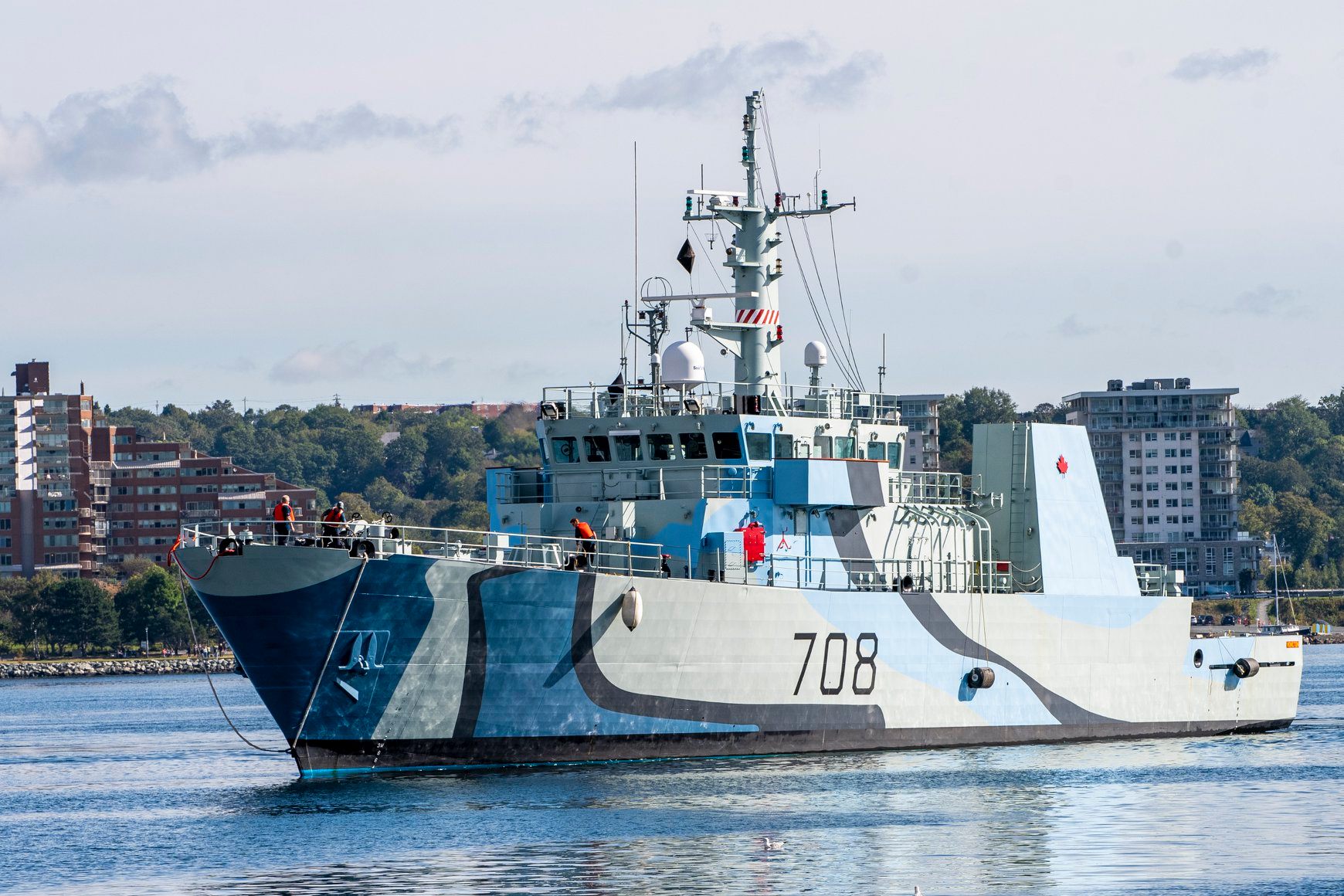
HMCS MONCTON sporting its new Admiralty Disruptive Camouflage. RCN Photo.
These small ships have punched high above their design and have proven to be a highly successful ship in service with our Canadian Navy.
Discover the individual histories of these ships on the For Posterity’s Sake website by clicking on the ship’s name.
HMCS BRANDON (710)
HMCS EDMONTON (703)
HMCS GLACE BAY (701)
HMCS GOOSE BAY (707)
HMCS KINGSTON (700)
HMCS MONCTON (708)
HMCS NANAIMO (709)
HMCS SASKATOON (709)
HMCS SHAWINIGAN (704)
HMCS SUMMERSIDE (711)
HMCS WHITEHORSE (705)
HMCS YELLOWKNIFE (706)
The RCN has produced the following videos, first on the impact these ships have had on the Canadian sailors that served in them and the paying-off ceremonies in Esquimalt and Halifax.
Paying-off Ceremony -Esquimalt
Guarding the Coast & Beyond: The Legacy of the Kingston class.
The Naval Reserve Association of Canada has an excellent webpage dedicated to the Kingston class.
Feature Image Caption: The Royal Canadian Navy (RCN) conducted a paying off ceremony of five Halifax based Kingston-class Maritime Coastal Defence Vessels (MCDVs), on 3 October 2025 at HMC Dockyard Halifax, Jetty NB. HMC Ships Shawinigan, Summerside, Goose Bay, Glace Bay and Kingston were paid off, during a formal naval ceremony to recognize and celebrate their long and distinguished service. Photo by Mona Ghiz, MARLANT Public Affairs.
Researched & written by Roger Litwiller ©
Published 16 October 2025
If you enjoy the content I create and find value in the articles on this website, please feel free to click on the coffee icon on the bottom right of the webpage and “Buy me a Coffee!” Your contribution will ensure that I can continue to provide the stories of these incredible Canadians and the Canadian Navy. Thank you for your support. Cheers, Roger
