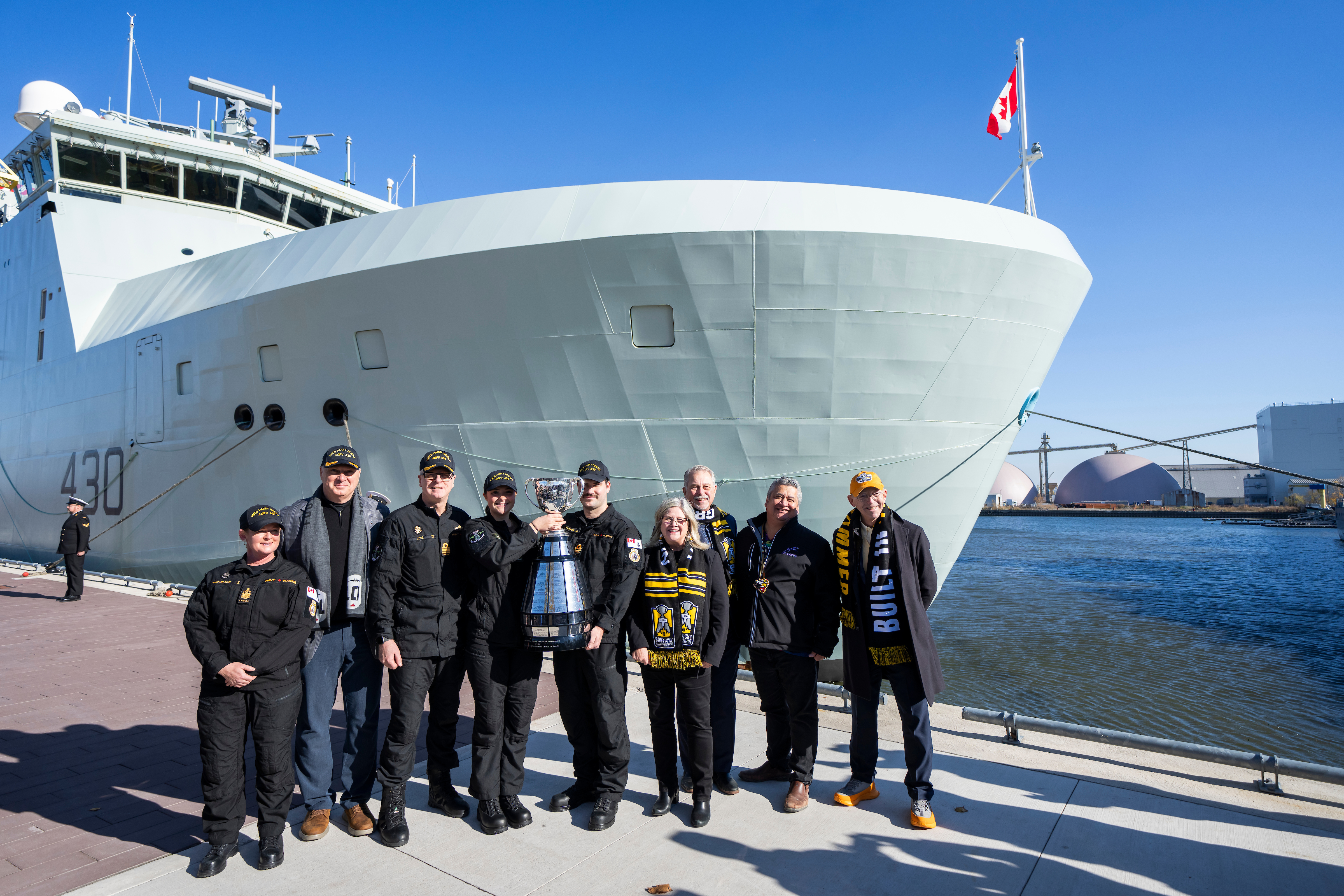
HMCS HARRY DEWOLF arrived in Hamilton, ON. on 13 November 2023 carrying the Grey Cup. Photo Courtesy the Canadian Football League.
On Monday 13 November 2023, His Majesty’s Canadian Ship HARRY DEWOLF secured alongside HMCS HAIDA in Hamilton, Ontario. On board the Royal Canadian Navy’s Arctic and Offshore Patrol Ship was a precious cargo, the Canadian Football League’s Grey Cup.
Canada’s Navy has a long tradition of escorting the Grey Cup to the host city for the annual match between the eastern and western divisions of the Canadian Football League. This honoured tradition stems back to the Second World War, when a team comprised of RCN sailors won the Grey Cup, beating the Hamilton Flying Wildcats 7-6 on November 25, 1944. [1]
The Grey Cup was commissioned in 1909 by His Excellency Earl Grey, the Governor General of Canada and named in his honour. With time the name Grey Cup has come to signify the trophy as well as the game to decide its winner.[2]
Canadian football was made up of several amateur and professional leagues, each eligible to compete for the cup. When war broke out once again in 1939, several of the professional Canadian Football teams suspended operations as many of the players had volunteered for military service. The Canadian military determined that competition for the Grey Cup was an excellent morale booster for the sailors, soldiers and air force personnel and several football teams were formed.[3]
The 1942 Grey Cup game were played between two service teams, the Toronto RCAF Hurricanes beat the Winnipeg RCAF Bombers 8-5. The following year, civilian teams returned and the Hamilton Flying Wildcats defeated the Winnipeg RCAF Bombers 23-14 for the 1943 Grey Cup.[4]
The 1944 football season followed the previous two years, with additional service teams competing, including HMCS YORK Bulldogs[5] formed from volunteers at the Toronto Naval Reserve Unit and a combination team of sailors from HMCS DONNACONNA in Montreal and the Navy’s Signal Training School, HMCS ST. HYACINTHE, known as the Navy Combines.[6]
The Navy Combine team was considered very much the underdogs. The players consisted of sailors of all ranks; during practice a player would tackle one of his teammates abruptly into the ground and following practice salute the same player once the uniforms were put back on.[7]
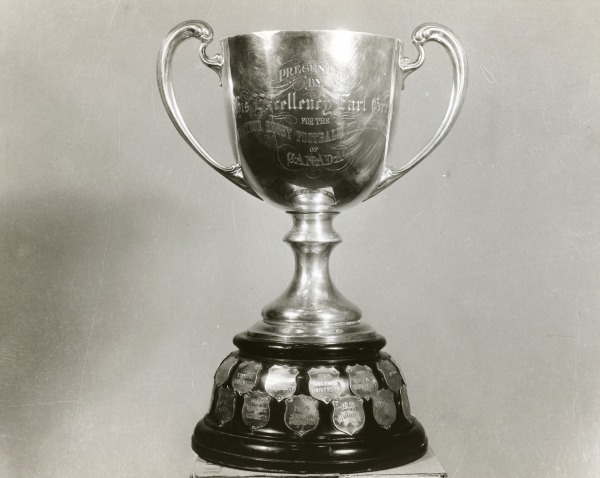
The Grey Cup. Photo courtesy Canada’s Sports Hall of Fame.
One of the players, John Crncich recalled his team consisted of raw recruits like himself and “old Salts” that had fought on the Atlantic, Murmansk Run, landing at Normandy, Italy and North Africa. He added the linemen were made up of sailors from the Shore Patrol.[8]
Practice for the team was in Montreal, the players from ST. HYACINTHE made the trek by truck when available, on foot when not. With any service team the recruiting of players was not a problem, retention on the other hand was a constant issue. As the team worked towards a cohesive unit on the field, players were posted to ships and shore establishments elsewhere.[9]
The strength of the Navy Combine Team continued to build throughout the season, beating McGill University late in the season to champion the Quebec League.[10] On 11 November they travelled to Halifax to face HMCS STADACONA in a match that would decide who would represent the east for the Navy Title. The Halifax team was favoured with a decided weight edge of 40 pounds per man and the fact they had soundly beaten the Navy Combines 3-0, two weeks previous.[11]
The hard work paid off for the “Combines” as they beat Stad, 13-0![12] On 16 November the Canadian Rugby Union announced that the Navy Combines would represent the Quebec Rugby Football Union at the Grey Cup on 25 November. The Ontario Rugby Football Union’s team would be decided following a series between the Toronto Balmy Beach team and the reigning Grey Cup Champions the Hamilton Flying Wildcats.[13]

The Hamilton Tiger-Cats honoured their wartime heritage by wearing a reproduction of the Flying Wildcats uniforms during a game on Sept 7, 2013, defeating the BC Lions 37-29 at Alumni Stadium. Photo/mandatory credit John E. Sokolowski
Hamilton has had several football teams beginning with the Hamilton Football club in 1869, by 1873 the team was commonly referred to as the Tiger Club and joined the Interprovincial Rugby Union in 1907. In 1941, the Tigers suspended operations due to the war. The same year a new professional team was formed under the name Hamilton Wildcats and joined the Ontario Rugby and Football Union. The team was made up of new players and players from the Tigers, when members of the Royal Canadian Air Force started playing with the team the name was changed to the Hamilton Flying Wildcats and remained a professional team.[14]
The Flying Wildcats beat the Toronto Balmy Beach 13-10 on 19 November and the match for the Grey Cup was set for 25 November in Hamilton, Ont.[15]
The Navy Combines played the Bulldogs from HMCS YORK for the Navy title on 20 November in what should have been a preparatory game to face the Flying Wildcats. Over 5,000 spectators gathered at Molson Stadium in Montreal to witness the local team take the Navy Title. The Navy Combines played one of the worst games of their season, after 14 fumbles the YORK Bulldogs clinched the game 12-1.[16]
YORK had a strong team during the 1944 season; the Bulldogs were in the Armed Forces League and therefore not eligible to challenge the Grey Cup. The team put forward a challenge to the winner of the Grey Cup exhibition game for charity. Stating in their challenge that they expected the Hamilton Flying Wildcats to have an easy victory over the Navy Combines and that YORK should be given the opportunity to prove they are the best team in the country.[17]
The Navy Combines drilled everyday preparing for their game in Hamilton. With their loss to YORK the team’s chances of victory was rated at 4-1 by the media. Once again the issues plaguing a service team struck the Navy Combines as one of their hard-tackling players was transferred to Newfoundland to take up his duties with the Navy.[18]
Canadian media also reported that due to the calibre of football being played by Navy teams across Canada, high school students have taken an interest in the game and are looking to join local football teams.[19]
The Navy Combine team left Montreal by train, still very much the underdogs on 24 November. Arriving that night they checked in to the local army barracks. The quartermaster handed each player a mattress and sent them to Building #3. There they found the barracks nearly abandoned, with nothing but rusty steel bunk beds to provide a fitful night’s sleep before the big game in the next day.[20]
In the days leading up to the match, ticket sales had been brisk. On 25 November the morning edition of newspapers across Canada reported on the back pages of the sports section that the Hamilton Flying Tiger Cats will make short work of the underdog Navy Team during the Grey Cup game in the afternoon. The bleachers at the Hamilton stadium began to fill and at 2:15 in the afternoon CBC Radio began broadcasting the game live across Canada.[21]
From the opening whistle the 6,000 fans in the stadium were treated to a fast paced football game, with both Hamilton and the Navy team driving the ball back and forth across the field. The Navy Combines scored the first point, bunting the ball into the Hamilton end zone late in the first quarter.
Both teams were playing at their best, neither able to capitalize through the hard-hitting pitched battle. The curse that befell the Navy team against YORK reared its ugly head in the second quarter, when they fumbled the ball. This time, the Flying Wildcats missed their opportunity and the Combines quickly recovered the ball. Late in the quarter Navy scored a touchdown bringing the score to 6-0.
During the third quarter Hamilton was unable to make any gains despite a fast pace game between the two teams and the score remained 6-0 in the Navy Combines favour.
From the onset of the fourth quarter, Hamilton made it very apparent they were going to fight hard and after several hard hitting attacks, pushed through the Navy line and scored a touchdown, followed by a successful boot for the extra point, tying the game 6-6.
Now anybody’s game to win or lose, both teams played aggressively trying to force a lead. With minutes left in the final quarter, the Navy Combines kicked the ball into the Hamilton end zone, rushing the field the Hamilton receiver was tackled in their end, giving The Navy Combines the go ahead point to win the game 7-6![22]
Evening editions of newspapers across Canada now reported on page 1, in one of the greatest upsets in Canadian football, the Navy Combined Team from HMCS DONNACONNA and HMCS HYACINTHE Won the Grey Cup! The story appeared alongside headlines, “ALLIES ADVANCE 7 MILES INTO REICH!”
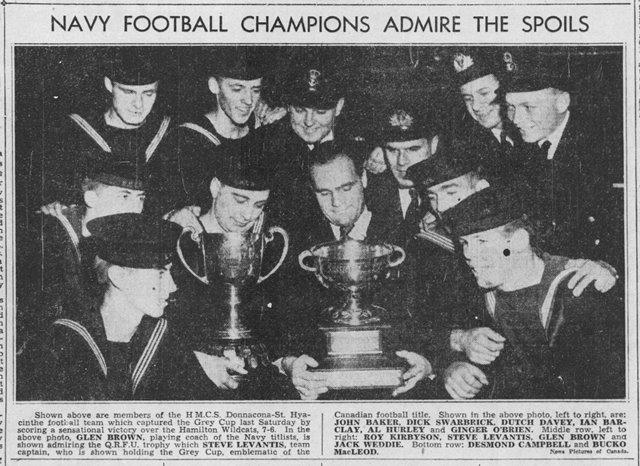
Photo courtesy the Montreal Gazette.
In the days following, it was revealed that a bouquet of daisies appeared in the Navy dressing room prior to the game with a taunting telegram supposedly from the Wildcats manager. It called the sailors a “bunch of kids” and they would take an awful trouncing from the Cats. This may have been the catalyst that spurred the sailors on to upset the favoured Flying Wildcats. It was later revealed the telegram and flowers were actually sent by The Navy’s own coach.[23]
The Navy Combines win was truly an upset, many of the reporters that earned their living predicting sports, having failed to see the strength of the Navy Combines stated that the competition for the Grey Cup should have been suspended until after the war, calling both teams’ amateurs and neither possessing the quality of a true football team. One reporter went as far to state that every team that ever beat the Navy Combines should be entitled to a rematch to win the cup. Absent from these tirades was the Canadian Rugby Union that oversaw the sport and both the Hamilton Flying Wildcats and the Navy Combine Team.
The rhetoric was so great that the RCN even suggested the Grey Cup be returned. The Navy Combines did attempt to return the cup to the CRU. The offer was refused and the cup promptly sent back. Stating the Navy Combines won the trophy and had earned the right to hold it.[24]
With the football season over, the sailors continued with their duties in the RCN as they had done throughout the football season. In 1994 the players from the Navy Combines received their Grey Cup ring celebrating the 50th anniversary of their win.
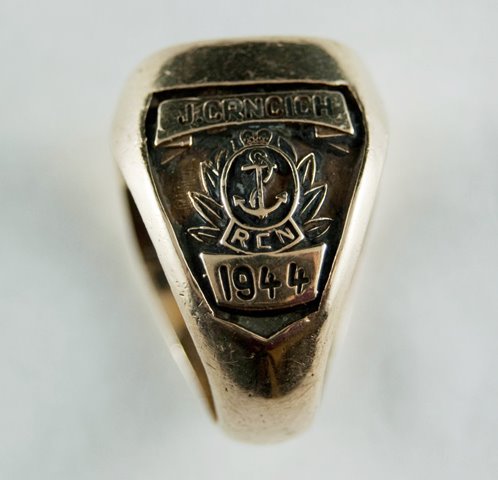
In 1994, on the 50th anniversary of their Grey Cup victory, team members were given their Grey Cup Champion ring with the RCN (Royal Canadian Navy) insignia. This is the ring given to John Crncich.
COLLECTION: JOHN CRNCICH, THE MEMORY PROJECT, HISTORICA CANADA
The 1944 Grey Cup was the last time that an amateur team was permitted to play for the cup. The following year the professional teams returned to the field. This included the Hamilton Tigers. But with two professional football teams in the city competing for players and fans, neither was financially successful. In 1950 the Hamilton Tigers and the Hamilton Flying Wildcats merged and the Hamilton Tiger-Cats took the field.[25]
The Royal Canadian Navy continues a strong relation with the CFL. Often Naval Reserve Units provide a colour party to opening ceremonies at stadiums across the country. The Navy’s ships named for communities with CFL teams routinely fly the respective team flag from their halyards on game days, exchanging messages of support from the ship’s companies to the players.
The ultimate honour of delivering the Grey Cup all stems from,
“That time a Royal Canadian Navy team won the Grey Cup!”
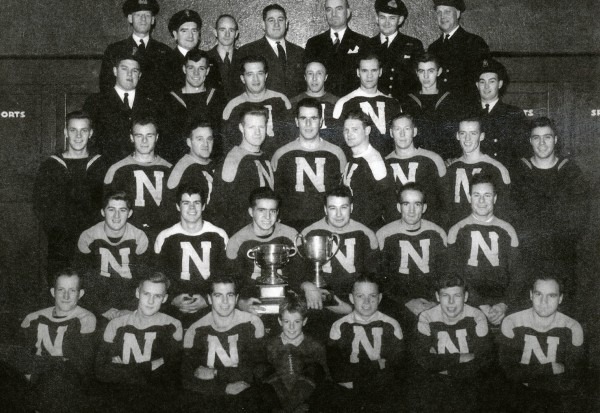
The 1944 Grey Cup Champion Team, the Navy Combines from HMCS DONNA CONNA and HMCS ST. HYACINTHE in Quebec.
Left to Right, first row: Charlie Elson, W. Charron, D. Hiltz, K. Clarke (mascot), Ginger O’Brien, Bucko McLeod, Coach Glen Brown. Second Row: Roy Kirbyson, John Taylor, J. Crncich, Steve Levantis, Jack Wedley, Al Hurley. Third Row: W. Patch, M. Baker, Hal Chard, T. Bainbridge, Ian Barclay, Sam Abbott, J.L. Leonard, Dick Swarbrick, Pat Santucci. Forth row: Dutch Davey, Mickey McFall, D. Katovitch, J. Spicer, D. Campbell, L. Raymond. Fifth row: WO John Montaque, PO George Reid, Bill Kydd, assistant coach “Slug” Sequire, assistant coach Fred Porter, honorary president Surgeon Lt. Cmdr. R.A. Lane, Lt. Chris Ellis. Photo courtesy The Montreal Daily Star.
Additional Reading:
- John Ward, “When the Navy Won the Grey Cup,” Legion, Canada’s Military History Magazine. Website Accessed 20 November 2023. https://legionmagazine.com/when-the-navy-won-the-grey-cup/
- Tommy Graham, “For P.T.’s Sake,” The Crow’s Nest, V3 N6, December 1944. P. 9. Accessed 20 November 2023. http://www.forposterityssake.ca/RCN-DOCS/CROWSNEST/Crow’s%20Nest%20-%20Volume%203%20Number%2006%20-%20December%201944.pdf
- “The Tea Bowl and the 1944 Grey Cup Champions – St. Hyacinthe-Donnaconas,” Canada’s Sports Hall of Fame. Website accessed 20 November 2023. http://canadasports150.ca/en/military-teams/the-tea-bowl-and-the-1944-grey-cup-champions/97
- “John Crncich,” The Memory Project, The Canadian Encyclopedia. Website Accessed 20 November 2023. https://www.thecanadianencyclopedia.ca/en/article/mpsb-john-crncich
- Steve Milton, “Ahoy! Grey Cup Shipped to Hamilton on HMCS HARRY DEWOLF,” The Hamilton Spectator, 13 November 2023. Website Accessed 20 November 2023. https://www.thespec.com/sports/football/cfl/ahoy-grey-cup-shipped-to-hamilton-on-hmcs-harry-dewolf/article_7d2db0c6-51b4-58bb-bd2a-4c56a84f945e.html
- Web Article: Frank Cosentino, Grey Cup, The Canadian Encyclopedia. Website accessed 20 November 2023. https://www.thecanadianencyclopedia.ca/en/article/grey-cup
- Web Article: Grey Cup Champions, Canadian Football Hall of Fame and Museum. Website accessed 20 November 2023. https://cfhof.ca/grey-cup-winners/
- Web Article: “Hamilton Tiger-Cats,” The Canadian Encyclopedia. Website accessed 20 November 2023. https://www.thecanadianencyclopedia.ca/en/article/hamilton-tiger-cats
If you enjoy the content I create and find value in the articles on this website, please feel free to click on the coffee icon on the bottom right of the webpage and “Buy me a Coffee!” Your contribution will ensure that I can continue to provide the stories of these incredible Canadians and the Canadian Navy. Thank you for your support. Cheers, Roger
Citations:
