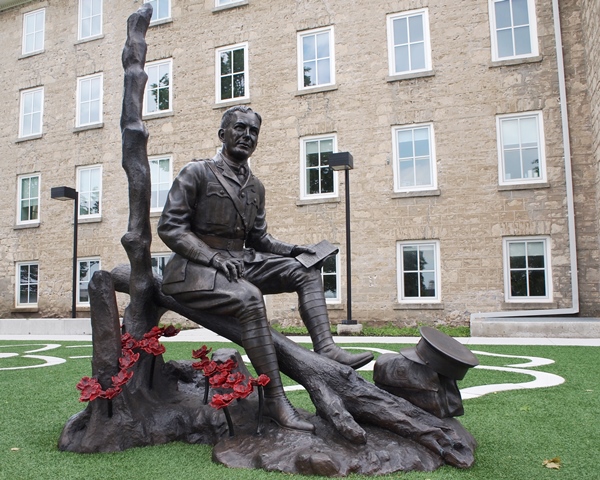
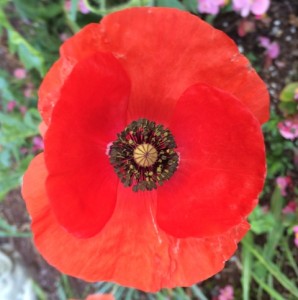
 Remembrance Day is upon us once again, and the bright red poppy adorns our breasts. For me the simple poppy took on a new meaning in 2014 and a strengthened resolve to wear this simple message with respect, honour and humility.
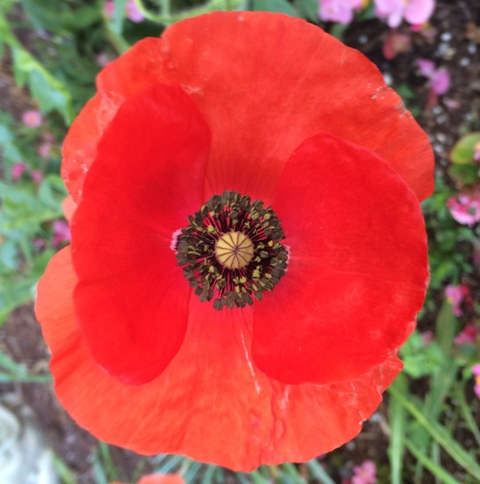
In 2014, my wife and I were away and missed Remembrance Day commemorations in Canada. Instead we were on a battlefield. Not the conventional battlefield that everyone thinks of during this time of remembrance. There were no trenches, no hilltop fortifications, no grand city to be liberated. The Battlefield we stood on was the Atlantic Ocean, but a battlefield just the same. There are no crosses row-on-row, no cenotaphs, no monuments, no graves to lay flags upon.
The ocean has known war throughout history. First in the days of wooden ships and later terrifying monsters of steel. Wars have been fought to “rule the waves,” it has seen in the past one hundred years the worst carnage mankind has wreaked upon ourselves. First in The War to End All Wars, known today as World War One.
Later during World War Two, thousands of ships were sent to the bottom in battles across all the oceans. Thousands upon thousands of sailors, merchant seaman, soldiers and airmen lay in unmarked watery graves. With no land to lay a cenotaph on, or mark a battle, these terrible sacrifices are all too soon forgotten.
Despite missing Remembrance Day in Canada, I was looking forward to being at sea and taking the time on 11 November to privately honour our Canadians who had made the ultimate sacrifice.
We arrived in the cruise ship in late October and I had brought with me a large bag of poppy’s knowing other Canadians may not have some with them. On November 1st we put on our poppy’s. Immediately we were asked, “Where did you get them?” “Do you have more?”
I was expecting this and had a pocket full. What surprised me was how many people from other nations, were asking for poppies.
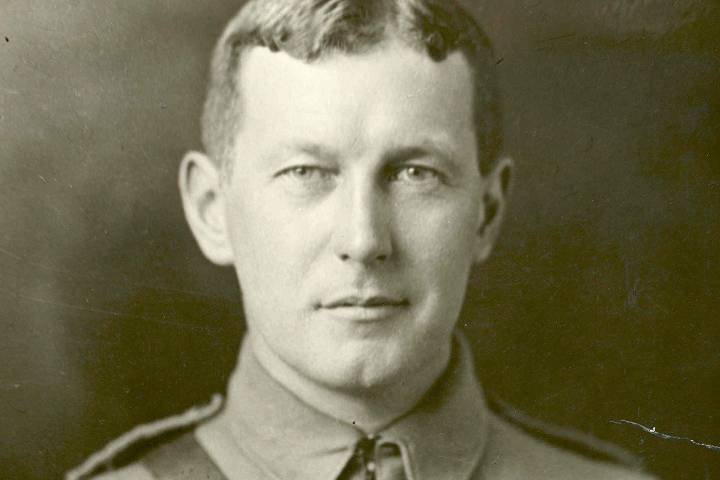
John McCrae
In Canada we learn the importance of the poppy and John McCrae’s poem at a very early age. We know he is Canadian. What I did not realize was how important John McCrae and his poem, In Flanders Fields is to many nations around the world.
I was approached by so many people, not only Europeans and the commonwealth, but around the world. Each person was willing to share why this simple blood red flower was important to them. Almost all described the same story, a simple poem, written over one hundred years ago has made the poppy a revered symbol of remembrance in their country.
Later I was honoured to come across a group of young cadets, standing on a corner of a downtown street, with boxes of poppies and collection jars, not in Canada, but in Barbados. These young teens knew exactly what their poppy stood for and were proudly wearing it on there immaculate uniforms.
As Remembrance Day quickly approached the staff of the cruise ship made plans for a service. I had to safeguard my poppy with diligence, I had emptied the bag I had brought with me and if I lost this one I would have to go without.
On 11 November 2014 we stood together with people from the UK, France, Belgium, Netherlands, Norway, Germany, United States, Poland, Russia, Italy, South America, Japan, and many more nations, tightly packed, shoulder to shoulder unable to move in the largest part of the massive cruise ship. Amongst us stood many veterans, some from World War Two.
Together as one, we honoured our brothers, sisters, fathers, mothers, sons and daughters, who had made the ultimate sacrifice in war. There were no victors or aggressors.
As each nation honours Remembrance Day in there own way, this was a simple but powerful service. A few words were spoken by the Captain of the ship, In Flanders Fields was read, a perfect and pristine silence overcame the passengers and crew gathered. Tears were shed as the mournful melody of Last Post resounded throughout the ship from a lone bugler perched high above the crowd.
For me, this was one of the most moving experiences I have ever had during Remembrance Day.
I encourage you to wear a poppy in the days leading up to Remembrance Day and on November 11th, take the time and attend a Remembrance Service, wherever you are.
This simple blood red flower, immortalized by a Canadian Doctor in a poem, written on the Battlefield has united so many nations, divided by war. Unfortunately for John McCrae, he never learned of the impact his words would have on humanity, as he too became a victim of World War One.
Below is John McCrae’s poem, In Flanders Fields. I invite you to read it aloud and listen to your own voice as you say the words. I know that you will quickly discover how moving and deeply personal this poem is to each of us.
In Flanders Fields
John McCrae
In Flanders fields the poppies blow
Between the crosses, row on row,
That mark our place; and in the sky
The larks, still bravely singing, fly
Scarce heard amid the guns below.
We are the Dead. Short days ago
We lived, felt dawn, saw sunset glow,
Loved, and were loved, and now we lie
In Flanders Fields.
Take up our quarrel with the foe:
To you from failing hands we throw
The torch; be yours to hold it high.
If ye break faith with us who die
We shall not sleep, though poppies grow
In Flanders Fields.
Lest We Forget
