
Dr Charles H. Best, Surgeon Captain, RCNVR in 1943. Photo courtesy University of Toronto.
Many know the name of Dr Charles Best for his fame as co-founder of Insulin with Dr. Frederick Banting in 1922 at the University of Toronto. Very few people realize that Dr. Best served Canada in two World Wars and his work for the Royal Canadian Navy saved many sailors lives and continues to influence their lives at sea today.
Charles Best was born 27 July 1899 to Canadian parents in Pembroke, Maine. Lulu and Herbert Best, a physician had moved to Maine from Nova Scotia to begin his practice. In 1915, young Charles moved to Toronto to begin University.[1]
With the First World War raging, shortly after his 18th birthday Charles set aside his education and joined the 70th Battery, Canadian Expeditionary Force at Toronto on 23 May 1918. After training in Petawawa, ON, which included a short hospital stay for dysentery, Gunner Best was sent overseas.
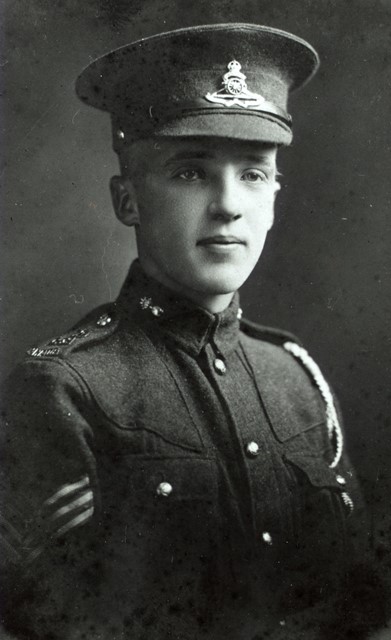
Sgt. Charles H. Best, 2nd Tank Battlion, 70th Artillary, CEF in 1918.
His unit sailed for England on 4 October 1918 in SS Victoria, successfully crossing the U-boat infested Atlantic without incident. On arrival Best was assigned to the 2nd Tank Battalion as a driver and promoted to Sergeant. Training began immediately in preparation for transfer to the frontlines in France.
Fortunately the war ended less than a month after Sergeant Best’s arrival on 11 November 1918. The 2nd Tank Battalion was returned to Canada on 22 November 1918, sailing in SS Aquitania to Halifax. Best was honourably discharged on 11 January 1919.[2]
Best returned to complete his undergraduate degree in Physiology and Biochemistry, working as a research assistant to Professor J.J.R. Macleod. In 1921, Macleod offered Best’s services to Dr. Frederick Banting, who was starting experiments to find a pure form of Insulin to treat diabetics. That May, Banting and Best set up their work in a small lab at the University of Toronto and began work. It took several weeks for the two men to produce insulin that was consistently able to lower the blood sugar in depancreatized dogs.

Banting and Best (Lt) with a dog on the roof of the Medical Building, University of Toronto. Photo courtesy of University of Toronto.
By January 1922 the insulin was ready for human testing and the first administration took place at Toronto General Hospital. Banting and Best continued their work and insulin went into large scale production. That fall Charles Best, following in his father’s footsteps, entered Medical School at the University of Toronto, graduating in 1925.
Dr. Best formed a team of researchers at the University of Toronto, continuing the research on insulin and began work on a purified form of Heparin. By 1935, Heparin was being used successfully in open heart surgery and is vital in Cardiac and organ transplant surgeries today.[3]
With the outbreak of war in 1939, Best initiates the Canadian Blood Serum Project, producing a dried human serum that could be administered anywhere. Best’s research team worked with the Connaught Anti-toxin Laboratories, the Canadian Red Cross, and the financial support of the Canadian government and led to the formation of the Canadian Blood Service.[4]
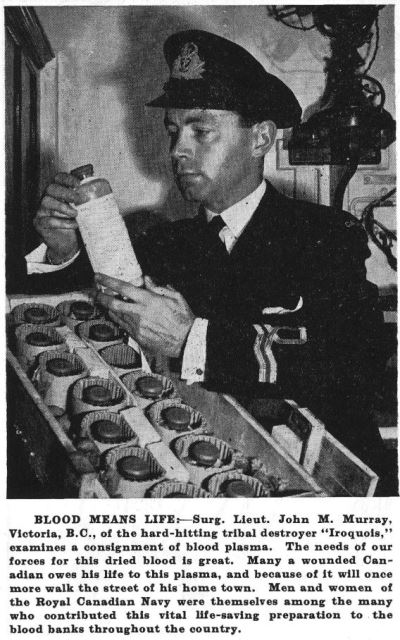
Photo courtesy, The Crow’s Nest Magazine, Special Edition, June 1945, Volume. 3 Number 12
Looking to play a more direct role in the war effort, Banting and Best decided to enlist. Dr. Banting had served in the Canadian Army Medical Corps during the First World War and once again offered his services. Sadly he was killed on 20 February 1941 in a plane crash in Newfoundland while flying to England.
Best enlisted in the Royal Canadian Navy and was appointed Dr. Charles Best, Honourary Surgeon Lieutenant Commander (Surg. Lt-Cdr), RCNVR on 16 June 1941.[5] Many of his research staff at University of Toronto also joined the RCN.[6]
Surg. Lt-Cdr Best was assigned to the RCN’s Naval Medical Research Committee and sent to the Navy’s east coast base, HMCS STADACONNA at Halifax. While there he was accommodated in HMCS VENTURE, the only sailing ship in commission with the RCN at the time.[7] This allowed Best an opportunity to experience what Canadian sailors were doing first hand. One of Best’s priorities became the development of a sea-sickness pill, when he became deathly ill during a voyage in one of the corvettes.[8]
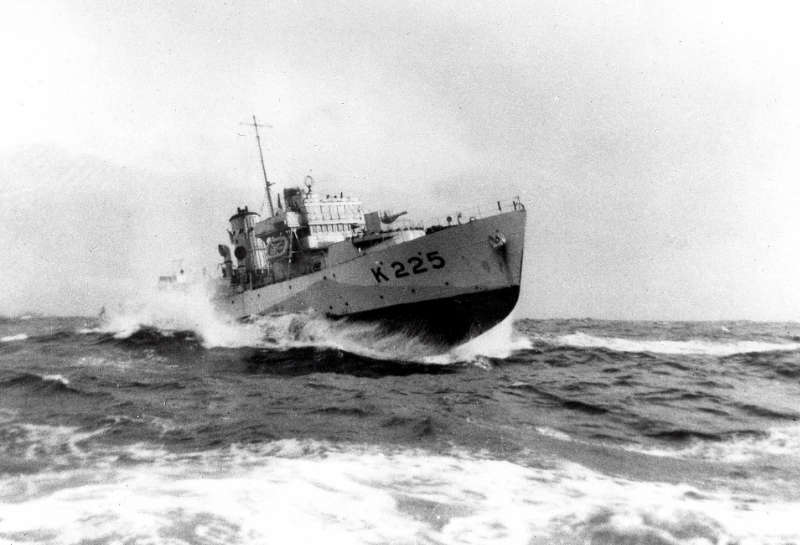
Corvette’s were notorious for rolling and could cause sea sickness for even the saltiest of sailors. HMCS KITCHENER at sea during WWII. Photo courtesy, For Posterity’s Sake.
On 19 January 1942, Best was transferred to Naval Service Headquarters in Ottawa and attached to HMCS BYTOWN, where he became director of the RCN’s Medical Research Unit[9] and later promoted to Surgeon Commander (Surg. Cdr).[10]
Some of the research work conducted by Surg. Cdr Best led to the RCN Pattern Lifejackets with blast protection for sailors that had to abandon their ships and faced certain death if the depth charges exploded as their ship sank beneath them. Other protective clothing was produced to fight against the cold harsh North Atlantic.
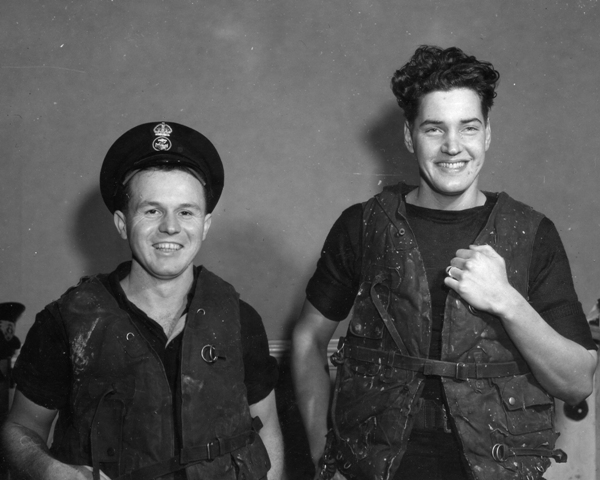
Petty Officer Ray Lounsbury (right) and Petty Officer Bernard Roden , both of Vancouver, BC. demonstrate the RCN issue lifejackets that saved their lives when HMCS TRENTONIAN was torpedoed on 22 February 1945.
Roger Litwiller Collection, courtesy Douglas Campbell, RCNVR.
For those unfortunate navy and merchant sailors that were forced to abandon their ships, Best’s research teams developed a high energy survival bar kept in the emergency kits in the life rafts.
Another area Best identified, was research on improving the vision of the gunners in the ships. He developed special goggles, with rose coloured lenses that allowed the gun aimers to follow the tracer fire directly into the sun and helped reduce flash blindness during night firing.[11]
Promoted to Surgeon Captain (Surg. Capt) on 1 July 1943,[12] Best became one of the most senior medical officers in the RCN. On 8 January 1944, Surg. Capt Best was awarded, Commander of the British Empire for his earlier work producing blood serum, a discovery responsible for saving countless military and civilian lives.[13]
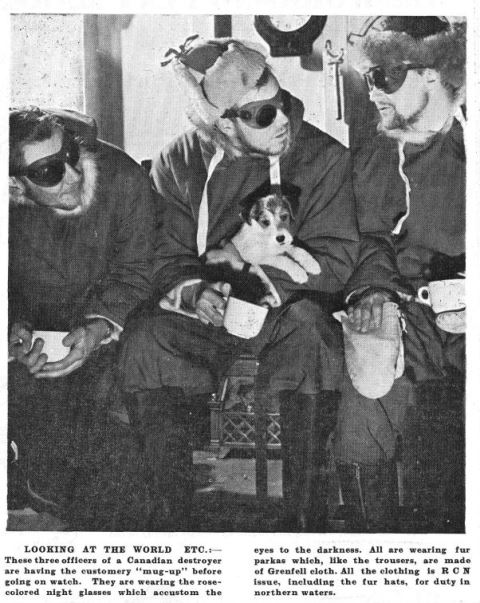
Photo courtesy, The Crow’s Nest Magazine, Special Edition, June 1945, Volume. 3 Number 12
A month later Surg. Capt Best was transferred to Toronto and attached to the Naval Reserve Unit HMCS YORK to continue his research using his labs at University of Toronto.[14] Many of his original research team rejoined him.
Most of his research was conducted in the labs, when physical research was required for work on the sea-sickness pill, the facilities at HMCS YORK was an ideal location. To test the effects of motion sickness a moving seat was developed with ropes and pulleys to simulate the three dimensional motion of the waves. Many of YORK’s sailors volunteered as Guinea pigs, taking a turn to sit in the stomach turning contraption affectionately dubbed HMCS Mal-de-Mer.

Photo courtesy, The Crow’s Nest Magazine, February1944, Volume. 2 Number 8
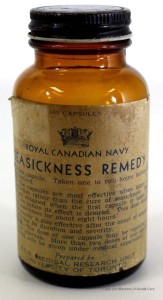
The results of these nausea inducing experiments was a little pink pill for sea sickness. Many praised the little pill, while others scoffed at it. Surg. Capt Best, himself defends his sea sickness pill as the best prescription yet devised.[15]
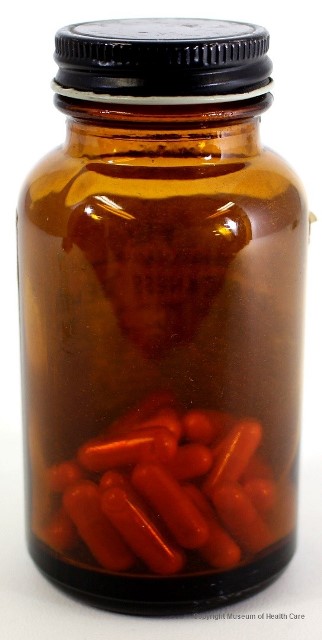
RCN Seasickness Remedy. Photo from The Collection of the Museum of Health Care at Kingston.
Perhaps one of Best’s greatest contributions to the RCN and sailors of continuing generations was his work in night vision. His research found that red light allowed the eyes to easily adjust at night from complete darkness to a lit interior of the ship. Very quickly red lighting was installed in Canadian warships, followed by Canada’s allies.[16]
At the end of the war, Dr. Best returned to his civilian medical research. He remained with the RCN transferring from the Royal Canadian Navy Volunteer Reserve to the RCN (Reserve) when the RCNVR and RCNR were combined in January 1946.[17]
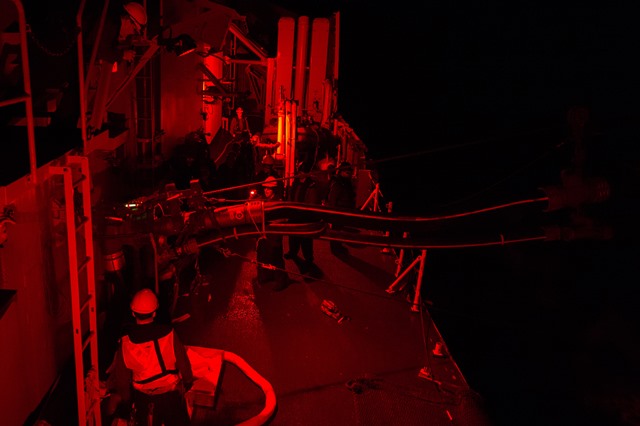
Under red light sailors in Her Majesty’s Canadian Ship (HMCS) Toronto conducts a night time Replenishment At Sea (RAS) with the French Supply Ship A630 Marne on October 20, 2014 during Operation REASSURANCE in the Mediterranean Sea. RCN Photo. (HS2014-A158-014)
Dr. Charles H. Best, Surgeon Captain, RCN(Reserve) last appears on the Royal Canadian Navy List as Active in January 1960, still attached to HMCS YORK in Toronto. He passed away in 1978 in Toronto.
Of all the discoveries by Dr. Charles Best, probably the most used by sailors around the world and likely the least known, each night as the sun begins to set, every sailor welcomes the warm glow when the red lights come on once again.
For additional reading on the incredible career of Dr. Charles H. Best and his contributions to Canada’s Navy, please see the links below.
Biography of Charles Herbert Best (1899-1978), University of Toronto
LIFESAVER IN A LAB COAT, Gerald Anglin, Maclean’s Magazine, June 1 1948
Stoker Mahoney and Pill No. 2-183, John Rhodes Sturdy, Maclean’s Magazine, February 14 1959
The Sea-Sick Pill
By Gordon D. MaCallum, ERA
Originally Published,
Crow’s Nest Magazine, July 1944, Vol 3, No. 1
Navy Men so bold and brave
You cannot make the sea behave;
So now a pill of pretty pink,
Calms it like a kitchen sink.
You need not fear the waves so high,
Nor all the antics ships will try.
You only need a pill or two
To face the worst the sea can do.
For some, of course, it does the trick,
They no longer get sea-sick.
Others from the pills obtain
Naught to stop the retching pain.
According to the buzz I’ve got,
Oh! This one’s good, I got it hot.
It came right from the source you see,
That all the pills don’t go to sea.
It seems that at the good ship “York,”
Where nothing floats, ‘cept maybe cork,
There is a craft named “Mal de Mer,”
That rolls and tosses, gets nowhere.
Now all the lads of Navy rig,
Cox’n, Stoker, and even Sig,
Must weather thru’ an hour’s trip
Aboard Macdonald’s latest ship.
It lets you know the power of
The pill you took a sample of.
Now should it fail” it sometimes will,
Sea life for you will hold no thrill.
Now I don’t want to frighten you.
But green will be your facial hue.
Whenever you forget to take,
The pills our Wrens and Doctors make.
If by some chance you don’t agree
Upon the rhyming that you see,
This poem is only to remind
Of all the meals I’ve left behind.
By God’s good grace, and the Navy’s best,
We’ve found an answer, not without test,
To the age-old dread of all who sail
Upon the sea, but o’er the rail.
If you enjoy the content I create and find value in the articles on this website, please feel free to click on the coffee icon on the bottom right of the webpage and “Buy me a Coffee!” Your contribution will ensure that I can continue to provide the stories of these incredible Canadians and the Canadian Navy. Thank you for your support. Cheers, Roger
