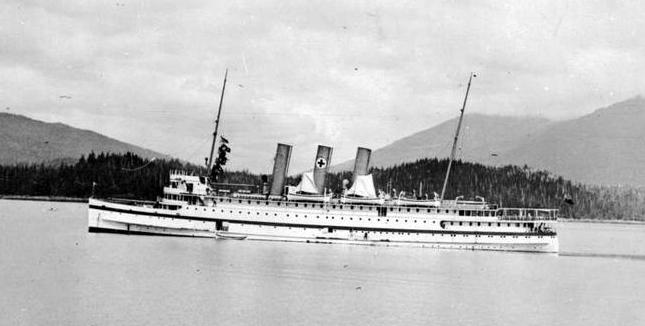

Postcard SS Prince George
The legacy of women serving in Canada’s Navy is legendary, beginning in 1914 in the early days of the First World War. Six nurses joined the Royal Canadian Navy and served in His Majesty’s Canadian Hospital Ship (HMCHS) PRINCE GEORGE.
At the time, concern was not given to making history or furthering women’s rights, in fact women did not have the right to vote at this time. This was an emergency commission of the Grand Trunk Pacific Railways passenger liner SS Prince George.
To fully understand the circumstances surrounding the RCN acquiring HMCHS PRINCE GEORGE and Vice-Admiral Kingsmill personally authorizing the first women to enroll in Canada’s Navy, a little background is needed.
In the opening hours of the First World War it was Canada’s West Coast that was under immediate threat of attack.
When Canada went to war on 4 August 1914, there were only three commonwealth ships on the Pacific Coast of North America. Two Royal Navy sloops, HMShips ALGERINE and SHEARWATER, both ships had been part of a multi-national force operating off Mexico on 31 July, protecting British Subjects during a civil uprising. Part of the force included the modern German cruisers, LIEPZIG and NÜRNBERG.

HMCS RAINBOW. Painting by Marc Magee.
The third ship was the RCN cruiser HMCS RAINBOW commanded by Commander Walter Hose, RCN, located at Esquimalt, BC. She was already quite old and had been relegated to the duties of a training ship. On 3 August RAINBOW was ordered to sea and guard trade routes south to the Equator in preparation of possible hostilities. Although she carried 6 inch guns she was no match for a modern cruiser.
On 4 August, SHEARWATER and ALGERINE were ordered to proceed with all speed to Esquimalt. Intelligence reports place LEIPZIG giving chase, possibly accompanied by NÜRNBERG. When war was declared that same day, RAINBOW became the first RCN ship to be at sea on an active war patrol.
RAINBOW’s orders changed, Cdr Hose received the following message from the British Admiralty,
“NURNBERG and LEIPZIG reported 4th off Magdalena Bay steering North. Do your utmost to protect ALGERINE and SHEARWATER, steering North from San Diego.
Remember Nelson and the British Navy. All Canada is watching.”
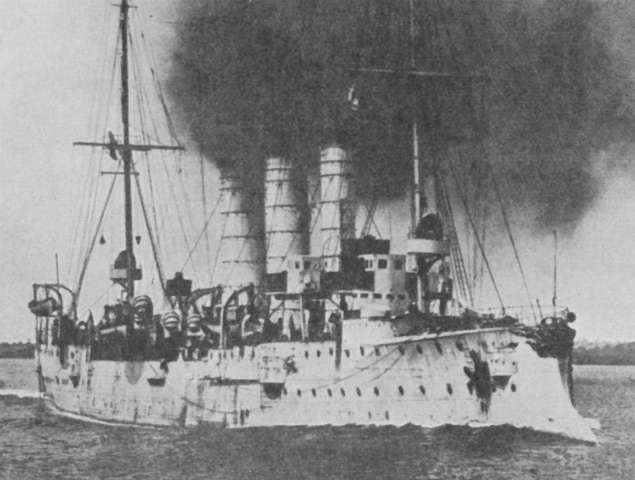
SMS LEIPZIG
The anticipated battle between RAINBOW and two German cruisers was not expected to go well for the Canadian sailors. Already twenty-one years old, she had sailed on 3 August with only half of her normal ship’s company and one third of her sailors were Naval Reserve Volunteers that had only joined a month before. She also lacked the modern munitions for her guns as none was available on the West Coast.
The RCN decided to take over a civilian ship that could operate as tender to RAINBOW and also provide a seaborne hospital for a large number of causalities. When a satisfactory ship to act as tender could not be found, the decision was made to prepare a hospital ship to follow RAINBOW on her patrol.

SS Prince George. Photograph by Walter E. Frost
Enter the Grand Trunk Railways passenger liner SS Prince George. Only four years old, she had worked along BC West Coast sailing from Victoria, Vancouver, Prince Rupert and Seattle. She was a fast ship at 19 knots and had three distinctive funnels with a cruiser type stern.
By the morning of 8 August RAINBOW was patrolling an area off San Francisco and no news of ALGERINE and SHEARWATER. The urgency for a tender/hospital ship took on a sudden urgency when National Defence Headquarters in Ottawa sent a message to Esquimalt, “Absolutely necessary tender be ready as Hospital Ship immediately. Expect action near Cape Flattery within 48 hours. You must do all you can. If no stores of ammunition on board can hoist red cross.”
A message was sent to Grand Trunk that their ship Prince George was to sail immediately for Esquimalt. When she arrived later that day an RCN officer was waiting for her and presented her master, Captain Dan Donald with a letter that his ship was being taken over for immediate use by the RCN. As passengers were being escorted off the ship from the forward gangway the RCN was moving supplies and material into the ship from the aft gangway.
At 1600, Esquimalt replied NSHQ urgent message, “Preparing GTR boat “PRINCE GEORGE” for Hospital Ship. Ready for sea 8 p.m. to-day. Request instructions.”
A unique crew configuration was needed. As there were not enough naval personnel to fill RAINBOW’s ship’s Company, Prince George’s civilian crew was retained including her master Capt. Dan Donaldson. Lieutenant Arthur Marshal Kinnersley Saul, RCNR was appointed as Commanding Officer with forty RCN personnel. It is interesting to note this mixed naval and civilian crew configuration would be repeated in 2017 with MV ASTERIX entering into service with the RCN and an auxiliary oiler.
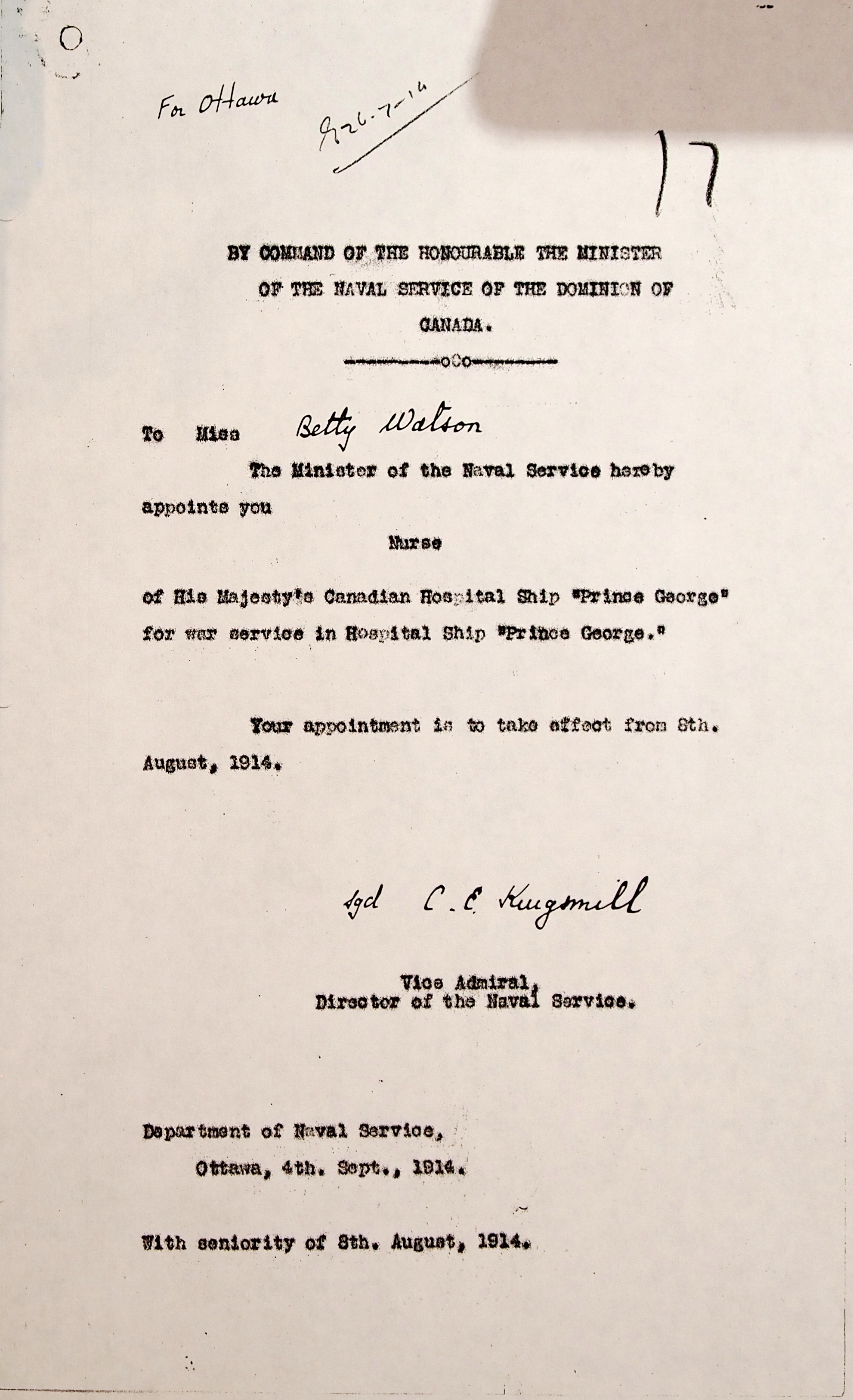
One of six letters signed by VAdm Kingsmill appointing PRINCE GEORGE’s nurses into the RCN in 1914.
Surgeon Charles Barron Wainwright, RCNVR was appointed as Principal Medical Officer. In the days leading up to Prince George entering service he gathered his medical staff. This included six nurses from the Hospitals in Victoria.
Miss Elizabeth Pierce from Ontario became the head nurse. She was joined by Miss Emma Gertrude Black from Fort William (Thunder Bay), Ont, Miss Annie Dover, Miss Mabel Ogilvie Lindsay, Miss Penelope Mellen and Miss Bessie (Betty) Irving Watson. All six women reported for duty in Prince George.
The urgency to sail was delayed and work continued to improve Prince George’s capability as a Hospital ship continued. An operating room was built in the crew quarters, decorative staterooms were cleared for hospital wards, and elevators were enlarged to accommodate stretchers. She was ordered to Vancouver on 10 August to pick up supplies and begin painting ship in her Hospital Ship colours, providing protection from attack under the Geneva Convention.
The next day, SS Prince George was commissioned into the RCN and became HMCHS PRINCE GEORGE and ordered to sail immediately to meet HMCS RAINBOW. The painting of the ship had not been completed and when she sailed her port side had received the proper Hospital Ship colours, all white with a green strip on her hull, while the starboard side remained in her original Grand Trunk colours. A large red cross had been painted on her centre funnel.
RCN Hospital Ship HMCHS PRINCE GEORGE
Commissioning of PRINCE GEORGE marked several significant “firsts” for Canada. She remains the only hospital ship to be commissioned into the RCN and the first hospital ship to enter service within the Commonwealth during the First World War. Her most significant achievement was the first time women sailed in a commissioned RCN ship as members of the RCN.
Later Vice Admiral Charles Kingsmill, RCN, Director of the Naval Service would sign letters for each of the six nurses appointing them into the RCN as officers, effective 8 August 1914.
By now RAINBOW was low on fuel as she was unable to draw coal, due to American neutrality law and had sailed from her patrol off San Francisco heading north towards Esquimalt on the 10th of August.
On 12 August, RAINBOW’s lookouts spotted a three funnel ship with cruiser characteristics and expecting to find a German cruiser of the same appearance, turned away. Cdr Hose would later state he turned to clear for action, expecting the battle to be a stern chase. There has been considerable criticism of this action.
The first meeting between PRINCE GEORGE and RAINBOW involved the cruisers guns pointed at the incompletely painted hospital ship, until she was identified. PRINCE GEORGE passed on the orders she carried for RAINBOW to return to Esquimalt to receive the proper ammunition for her guns that had been rushed by train from Halifax and additional sailors taken from HMCS NIOBE.

Typical WWI Canadian Nurses Uniform.
On 13 August RAINBOW with PRINCE GEORGE located HMS SHEARWATER 20 miles from Esquimalt. Not having a radio on board, SHEAWATER’s first message asked if war had been declared. The sloop was escorted into Esquimalt and all three ships arrived later that day.
Rainbow was quickly coaled and immediately returned to sea with PRINCE GEORGE in search of HMS ALGERINE. Latest intelligence reports placed both LIEPZIG and NÜRNBERG steaming north at full speed. RAINBOW had taken on the shells for her guns, but the fuses for the rounds had not arrived, she remained seriously disadvantaged in an action with the German cruisers.
ALGERINE was located on the 15th off the Washington coast near the Caroll Islands, her first message to RAINBOW, “Damn Glad to See You!” All three ships returned to Esquimalt on the 15th and the fuses for RAINBOW were waiting for them.
RAINBOW, with PRINCE GEORGE shadowing, left Esquimalt on 18 August with the orders,
“Proceed and engage or drive off LEIPZIG from trade route: do not follow after her. You should cruise principally off San Francisco.”
PRINCE GEORGE had received a message from the Senior Naval Officer in Esquimalt,
“You are hereby cautioned that you are to behave when at sea with absolute neutrality observing that any breach will endanger the lives of the women who have so gallantly volunteered their services as nurses.”
RAINBOW’s orders were rescinded later that day and both ships returned to Esquimalt.
On the 20th RAINBOW was ordered to investigate a sighting of a cruiser near Prince Rupert and sailed immediately. PRINCE GEORGE was sent to PRINCE RUPERT to wait further instructions. After conducting a search of the area, Cdr Hose brought RAINBOW into Prince Rupert to gather information on the sighting and he met with Lieutenant Saul, Hose instructed PRINCE GEORGE’s Commanding Officer,
“It was far too gruesome to be followed by a hospital ship all the time and (Prince George) had better remain in Prince Rupert until she was required.”
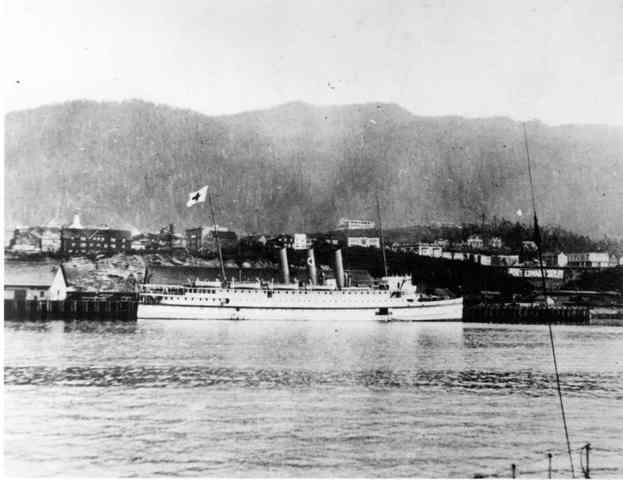
HMCHS PRINCE GEORGE, in Prince Rupert, BC in August 1914.
With limited fuel supplies in Prince Rupert, PRINCE GEORGE was ordered back to Esquimalt arriving 31 August. RAINBOW returned on 2 September without finding the German Cruiser.
The need for RAINBOW as a first line of defence diminished when Japan entered the war and the cruiser IDZUMO arrived in Esquimalt soon followed by HMS NEWCASTLE, both modern cruisers took up patrols. Also two submarines, purchased by the BC Government and transferred to the RCN were also available.
There was no longer a need for a hospital ship and as PRINCE GEORGE could not act as a tender, the decision was made to pay her off and return the ship to Grand Trunk Railway. VAdm Kingsmill visited the hospital ship on 2 September, thanking the nurses, medical staff, RCN and Merchant sailors for their service and made the announcement that their ship would not sail again.
Landing of stores began immediately and the six nurses returned to civilian life. PRINCE GEORGE was officially paid-off on 4 September. Work commenced to return the ship to the same state as she was as a passenger liner. Following a brief period in the drydock she was officially returned to Grand Trunk on 30 September.
Fortunately for all concerned, records show only two patients were treated in PRINCE GEORGE during her brief thirty-three day service in the RCN. A sailor from the Japanese cruiser IDZUMO was treated for a broken leg and one of the nurses twisted an ankle.

SS Prince George after her return to passenger service. Photograph by Walter E. Frost
On 4 October SS Prince George sailed from Victoria to Seattle, Washington, resuming her normal passenger service, never having realized the full importance she had played in Canadian Naval History.
Women would not have an official role in Canada’s Navy until 31 July 1942 with the formation of the Women’s Royal Canadian Naval Service (WRCNS). Over 6,000 women joined the WRCNS and served with distinction in 39 trades in Canada and overseas, until the end of hostilities in 1945.
It would still take until 1951 for women to officially join the Royal Canadian Navy Reserves (RCNR) and another four years to join the RCN. Women would not go to sea again in an RCN ship until 1980 when the diving support ship, HMCS CORMORANT began trials of mixed gender ship’s company.
All of these milestones where a repeat of the accomplishments of RCN Nurses, Elizabeth Pierce, Emma Black, Annie Dover, Mabel Lindsay, Penelope Mellen and Betty Watson sixty-six years previous.
Since 2001, all trades in Canada’s Navy are open to women with the opening of the submarines service.
Discover more of the legacy women have contributed to Canada’s Navy. Women in the RCN -An Incredible Legacy
NOTE: If RAINBOW had been able to draw coal off San Francisco and not forced to leave her patrol area on 10 August, she would have met LIEPZIG. The German cruiser sailed into the area the next morning. The resulting battle could have led Canada’s Battle Cry, “Remember RAINBOW!”
If you enjoy the content I create and find value in the articles on this website, please feel free to click on the coffee icon on the bottom right of the webpage and “Buy me a Coffee!” Your contribution will ensure that I can continue to provide the stories of these incredible Canadians and the Canadian Navy. Thank you for your support. Cheers, Roger
