• Writing
    • Writing History -Get it right or else!
    • Just Tell The Story -The Best Advice I Ever Received
    • How I became an “Accidental Archivist!”
    • Finding the Perfect Place to Write
    • White Ensign Flying -My Inspiration
  • Maritime Affairs
    • Women in the RCN -An Incredible Legacy
    • HMCS IROQUOIS Exploits After VE Day
    • Unveiling MV Asterix, Resolve Class AOR
    • MV Asterix -Why Not HMCS ASTERIX?
    • MV ASTERIX -Exterior Tour of RCN’s Interim AOR
    • Throwing Away Canadian History, ex-HMCS ATHABASKAN to go to Breakers!
    • Ships For Victory -Can Canada Build Ships Today
    • The Canadian Maple Leaf -A RCN Tradition Honouring Our Sailors Past
    • RCN Could Chase Subs Underwater!
    • 10 Foot Model of RCN WWII Corvette TRENTONIAN
    • “Crest is for Teeth, Ship’s Have Badges” and Other Poor Naval Grammar
    • My Experience with a Rogue Wave on the High Seas
  • Paramedics
    • When Did I Become An “OLD FART!”
    • “Suck It Up Buttercup!” No Longer an Option for First Responders Facing Critical Incident Stress and PTSD.
    • Dedication Ceremony for Afghanistan Memorial in Trenton
  • Railroading
  • Roger’s Rambles

Roger Litwiller

Author and Naval Historian

  • Home
  • The Books
    • White Ensign Flying -The Story Of HMCS TRENTONIAN
      • Bonus Material
      • Published Reviews
      • Readers Comments
    • Warships of the Bay of Quinte
      • Published Reviews
      • Reader Comments
    • Canadian Emergency News
    • Esprit-de-Corps Magazine
  • The Author
    • Profile
      • Biography
    • Photo Art
    • Paramedics
    • Railroading
  • Research
    • Canada and the Battle Of Atlantic
      • Canada and the Battle Of Atlantic
      • Royal Canadian Navy -Victory’s/Losses Battle of Atlantic in World War II
      • Royal Canadian Air Force Submarine Attacks Battle Of Atlantic during WWII
      • Canadian & Newfoundland Merchant Navy Losses “Battle Of Atlantic in WWII
    • Royal Canadian Navy Pennant Numbers World War II
    • RCN Photos
    • Links
  • RCN Photo of the Day
  • Events
  • Contact
You are here: Home / Battle of The Atlantic / HMCS ESQUIMALT
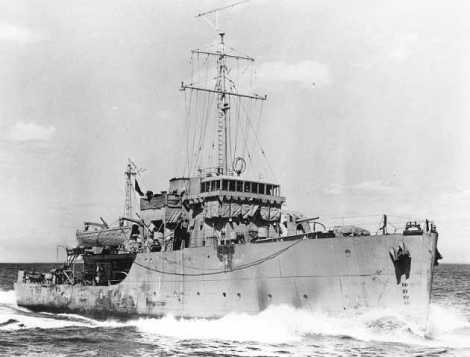
HMCS ESQUIMALT

HMCS ESQUIMALT

April 16, 2016 by Roger Litwiller

HMCS ESQUIMALT, Bangor class minesweeper, was torpedoed by U190 off Halifax on 16 April 1945. Forty-four sailors of her ship’s company of seventy-one were killed when she was lost.

Late in the day of 15 April, ESQUIMALT left Halifax to perform and anti-submarine sweep of the approaches to the harbour in advance of a convoy leaving for St. John’s, NL.  She was to be joined the next morning by another Bangor, HMCS SARNIA.  U190 was patrolling off the Halifax approaches and had taken a position near the East Halifax Light Vessel.  The submarines CO thought he had been detected and made an emergency dive and fired a single GNAT from her sterntubes, as he turned his submarine away from the approaching minesweeper.

At 0630 the torpedo exploded in ESQUIMALT’s starboard side in the engine room.  The minesweeper immediately began to sink and was gone in four minutes.  The ship’s whaler was already under water, still secured to the davits before it could be launched.  Several of the Carley floats could not be launched and the auto-release mechanisms did not work.

Many of ESQUIMALT’s survivors took to the frigid North Atlantic water.  SARNIA arrived at the rendezvous location alone and was distracted hunting a submarine contact.  She did not return to the rendezvous location until almost 1000, it was then that ESQUIMALT was reported as missing and a search began.

The light ship nearby did not see ESQUIMALT sink and later search aircraft mistook the Carley floats for fishermen.  It was six hours after the attack that SARNIA located the survivors, many of ESQUIMALT’s sailors died of exhaustion and hypothermia while waiting for rescue.

Despite an exhaustive search, U190 escaped the area.  The loss of ESQUIMALT is particularly sad as the war was over two weeks later.  U190 was still at sea when Germany surrendered and she was captured by HMCShips THORLOCK and VICTORIAVILLE off Newfoundland and taken to St. John’s.  The submarine was later moved to Halifax and commissioned into the RCN to be studied.

U190 was paid-off and used by RCN ships and aircraft as a target, sinking her near the location of ESQUIMALT’s final resting place on 21 October 1947.

Filed Under: Battle of The Atlantic Tagged With: Bangor class, Battle of Atlantic, Halifax, History, HMCS, HMCS ESQUIMALT, HMCS SARNIA, Minesweeper, Naval History, Navy, North Atlantic, RCN, Roger Litwiller, Royal Canadian Navy, ships, U190, WWII

About Roger Litwiller

Author, historian and lecturer of Canada's proud Naval heritage. Published books -White Ensign Flying, Warships of the Bay of Quinte. Retired Paramedic with 37 years service.

I am a storyteller, who can save your life!

Meet the Author

Author, historian and lecturer of Canada's proud Naval heritage. Published books -White Ensign Flying, Warships of the Bay of Quinte. Retired Paramedic with 37 years service.

I am a storyteller, who can save your life! Read More…

Follow for Daily RCN History posts!

  • 
  • 
  • 
  • 
  • 
  • 

Support the Research!

Thank you for your interest in discovering the legacy of Canada's Sailors by visiting my website. If you found value from the articles on this website, please support my ongoing research by clicking on the "Buy me a Coffee" icon on the bottom right corner. Your contribution will assist my continued work. Thank you!

Archives

© 2024 Roger Litwiller. All rights reserved. · Website by BUILD MARKETING