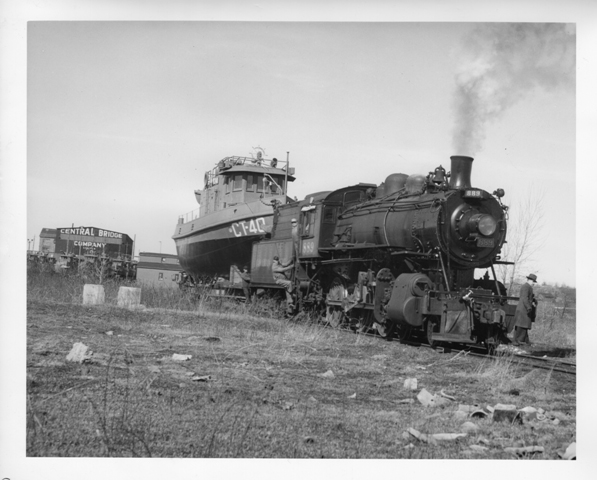
CP889 moves TANAC Tugboat CT40 completely finished from the Central Bridge Company’s plant in Trenton, Ontario to the launching area on the Trent River. The tug will travel almost two miles by rail on a specially designed flat car.
Photo courtesy, Trent Port Historical Society.
I have found some incredible photos of a shipbuilding industry that relied heavily on the Canadian Pacific Railway for its operations. The advantage to us layout builders is this shipbuilding industry could fit on almost any size layout.
At the start of WWII a prominent and well known boat builder, Herb Ditchburn, moved to Trenton, Ontario to construct eight rescue launches for the Royal Air Force. Ditchburn was the owner of Ditchburn Boats and designed and built the beautiful Muskoka boats. Many are still in use today and can fetch a very high price when one comes on the market.
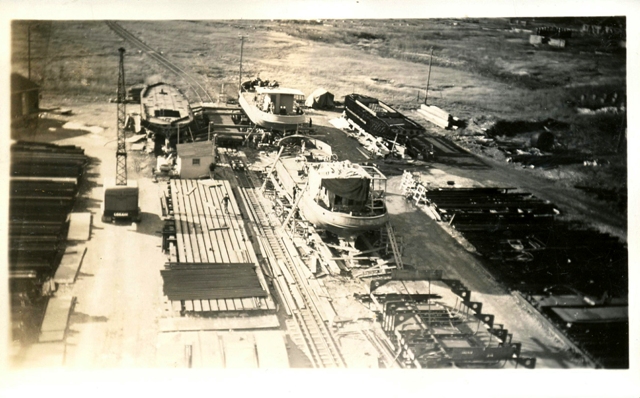
The above photo shows five of the ten lighters under construction at Central Bridge in Trenton, Ontario. Note the single rail line running through the site. At the top centre of the yard, a near finished ship is ready to be moved onto a specially designed rail flat car for transport to the Trent River, almost two miles away.
Photo courtesy, Trent Port Historical Society.
Ditchburn set up a factory on the banks of the Trent River. The launches were similar to a torpedo boat and were designed to race into the English Channel and rescue the air crew from fighters and bombers that had ditched while returning from attacks on Germany.
When this contract was complete, a local company had secured a contract to build ten ammunition and water lighters for the Royal Canadian Navy. Ships of all types and sizes were in very high demand and any industry that could weld two pieces of steel together was called on to build ships.
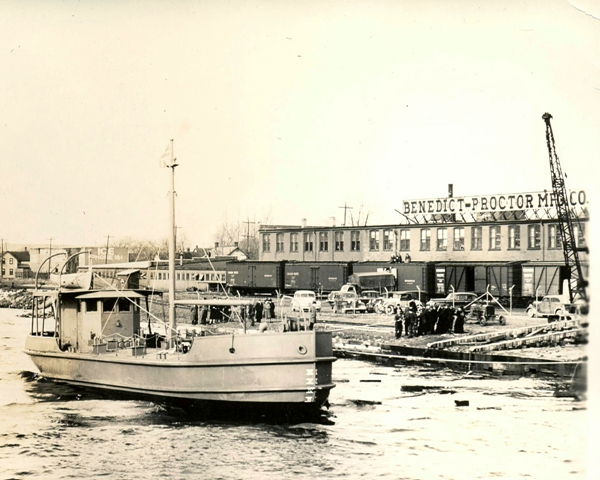
Tasting fresh water for the first time an 80 foot ammunition lighter has just been launched. The slip can be seen on the right side of the photo with the rail line running up to it.
Photo courtesy, Quinte West Public Library.
Hence, Central Bridge in Trenton was now a shipbuilder in addition to building airplane hangers and bridges. The company faced a very large problem from the onset. Building the 80 foot lighters was easy, launching the small ships was difficult. The factory was located two miles inshore from the Trent River.
The ships were constructed on site and moved by rail on a specially designed flat car to the river. The lighter was then transferred to a slip and was launched sideways into the water.
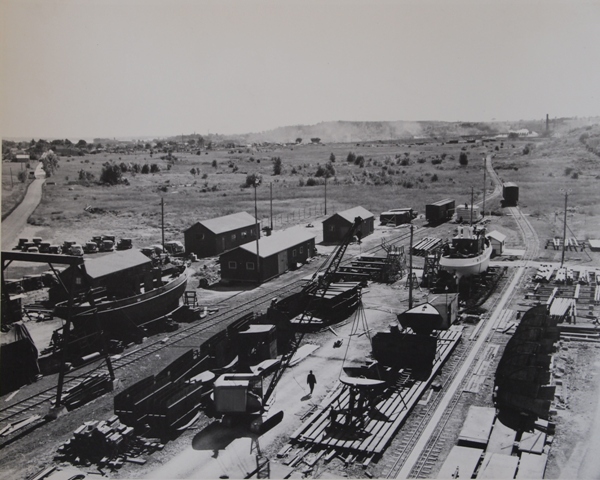
To accommodate the increase in ship building a second siding was constructed into Central Bridge. This photo was taken from the roof of the factory over looking the yard and gives a great perspective of the distance Central Bridge was from the Trent River. The large smokestack on the right of the photo is a paper mill located beside the river. The tug would travel by rail past the paper mill to the launching area located a mile further down river.
Photo courtesy, Trent Port Historical Society.
When this contract was finished, Central Bridge was given a contract to build 111 sixty-five foot TANAC tug boats. TANAC stands for Canada Tugs. These tugs were to be mass produced and were shipped all over the world.
The tug would then be moved onto one of the slips in the yard to finish construction. This is where; Ditchburn heavily influenced the construction of the tugs. All the components of the ship were pre-fabricated on site and the finished components installed on the hull, this included cabins, wheelhouse, winches, firefighting equipment, etc. At peek construction, Central Bridge was producing three tugs a week.

At sixty-five feet, the tugs were small enough to start construction inside the plant. The hulls were built upside down to make welding the steel easier. Once the hull was complete it was turned over onto a flat car and a CPR engine would pull the tug out of the plant.
Photo courtesy, Quinte West Public Library.
When the tug left the yard it was completely finished, the only stage that remained was launching. During the first year of this contract the tugs were transported to the river and launched sideways into the river, the same way as the lighters.
Again, Ditchburn’s shipbuilding experience made a dramatic change. That winter he had a long track laid from the water’s edge into the middle of the river. The entire track was built on top of the ice of the frozen river. In the spring when the ice broke up, the rail sank to the bottom of the river. Divers were sent to inspect the track and ensure the rail was solid and level.
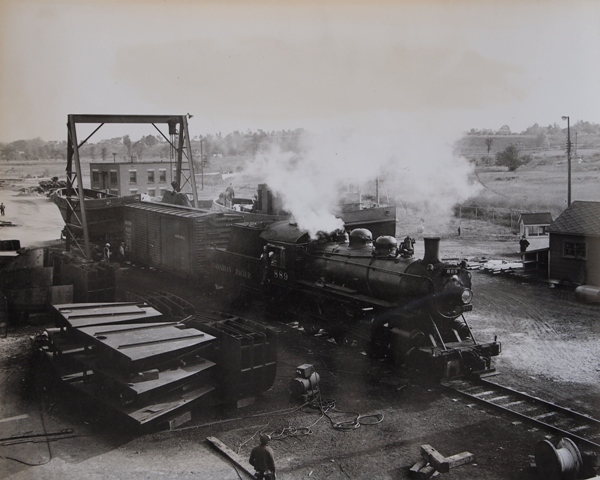
The tug was then moved under a crane and the diesel engine would be dropped into the hull. In this photo the top of the engine can be seen next to the hull, behind the boxcar.
Photo courtesy, Quinte West Public Library.
Now the tugs could be launched directly into the river. During the winter months, construction of the tugs continued and the finished ships were literally stockpiled at Central Bridge. With the new launching system the tugs were moved on to the flat car and pushed to the river by a CPR engine.  A winch car was then placed between the engine and tug. At the water’s edge the winch was released and the flat car rolled down the track into the river. Once it reached deep enough water, the tug simply floated off the flat car and the winch then pulled the flat car back to the train.
The tugs were completely finished when they were launched and the crew would start the engines and sail the ship under her own power to the dock. The CPR engine would then return to Central Bridge for the next tug.
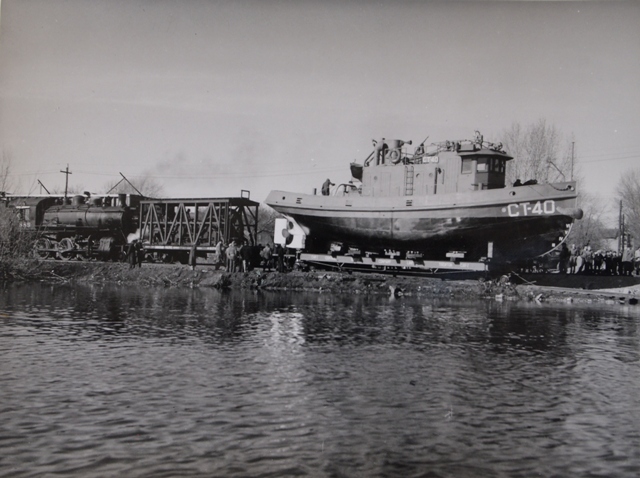
TANAC CT40 being launched from a specialized flat car. The winch car is next and the entire train is moved by a CPR engine. After the ice broke up in the spring, two to three tugs a day were being launched.
Photo courtesy, Trent Port Historical Society.
The tugs would complete their “sea trails” in the Bay of Quinte. Once accepted, they were formed into flotillas of twelve tugs and sail as a small fleet from Trenton, exiting the Trent River, crossing the Bay of Quinte and Lake Ontario. The fleet would then take the Erie Canal to New York City where they were loaded as deck cargo on a liberty ship and transported all over the world. Several of these tugs are still in service today.
This could be an interesting and unique industry to construct on a layout. Because the ships are 65 to 80 feet in length, the foot print on the layout does not have to be massive as most marine industries normally are. In fact the entire industry doesn’t even have to be on or near water.
The factory could be a building front, set against a back wall with the ship building yard occupying as little as 100 scale feet of layout space and only two sidings. Any period from steam to modern could be used for this industry.
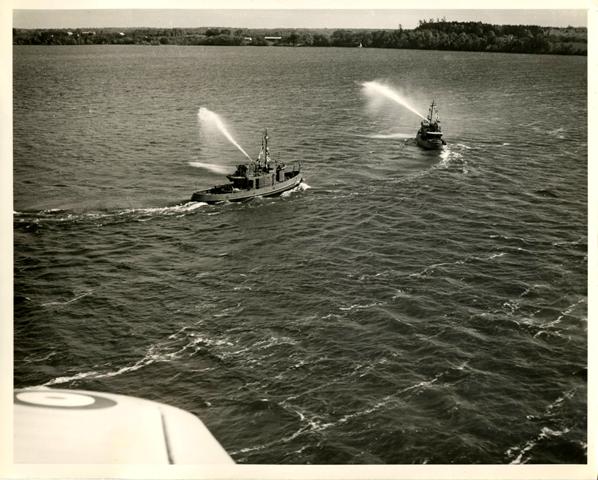
Two TANAC tugs photographed from a Royal Canadian Air Force plane while conducting their acceptance trails in the Bay of Quinte.
Photo courtesy, Quinte West Public Library.
Can you imagine the possibilities? Car loads of steel plate and beams for the hulls along with wood, pipes, large marine engines and everything else needed to build these small ships entering the plant area. Think of the added interest of a flat car leaving the plant with a finished tug, ready to be launched at a nearby river or waterfront.
If you are up to the challenge, post some design ideas in the comments.
