
Having an Engine Terminal on my layout was a “must have” in my consideration during the design process.
Engine Repair and Maintenance facilities have always fascinated me, therefore I had to have one on my layout.
I have also been more interested in the engines than rolling stock and have collected a fair number of engines from various railroads. Not wanting to display them on shelves, the Engine facilities had to be large enough to store several engines, ready for use.

Schematic of Engine Maintenance and Repair Yard and Car Shop.
The facilities include a fueling area, repair building, service building, turn table, engine storage area and car repair shops. I was able to include a turn around track with sufficient radius that I can turn a full passenger train.
All the sidings in the Engine Yard are isolated with remote switches to turn power on/off to each individual siding, providing ample storage space for my collection of engines.
The entire engine terminal and car repair shops occupy a triangular area of 3 feet by 5 feet and is independent of the mainline.
Laying the Track

Roughing in track for the Engine Yard.
Once I had designed the track arrangement for the Engine Facilities, it was time to lay track. I can’t stress enough how taking your time and ensuring that each piece is laid properly. Extra time and patience now will save allot of frustration later.
At this time the location of the buildings and turntable are roughed in.
I had to build this section in the centre of the layout and then move it to its final place in the corner. Once secured, I can reach it to fix problems, but too difficult a reach for construction.

Taking the time to ensure track and building will work, save many headaches later.
Roughing In
The track laid and tested thoroughly, its time to place the buildings, round table, roadways and hills.
Again its time to test the track! Use the longest cars, shortest cars, long engines. In short, use the poorest running equipment you have. If these can run smoothly then everything will work well.

I started the scenery with building the contours of the hills in the open areas of the Engine Yard followed by ballasting the track and finally the gravel roads.
Scenery
Now is the time to lay the concrete pads in the work areas, lay ballast on the tracks and turf on the hills. It still looks bare, but overall the area is progressing nicely.
The turntable, water tower and small brick service building is all that is left from the days of steam. The roundhouse was torn down years ago to make room for the diesel shop.

Test your track operation at every stage of the build. This will prevent headaches from being missed and major problem solving later.
Testing, Testing, Testing!!!
With the ballast in place, it is time to test the track again! Vigilance now will save headaches later. Â Attach power to the track and run your worst operating engine. Â If you can get this engine to run smoothly on the tracks, then your best engines should run flawlessly.
Any track issues can be easily resolved now. Â Later when the scene is finished a missed problem may require a major rebuild.
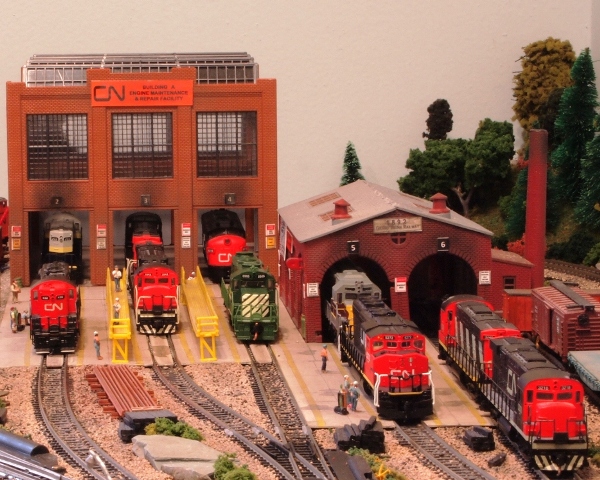
All yard areas are filled with “stuff,” garbage old rails and ties, weeds, storage items, etc. fill the empty spaces for more realistic appearance.
Details
Any service facility/yard is full of “stuff.”
The overall appearance of the scene is in the small details. Â Take the time to add everything from garbage cans, old ties, crates, rail, weeds, broken ties, etc.
Also consider, railway company’s will use any open space for storage, include lengths of ready to use rail, crates, bundles of ties, steel drums, spools of cable, and other valuable commodities.
Having people in a scene adds to the realism of the layout. Â A maintenance facility is a busy working place for the railway. Â I have included many figures from several manufacturers throughout the scene.
Facilities
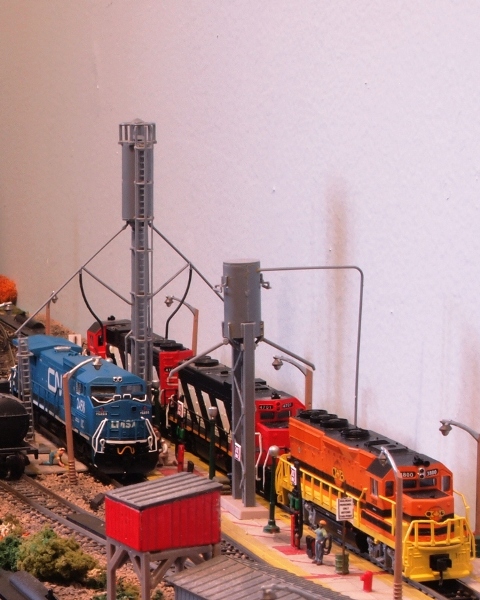
Every Engine Yard/Facility must have a fuelling area. This provides another opportunity for a mini-diorama.
Fueling Area
An engine facility would not be complete without a fuelling area.
I used an assortment of parts from several kits to build this area. Â Including pumps, sanding towers, light posts, fire hydrants, garbage cans and pallets with HazMat equipment.
Up to six engines can be fueled at a time on two parallel tracks, a third track is for tank cars and storage box cars.
Building “A” -Heavy Repair and Maintenance Shop
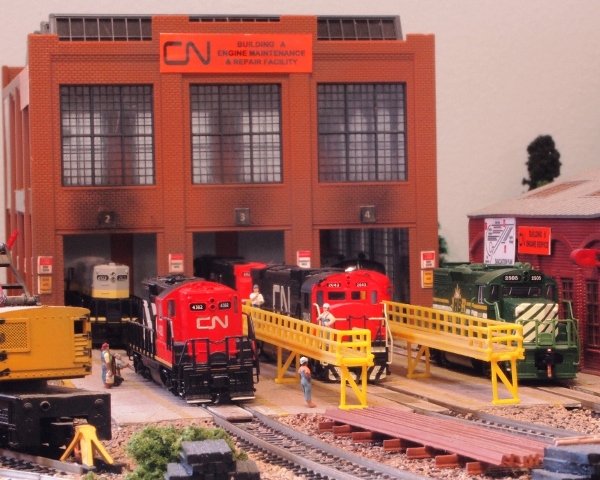
Building A -Heavy Repair Shop.
All major repairs and maintenance is performed in Building A.
Three tracks lead into the two story building with an exterior catwalk on the middle track.
A full concrete apron extends from the building, providing an exterior work area for the crews.

Light service to engines is performed in Building B, left over from the old days of the Grand Trunk Railway.
Building “B” -Service
One of the few buildings remaining from the old Grand Trunk Railroad, this building now performs light service and maintenance to the engines.
Two tracks pass over a concrete apron, providing space for the quick maintenance and service to engines between runs.
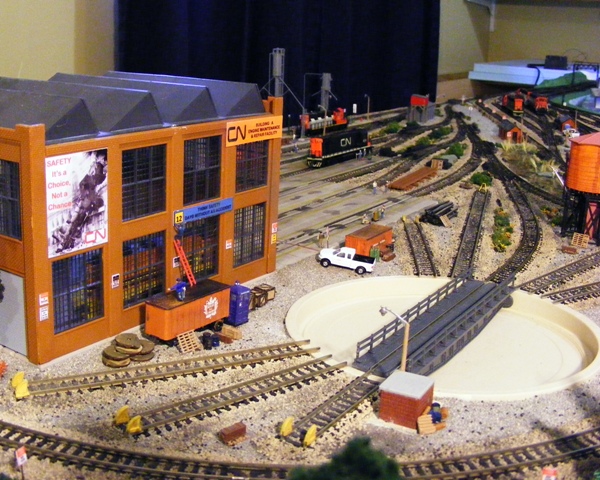
The turntable is all that is left from the old roundhouse. It is still used as a storage area for MOW Equipment.
Turntable
The turntable is all that remains from the old roundhouse, still in use as a storage area for MOW equipment, turning engines and additional work space as required.
The old water tower still stands on the approach track to the turntable.

Three storage tracks in the Engine Facility can hold seven engines. Another mini-diorama in this location as a track crew has just replaced a length of bad rail on one of the tracks.
Engine Storage Tracks
At the far end of the Engine Terminal is a set of three storage tracks for ready use engines. Â These tracks have direct access to both the east and west sections of the freight yard. Â Once a train has been assembled the crew can move the head end power directly to the train and move onto the mainline.
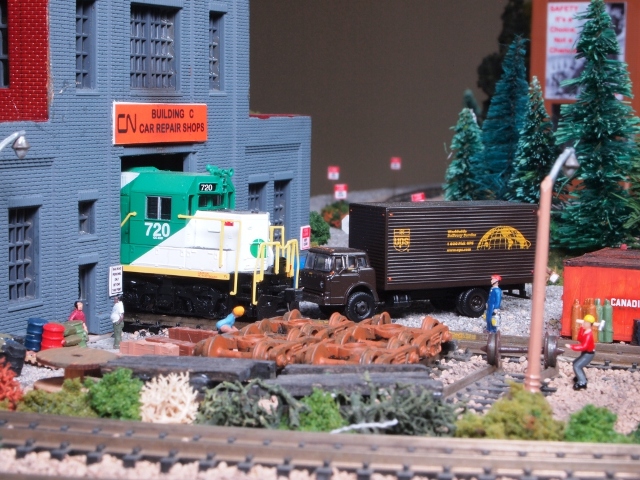
A GO Transit engine has been used to push the next bad order car into Building C for repairs.
Building “C” Car Shops
All manner of maintenance and repair to rolling stock can be performed to bad order cars in Building C.
A single track enters the building with two storage tracks for additional rolling stock waiting for repair.
The area around the building is full of ready use parts to move the repair work quickly.
Micro-Diorama’s Within the Engine Facility
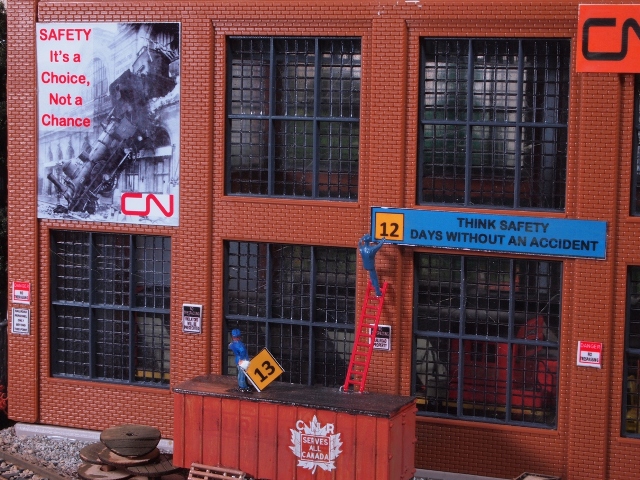
Always Think Safety even on a model railroad.
All through the Engine Facility are opportunities for additional micro or mini diorama’s. Â As I noted, in the Storage Tracks, a gang has replaced a length of bad rail. Â Others include a UPS delivery to Building C and a supervisor talking to the staff outside Building A.
One of my favourites involves the wall of Building A.  In this scene, the fellow replacing the safety sign on the side of Building A, is standing on the top rung of a short ladder, placed on top of an old trailer. While his partner who should be holding the ladder is distracted by the large safety sign on the wall.
I have designed all the signs on the layout and print them from the computer, including various safety and warning signs and  bill boards.
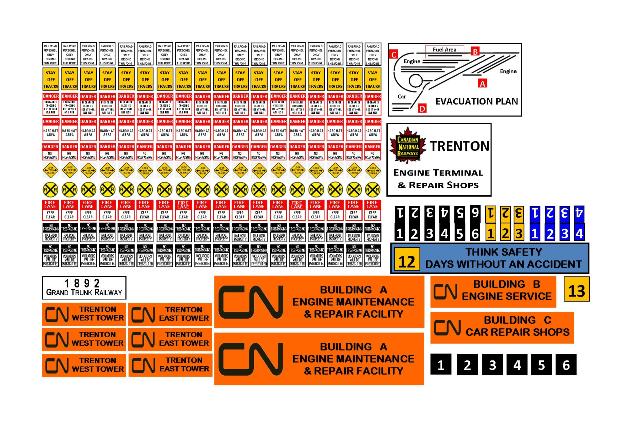
I design the signs using Microsoft Publisher and print them on 4×6 photo paper.
Summary
I have enjoyed the entire design and build process of the Engine Facility. The layout is working very well and I can easily occupy time working just in the Engine Yard, moving motive power through the various stages of prepping for the next long haul. Â The size of the facility is sufficient for me to display up to twenty-three engines without overcrowding.
