
City of Trenton Map -1917
I came across an old map in the Quinte West Public Library showing the railroads that ran through Trenton in 1917.
I was amazed that four railroads were operating here. They were the Grand Trunk -GTR (1856), Central Ontario -COR (1879), Canadian Northern -CNoR (1910) and Canadian Pacific -CPR (1914). Today there is very little evidence of this massive rail empire. Canadian National took over all the railroads in the area with the exception of the CPR in 1923 and today almost all facilities are gone. The only structure left from the Canadian Northern is the original roundhouse, now a business mall.
The map on the right is the overall view and below are close up portions of the map.
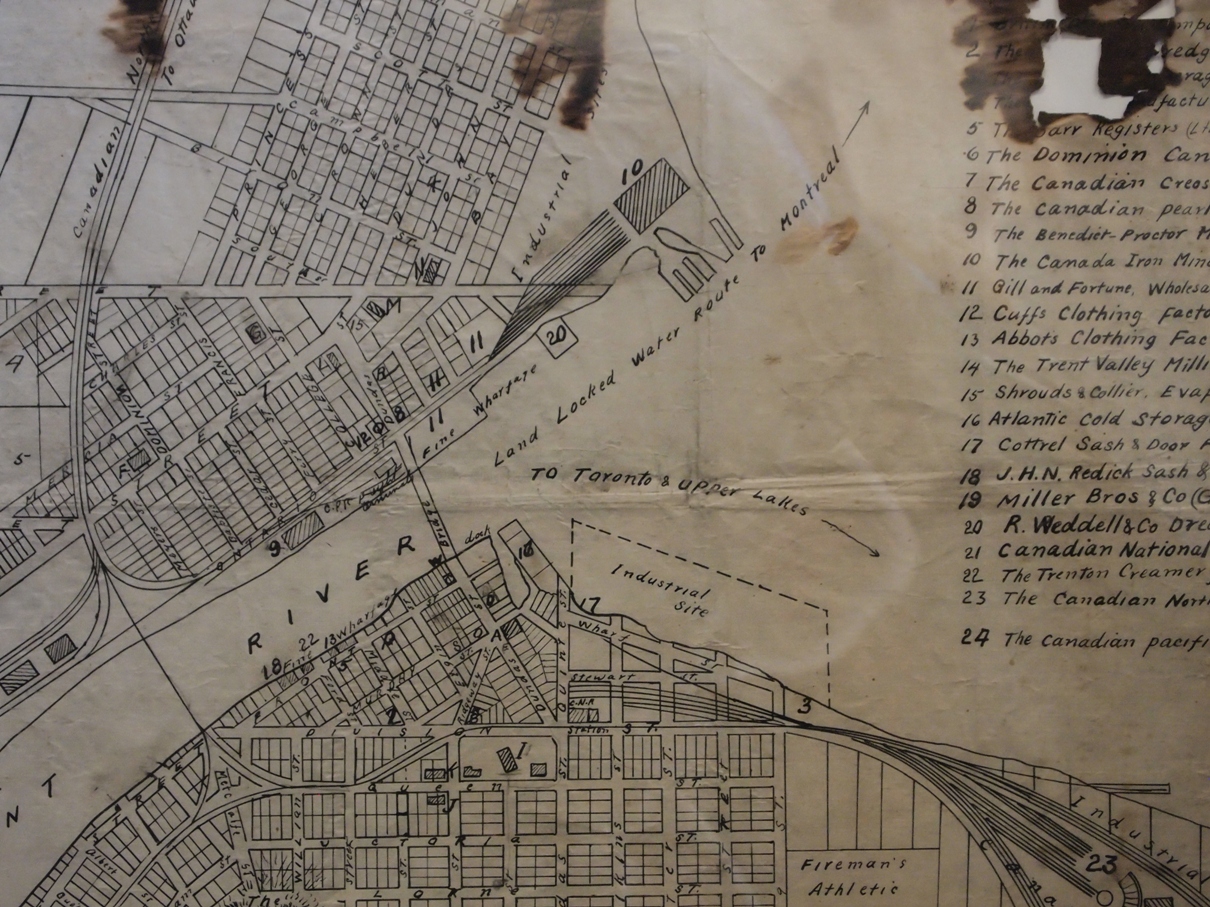
Excerpt -City Centre, Map of Trenton 1917
City Centre
The downtown area of Trenton was criss-crossed with tracks and large industrial areas and wharfs along both side of the river. The rail bridge across the river has been removed. CPR had a large yard on the east side of the river.
Canadian Northern and Central Ontario serviced the west side of the river. The two railroads shared a passenger station in the downtown core at Dundas and Quinte St. There is now a Metro grocery store where the all brick station once stood.
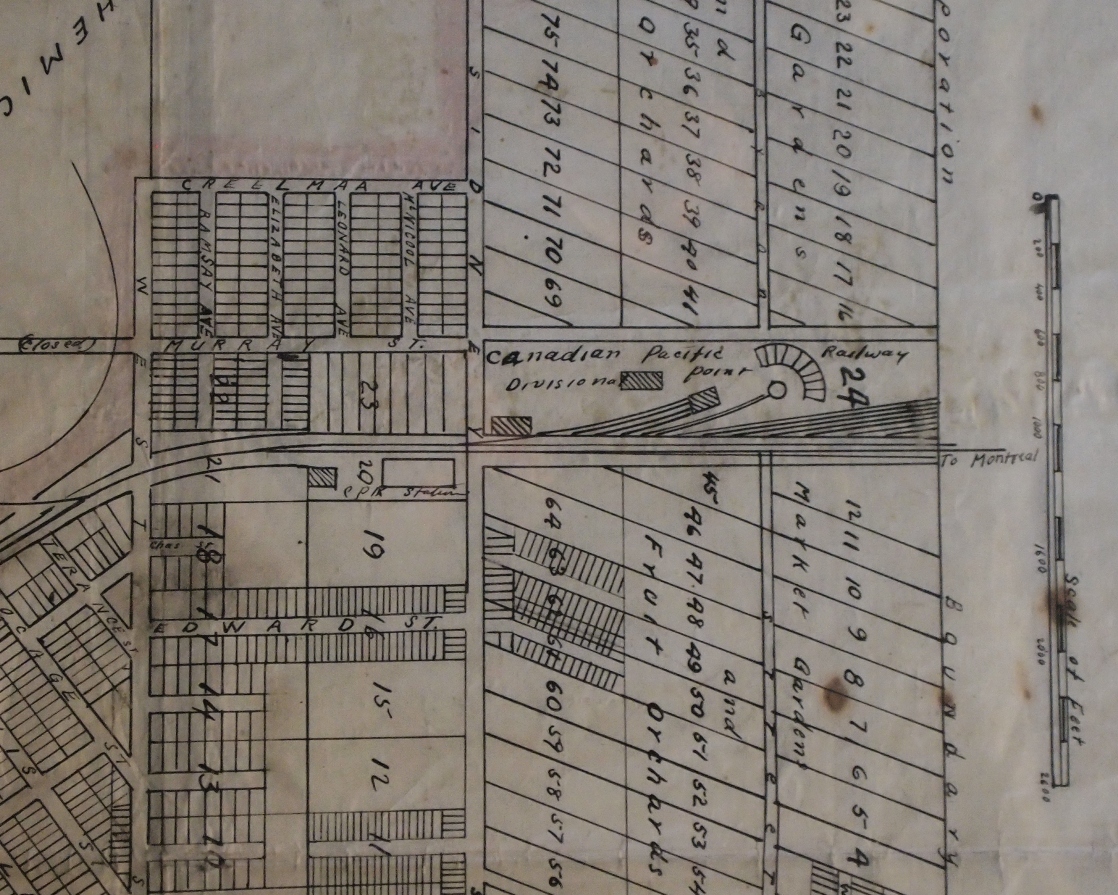
Excerpt -CPR Division Point, Map of Trenton 1917
Canadian Pacific Division Point
The CPR Division Point was located south of Murray St. CPR still has its main line running through this area. Originally consisting of a roundhouse, shops and yards, all that is left is a small holding yard. (See Photo)
The yard and shops ran east from Sidney St and now is an apartment complex. The CPR station was located west of Sidney St, #20 on this map.
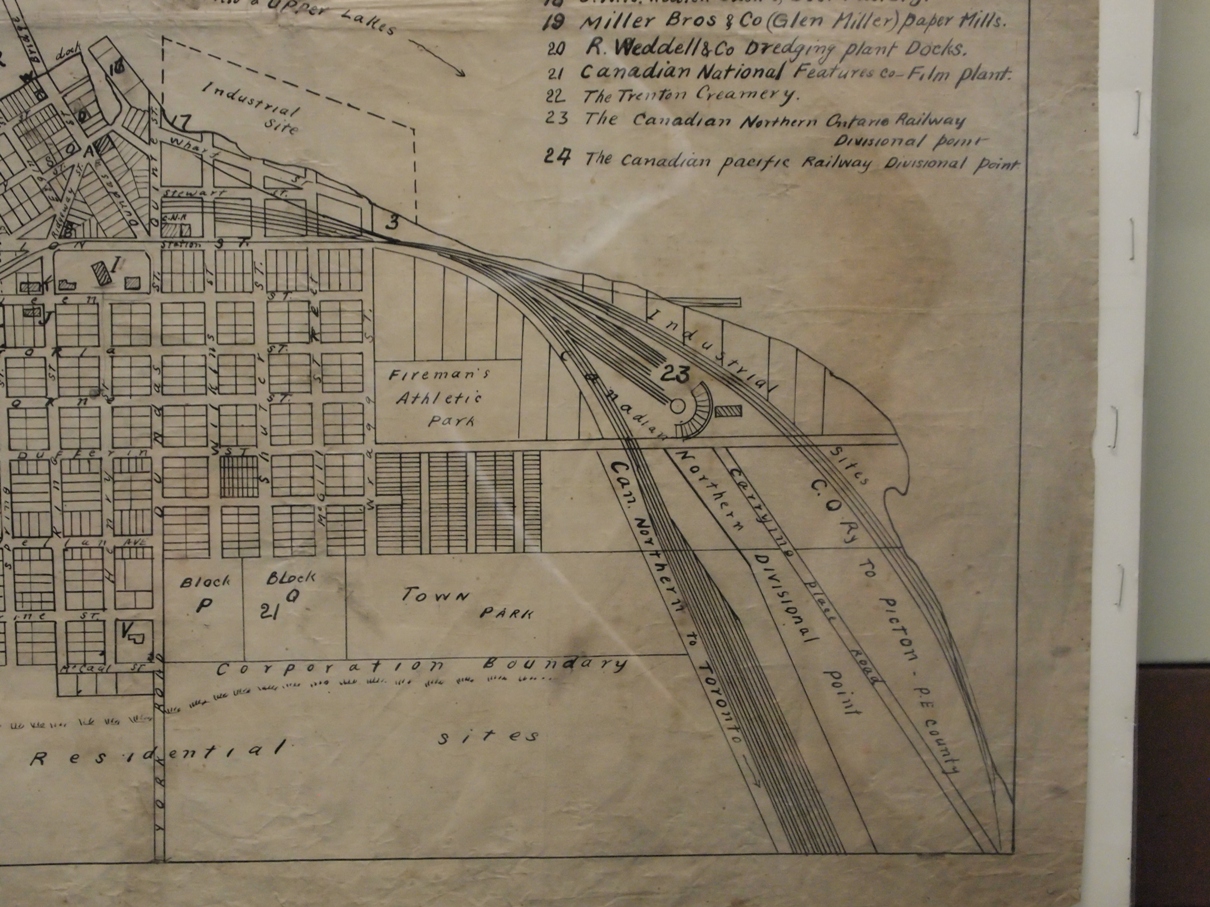
Excerpt -CNoR Division Point and COR Junction, Map of Trenton 1917
Central Ontario Railway and Canadian Northern Railway
Originally built as the Prince Edward County Railway -PECR in 1879 the line was renamed the Central Ontario Railway in 1882. The line ran from Picton in the south to Maynooth in the North. The Picton section was removed only a few years ago as the line was still supplying a concrete plant. The line has now been converted to a trail.
Canadian Northern had a large facility at the bottom of Dufferin St. The only reminder of the line is the roundhouse which has now been converted to a business area. Sections of the rail bed can still be seen along the bottom of 2nd Dug hill Rd.

Excerpt -Trenton Junction, GTR Yard and COR Yard, Map of Trenton 1917
Trenton Junction
This is where Grand Trunk crossed the Central Ontario tracks. The COR had a round house and yards and a passenger station where the “U” is on the map. The GTR station was opposite the roundhouse. Originally the two lines crossed at grade level. Â When the canal system was built on the Trent River the Grand Trunk line had to be elevated and now crosses over the COR line. Â All of this area is now operated by Canadian National.
This area is the only section of COR track still in existence. It has approximately 1 km of track running south of the main line and then switches north under the CN main line to a grain elevator opposite the RC Cemetery and ends there.
VIA Rail has a kiosk where the GTR/CN station was. Also a small work shop is in use by CN Signals below the kiosk on the COR line and the original bridge for the Junction is still in use.
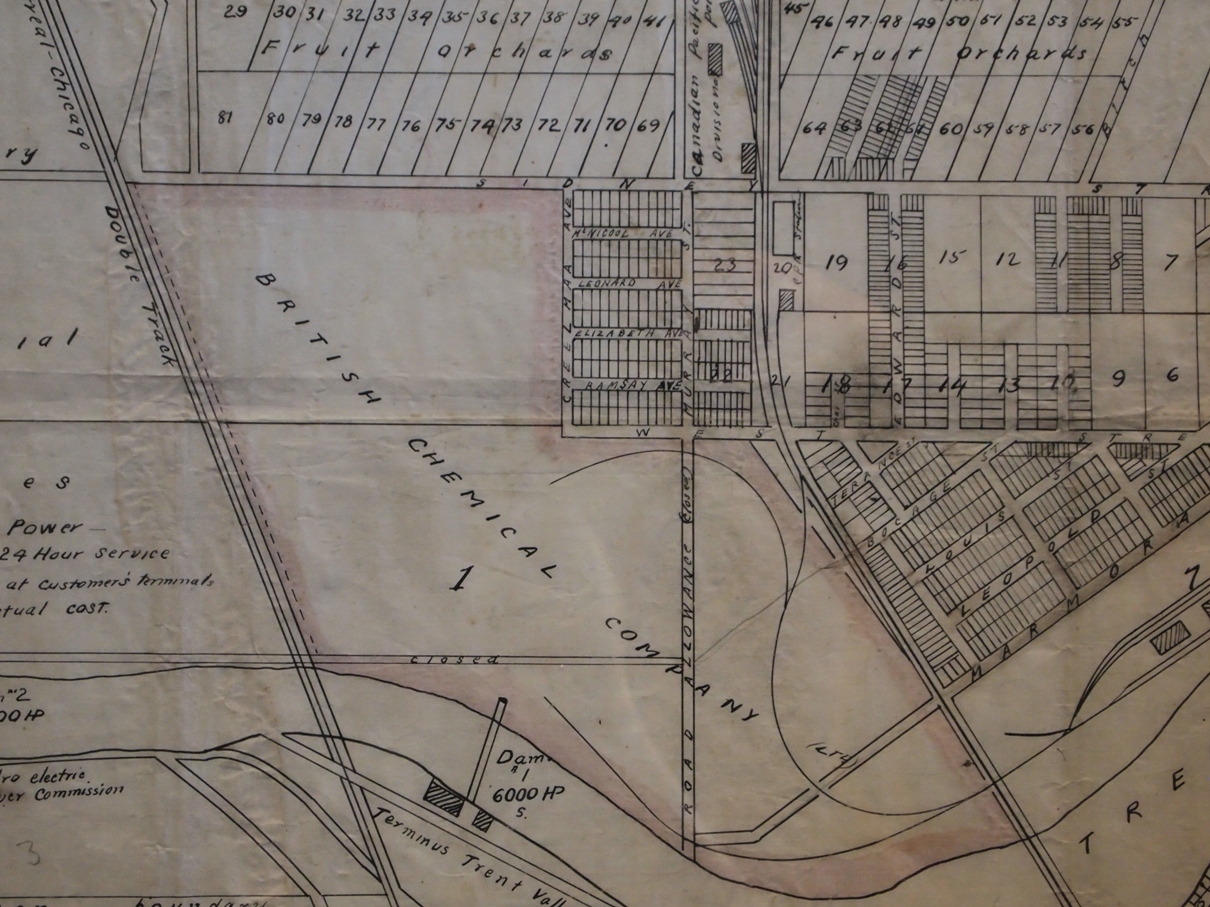
Excerpt -British Chemical Plant, Map of Trenton 1917
British Chemical Company
The British Chemical Company operated a huge complex of building and produced explosives. The plant covered 2000 acres and contained 120 buildings, and at the time was the largest ammunition factory in the Commonwealth.
In 1917 they where providing explosives for the Great War. When the Halifax explosion occurred on 6 December, 1917, it is said that the freighter Mont Blanc was carrying explosives manufactured in Trenton.
Trenton suffered almost the same fate as Halifax on Thanksgiving Day 1918 when the Chemical Plant exploded, the force of the blast could be felt 20 km away in Belleville. Trenton was protected by a large natural bunker that the complex was built inside. This was also the reason for choosing this location.
There are still some ruins of the buildings near No. 1 Dam. The entire area is industrial now and a large fireworks warehouse has been constructed in the area.
