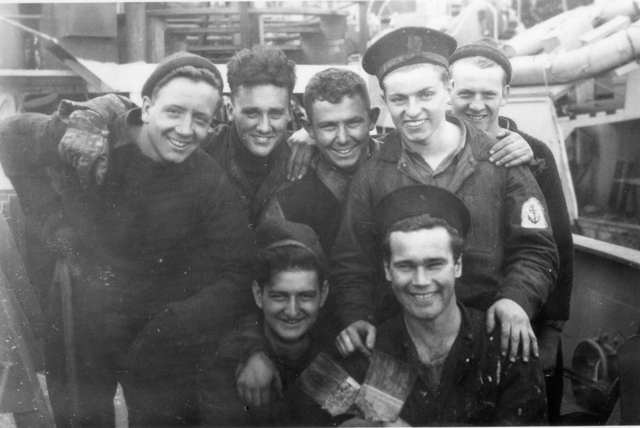
Demonstrating what seems to be a sailors primary duty, chipping, scraping and painting ship, a group of TRENTONIAN’s take a break and cross brushes for the camera.
Roger Litwiller Collection, Allen B. singleton photo, courtesy Douglas Campbell, RCNVR. (RTL-DC055)
During the fifteen months of TRENTONIAN’s service she was painted many times. Several camouflage schemes were given to the ship. Her ship’s company spent many hours performing paint ship routine, chipping and scrapping the old paint and applying the new.
One of the comments made by the men when TRENTONIAN was lost, was the time wasted in giving her a new coat of paint only two weeks before.
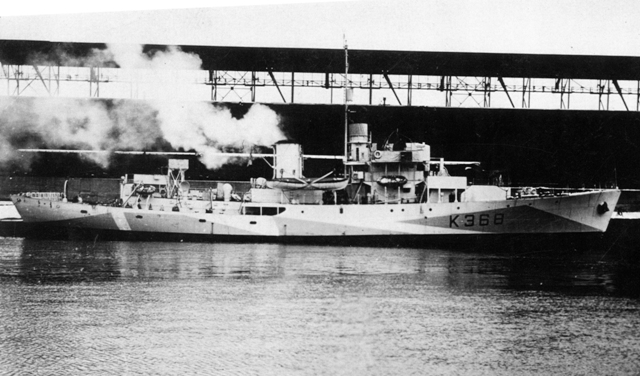
HMCS TRENTONIAN at Montreal just after commissioning in December 1943. Roger Litwiller Collection -courtesy Gary McGregor. (RTL-GM001)
Western Approaches
December 1944
TRENTONIAN was first painted in the Western Approaches camouflage scheme at Kingston Shipyard. The scheme consists of an off white overall with geometric patterns of pale blue and green, pennant numbers are black. This was a common colour scheme for ships operating in the North Atlantic and was based on the premise that a lightly coloured ship would blend better into an overcast horizon. The blue and green patches were added to break up the silhouette of the ship during good weather.
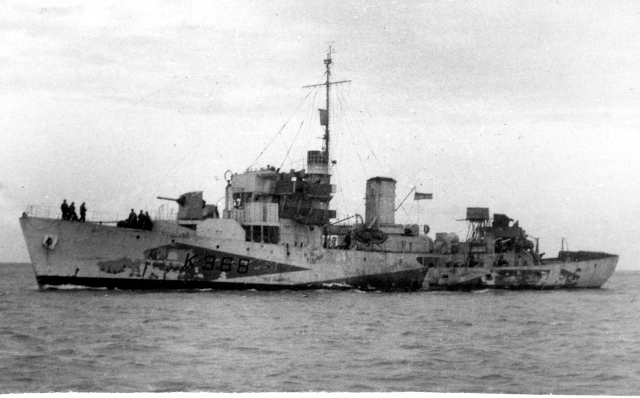
HMCS TRENTONIAN heavily weathered after several months of operations and fighting North Atlantic winter storms. Photo courtesy Military Museums of Calgary.
Western Approaches
(Weathered)
In the course of just three months the bright colours of TRENTONIAN’s camouflage scheme have been worn off. The unrelenting forces of the sea, wind, salt and rust, combined with a North Atlantic winter storm has drastically changed the ships appearance.
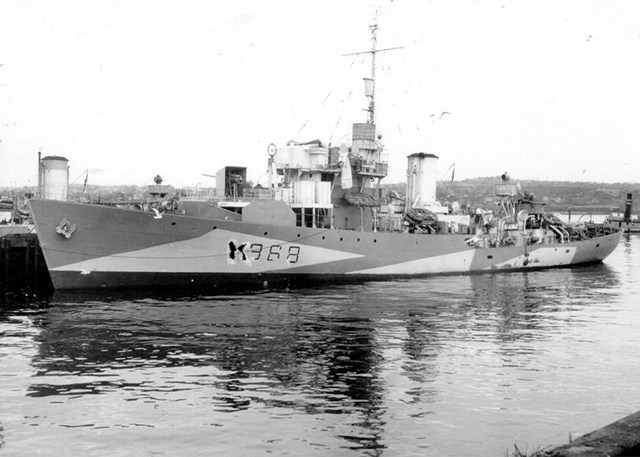
HMCS TRENTONIAN in Halifax, April 1944, sporting a fresh coat of dark and light grey paint. Her pennant number was not fully painted at the time of the photo so Bruce Keir added the “K” in ink. Roger Litwiller collection, Allen B. Singleton, RCNVR photo, courtesy Bruce Keir, RCNVR. (RTL-BK043)
Western Approaches
April 1944
By April 1944, TRENTONIAN’s paint had worn thin. In Halifax she was repainted in a variation of the Western Approaches scheme. Off white on the upper works with light and medium grey geometric patterns on the hull and superstructure, pennant numbers are black. This photo was taken before the painting of the pennant numbers was complete and Stoker Bruce Kier scratched the “K” into the photo. Four additional 20mm Oerlikon machine guns were added to TRENTONIAN soon after the paint was complete. Two were located aft of the funnel and two aft of the pom-pom platform.
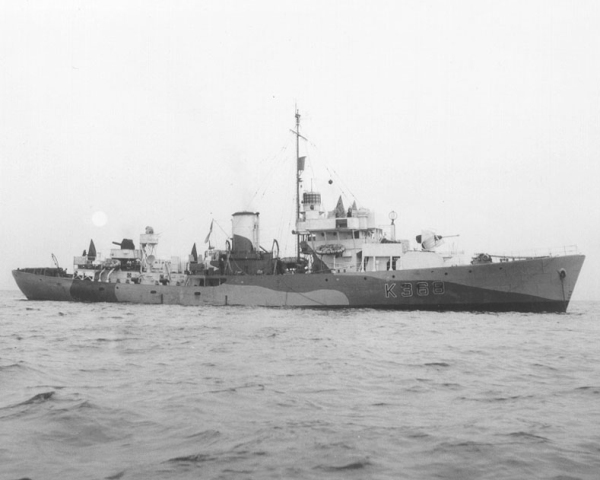
HMCS TRENTONIAN freshly painted in July 1944. The davits have been swung out and the ships whaler has been lowered. Roger Litwiller Collection, Allen B. Singleton, RCNVR, photo, courtesy Tom Farrell, RCNVR. (RTL-TF035)
Admiralty Disruptive
July 1944
Paint quality during the war was inferior and TRENTONIAN needed a new coat of paint by July 1944. At this time she was given the Admiralty Disruptive scheme. Her bridge, upper works and funnel top are painted off white. Part of her upper works, funnel base and hull are painted in a medium grey with a dark grey wave over top. Pennant numbers are black with a white outline. The additional Oerlikons are clearly visible.
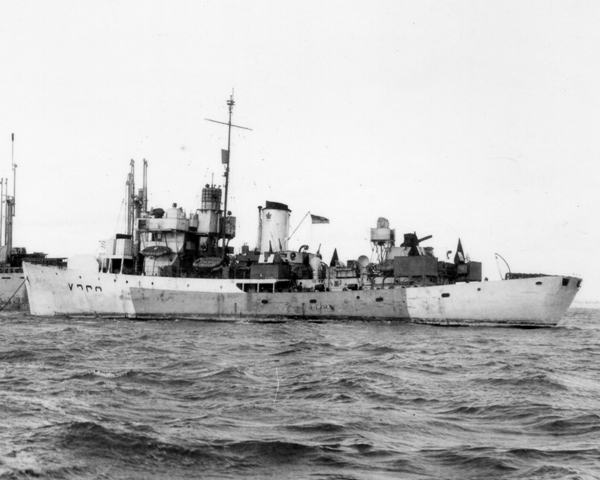
TRENTONIAN anchored outside of Cherbourg, France in her “false hull” camouflage scheme, September 1944. The maple leaf on her funnel is visible and her name board has been hung on the railings above the depth charge throwers. Her pennant number has been partially removed by censors. Roger Litwiller Collection, Allen B. Singleton, RCNVR photo, courtesy Dougals Campbell, RCNVR. (RTL-DC041)
Admiralty Alternative Scheme -False Hull November 1944
TRENTONIAN was given the False Hull camouflage scheme in November 1944. The entire ship is painted light gray with a medium gray panel painted on the hull. The forward line of the panel matches the rake of her bow and starts at the forward point of her bridge. The censor has removed the black pennant numbers in this photo. The ships name board is visible on the railing above the waist depth charge throwers. A green maple leaf has been painted at the top of the funnel.
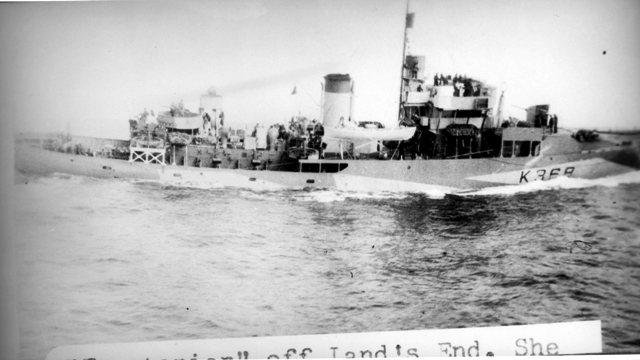
TRENTONIAN underway off Land’s End, English Channel, 22 February 1945.
Photo courtesy Military Museums of Calgary.
Western Approaches
February 1945
TRENTONIAN underwent a change of commanding officers at the end of January 1945. The new skipper ordered the ship painted in February. Returning TRENTONIAN to the Western Approaches scheme. The white superstructure and medium gray hull with light gray geometric patterns is similar to the camouflage scheme used in April 1944, with the exception of the gray band painted at the top of the funnel. This is the only photo of TRENTONIAN in this paint scheme and was taken shortly before she was torpedoed on 22 February 1945.
Anyone building a model of TRENTONIAN will find this section very useful as well as the Ship’s Plans Page. Also see my blog post on Bill Cullen’s Ten Foot 1/20 scale model of HMCS TRENTONIAN.
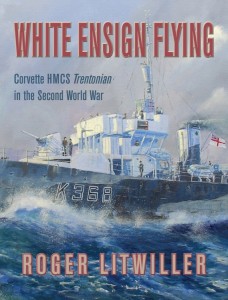 Discover more of HMCS TRENTONIAN’s incredible story in White Ensign Flying.